Startup Orbit Robotics has just unveiled a robot that looks strange at first glance. A humanoid torso, four arms, and no legs. Its name is HELIOS, and it is designed for environments where gravity does not exist and every hour of human labor costs roughly $140,000.
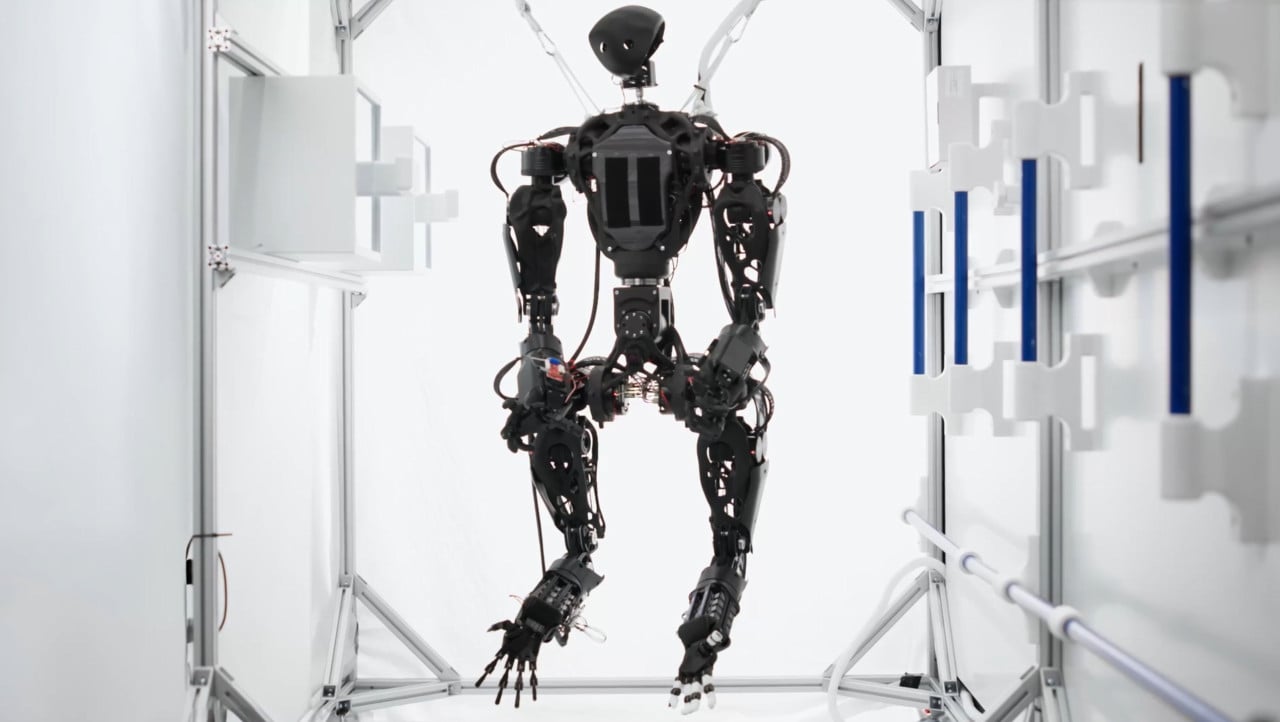
Orbit Robotics began as a project centered around the Swiss Federal Institute of Technology in Zurich (ETH Zurich), and HELIOS is its most ambitious creation to date. The robot was introduced through a teaser video in which it hangs suspended in a test rig, revealing a lightweight black skeleton interwoven with a network of cable-driven pulleys and joints.
Robot design
Inside a space station, people do not move around by walking. They move by grabbing handrails, holding onto walls, and pushing off surfaces. Legs are useless in a zero-gravity environment. Orbit Robotics took this fact into account and gave HELIOS a second pair of arms instead of legs. Two arms are used to anchor the robot in place, while the other two work. Exactly what you need when unpacking cargo or repairing equipment without being able to brace yourself against the floor. Conventional two-armed robots cannot do this in zero gravity without spinning uncontrollably.
A full forty percent of the crew’s available time aboard the International Space Station is spent on maintenance tasks. A single cargo unloading cycle can take nearly 50 hours of work. With astronaut labor estimated to cost approximately $140,000 per hour, the sums involved are astronomical.
HELIOS is not built like a typical industrial robot with heavy rotary actuators in every joint. The engineers chose a different approach: a so-called tendon drive, powered by cables that function like tendons. The motors are positioned at the shoulders, as close to the body as possible, and transmit force through cables and pulleys to the arm joints. This makes the moving parts much lighter.
The elbow joint is designed as a rolling contact joint. The result is smooth movement with minimal friction while retaining sufficient strength. In space, where even the slightest jerk can destabilize both the robot and everything it is holding, this is one of the most important design decisions in the entire project. The hands have five fingers. This allows HELIOS to handle delicate manipulation tasks, not just move boxes around.
Many of the load-bearing structural components are 3D-printed, simplifying both production and potential repairs.
HELIOS has not yet been to space. Testing is taking place in a terrestrial environment, where the robot hangs from straps in a setup simulating the interior of a space station. It is an imperfect substitute, but sufficient for verifying joint mobility and controllability.
Alongside HELIOS itself, Orbit Robotics has also developed a test platform called IKARUS. It was created in just two months and serves three purposes: remote operation of the robot by an operator, so-called imitation learning, in which the robot observes and mimics human movements, and testing hardware improvements. The idea is appealing: an astronaut demonstrates a procedure once, and the robot remembers it and repeats it on its own.
Work intended for HELIOS
Orbit Robotics is not trying to replace astronauts. Instead, it aims to reduce the amount of work that does not require their intellect. Moving boxes, sorting supplies, checking inventory, and performing routine repairs. These tasks do not require human judgment; they require hands capable of staying in place and working with precision.
Space stations are designed for people: handrails, hatches, modular cabinets, and handles. A humanoid robot makes sense in such an environment because everything is tailored precisely to the human body. Specialized robotic arms such as Canadarm2 or Dextre are powerful outside the ISS, but they cannot enter the station. Orbit Robotics’ long-term plan is for HELIOS to first take over logistics and cargo management before gradually advancing to more demanding maintenance and infrastructure tasks.
Orbit Robotics has not disclosed the price, production timeline, or amount of funding raised. HELIOS remains a prototype that the developers continue to work on. The company has not yet established any partnerships with space agencies or commercial station operators such as Axiom Space.
Sources: interestingengineering.com and thenextweb.com