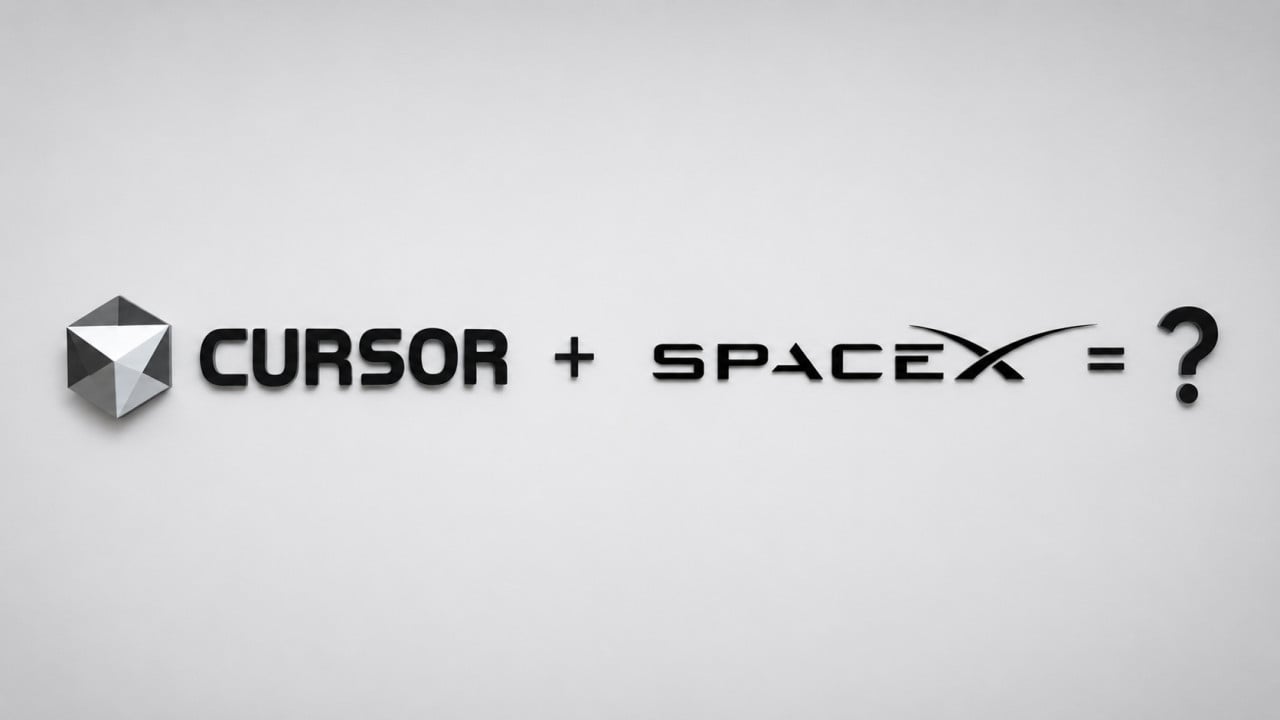
Four MIT students launched a tool for programmers a few years ago. Today, their company, Anysphere, is worth $60 billion, and SpaceX wants to buy it. Cursor is an artificial intelligence-powered code editor. It helps developers write, fix, and ship code faster than they could on their own. Companies such as NVIDIA, Adobe, Uber, Shopify, and PayPal use it every day. More than half of Fortune 500 companies have deployed Cursor directly in their development workflows.
For example, Salesforce needed more than ten years to reach $3 billion in annual revenue. Cursor achieved it in approximately two years. In February of this year, it surpassed $2 billion in annual revenue, added another billion in April, and crossed the $3 billion mark. By the end of this year, the company expects to exceed $6 billion.
More than 3,000 enterprise customers pay at least $100,000 a year for Cursor. The total number of paying users exceeds one million. And with a workforce of between 200 and 500 people, that means each employee generates an average of more than $6 million in annual revenue, far surpassing the efficiency of even Silicon Valley's largest technology companies.
Michael Truell, Aman Sanger, Sualeh Asif, and Arvid Lunnemark met at MIT. Their first project focused on artificial intelligence for mechanical engineers, but it found no practical use. The team therefore decided to take a different approach: to build a next-generation work environment for developers. And that is how Cursor was created. A tool that not only suggests what programmers should write but also helps them manage large projects, find bugs, and work more efficiently overall. It quickly earned a reputation as one of the best tools of its kind. And it has been growing at a dizzying pace ever since.
SpaceX and the $60 Billion Offer
In the spring of this year, xAI, Musk's artificial intelligence company, began leasing computing capacity from its Colossus supercomputer to Cursor for training its own models. Two of Cursor's most experienced engineers moved directly to xAI. Meanwhile, xAI merged with SpaceX.
In April, SpaceX announced that it wanted to buy Cursor for $60 billion, or pay $10 billion as a collaboration fee if the acquisition does not go through. Cursor had been valued at just $2.5 billion in January last year, then at $9 billion in May, and reached a valuation of $29.3 billion in November after closing a $2.3 billion funding round.
The acquisition itself is not expected to happen immediately. SpaceX plans to list on the Nasdaq stock exchange around June 12 under the ticker SPCX at a valuation of approximately $1.75 trillion, which would make it the largest IPO in history. The purchase of Cursor is expected to be completed roughly 30 days after trading begins. In the meantime, Cursor has canceled a planned $2 billion funding round because the computing capacity that was to be financed by the round is now being provided directly by xAI.
Proprietary Models as a Ticket to the Future
Cursor long depended on models from OpenAI and Anthropic, earning it the label “AI wrapper" in technology communities on Reddit and developer forums—that is, a product built entirely on foundations provided by others. Critics point out that without its own model, the company is vulnerable to its suppliers, which are also its direct competitors.
Cursor responded to this criticism by launching its own Composer model, whose latest version, Composer 2.5, was trained partly on SpaceX infrastructure. The goal is clear: to gradually reduce its dependence on external providers and become a full-fledged AI platform. The partnership with SpaceX significantly accelerates this effort. SpaceX's Colossus data center in Memphis, with computing power equivalent to one million H100 graphics cards, gives Cursor access to computing infrastructure that it otherwise could not afford.
Sources: startup.az and bloomberg.com