There is a frequently repeated legend that Robert E. Lee, then stationed in Texas before the outbreak of the Civil War, once stood on the bluff where a fortification had been built in 1849 and declared that he could hear “the footsteps of the coming millions” of settlers heading for Texas. Nothing of the sort actually happened. Yet seventy years later, almost on that very same bluff above the Trinity River, a magnificent statue of General Lee nearly arose, created by sculptor Gutzon Borglum.
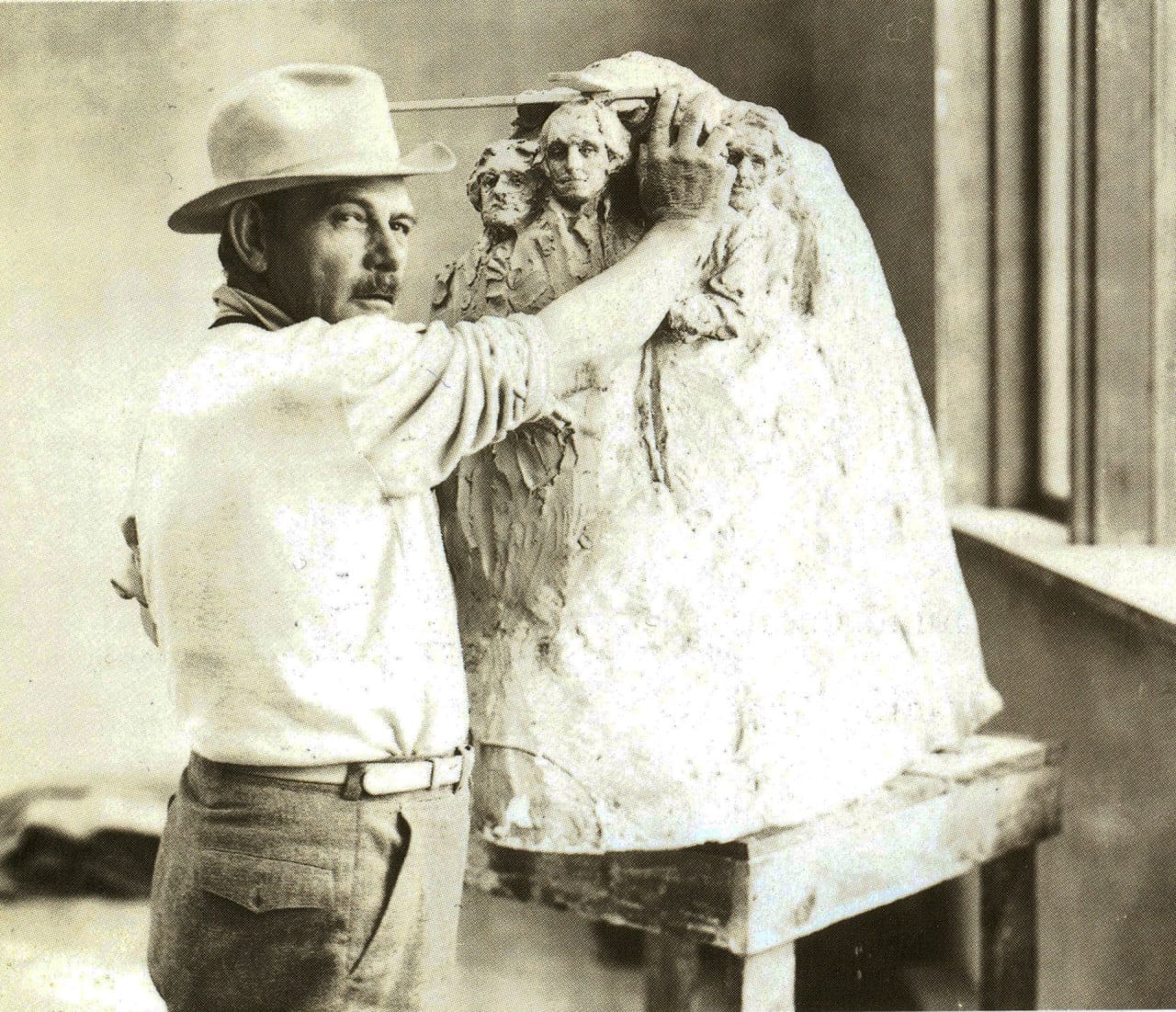
Borglum, best known for the colossal sculptures at Stone Mountain in Georgia and Mount Rushmore in South Dakota, was of Czech descent. He was born in Idaho in 1867 into a Mormon family, though he himself was never particularly religious. He studied fine art at the California School of Design and the Académie Julian in Paris, specializing in sculpture. He exhibited his work at New York’s Metropolitan Museum of Art and later helped organize the landmark 1913 exhibition at New York’s Armory. He soon fell out bitterly with the other organizers, however, and moved to Stamford, Connecticut. In 1915, he similarly quarreled with the sponsors of the Stone Mountain project, destroyed all his models, and slipped out of Georgia during the night. He then appeared in Dallas, where the volatile sculptor told a newspaper reporter that he intended to settle in Texas, “where people truly understand him.” As a high-ranking member of the revived Ku Klux Klan, he would undoubtedly have felt at home in a city dominated by the Klan and by still-vibrant nostalgia for the South.
In 1925, Borglum moved to San Antonio to devote himself fully to his Texas projects. Texans captivated him, and he found in them an appreciative audience for his brand of grandiose heroic sculpture. His largest commission came from the Trail Drivers Association: a magnificent monument commemorating the era of the state’s long cattle drives. He took up residence in the famous Menger Hotel and worked on the Trail Drivers sculpture for the city that regarded itself as the starting point of the celebrated Chisholm Trail. Because one figure was never enough for him, he created a group of two cowboys on horseback driving a herd northward. The thirty-three-foot-tall clay model was ready for casting in early January 1926, and Borglum set out on tour with a smaller working model at a scale of two inches to the foot, perfect in every detail. He visited Dallas in January and Fort Worth in February. His tour coincided with a membership drive by the Trail Drivers Association, which sought to raise the $150,000 needed to cast the statue in bronze in Europe.
The visit to Fort Worth was a great success. It coincided with the 1926 Fat Stock Show, a golden opportunity to appeal to those who most cherished Texas’s ranching heritage. The touring model was displayed in the lobby of the Texas Hotel throughout the show, and the Trail Drivers Association came to the city that year for its annual convention. Borglum remained in Fort Worth for several days, giving speeches to raise money for the monument fund. Naturally, he also had a personal stake in the matter: if the statue was not cast, he would receive practically nothing for his clay model.
Borglum connected exceptionally well with his Fort Worth audience, not only because of his cowboy attire but also as a man of grand ideas and a patriot who believed that magnificent monuments to famous historical figures were memorials to American civilization. His earlier works had paid tribute to General Philip Sheridan, President Abraham Lincoln, and the Puritans. The people of Fort Worth grew so fond of him that the local chapter of the United Daughters of the Confederacy approached him with a request to create a magnificent monument to the Southern Confederacy. The intended subject was none other than General Robert E. Lee. Borglum still bitterly resented the abrupt end of his unfinished Stone Mountain project. Its “moment of greatest triumph” came on January 19, 1924, when the general’s face was unveiled from half a mile away in the presence of the sculptor and a group of ladies from the United Daughters of the Confederacy. Borglum had begun carving a magnificent scene with 1,200 figures into the granite mountain back in 1915. The head alone measured twenty feet. The 1924 unveiling was the first time Borglum had ever seen his work from far enough away to appreciate it. Soon afterward, he was dismissed from the project when its costs soared. Now the Fort Worth chapter of the United Daughters of the Confederacy was offering him a second chance to realize his vision of a magnificent General Lee. Borglum told them that he had a business meeting in New York, but promised to return and begin work before the end of April. Meanwhile, other Fort Worth residents hoped to lure the Trail Drivers monument away from San Antonio and place it where they believed it truly belonged.
Borglum’s other commitments prevented him from returning to Texas until July. First came the unveiling of the “Wars of America” monument in New Jersey: not only his personal masterpiece, but also the largest bronze sculpture in the world at the time. He also accepted commissions for a statue of Alexander Stephens, vice president of the Confederacy from 1861 to 1865, intended as Georgia’s contribution to the Hall of Fame in Washington, and, under congressional authorization, for carving a “colossal natural granite monument” devoted to a chapter of American history into the face of a thousand-foot mountain in South Dakota. His fee for the South Dakota project alone was $447,000.
Borglum’s simplistic worldview influenced both his work and his understanding of history. He believed that civilization owed its progress to great heroes. As in Greek mythology, godlike heroes determined the course of events, sometimes together and at other times in combat. He once said: “If Abraham Lincoln and Robert E. Lee had met in private conference at the very beginning of the Civil War, they would have resolved their sectional differences as only strong and noble men can.” The absurdity of an elected president and a colonel in the United States Army sitting down as equal partners to resolve the crisis never occurred to the simple-minded sculptor.
The members of the Julia Jackson Chapter of the United Daughters of the Confederacy in Fort Worth may not even have known how many commissions Borglum was juggling at once when they approved a fee of $50,000 for the statue of General Lee. He assured them that he would be occupied with the Trail Drivers monument until the end of the year, but that as soon as it was finished, he would come to Fort Worth and begin their commission. In reality, he was still working on the Trail Drivers monument in mid-1927, with no end in sight. In June 1927, all he could say was that the work was “progressing satisfactorily.” The bronze casting of the colossal statue was ultimately delayed until 1940 for lack of funds, and when it was finally cast, it was only one-quarter of the planned size.
The difficulties with the Trail Drivers monument did not prevent him from trying to keep the General Lee statue project alive. In early 1927, he made several trips to Fort Worth to consult with his sponsors from the United Daughters of the Confederacy. Somewhere during the planning process, the estimated cost tripled from $50,000 to $150,000. Cost overruns were the curse of every Borglum commission. Yet this neither stopped nor slowed the ladies of the Julia Jackson Chapter: they were determined that Fort Worth would have its Lee statue, and a small matter such as money would not stand in their way. In April, Borglum brought four different working models of Lee to Fort Worth for the ladies to choose from. One was exhibited in the Carnegie Public Library, where visitors were invited to imagine the model as a forty-foot-tall equestrian statue, excluding the pedestal, in which Lee on horseback stood alongside five other “leading” Confederates, who remained unnamed, much as Hercules or Odysseus was surrounded by his “companions” in Greek sculpture. Another model depicted Lee on horseback accompanied by only two adoring soldiers. The finished work was to be mounted on a four-sided granite pedestal, each side adorned with a relief depicting one of Lee’s famous wartime victories. The entire project was a scaled-down version of Borglum’s vision for Stone Mountain. Once completed, the monument was to stand in Bluff Park, also known as the “north terrace” of the courthouse, from which it would majestically overlook the Trinity River. The site had only recently become available after the demolition of the old 1884 county jail, whose grounds had been converted into a public park. Paddock Viaduct would serve as a promenade leading to the monument. The United Daughters of the Confederacy hoped for an unveiling in the fall of 1927.
Once the sculptor’s work was completed, the bronze casting would be done in Europe, where the finest statues were cast. But that stage was still a long way off. In early June, Borglum announced that he had “completed the plans for beginning work” and that “every element” of the project, from the design of the work to its location, had been “coordinated” with the city of Fort Worth and its sponsors. The truth was that the only reason the city was involved at all was that, as the administrator of Bluff Park, it had the final say on the statue’s placement. The city fathers had not the slightest intention of putting any of their own money into such a venture. The only source of funding, apart from the money raised by the Julia Jackson Chapter, was contributions from the Sons of Confederate Veterans. Borglum kept local interest alive by promising that his Lee statue would be “the largest equestrian statue in the United States,” even larger than his 1908 statue of General Sheridan at Sheridan Circle in Washington. Perhaps Bluff Park would be renamed “General Lee Park”? Yet Borglum was clearly beginning to back away from the Fort Worth commission. Before leaving for South Dakota, he announced that he had “completed the plans for beginning the [Fort Worth] work,” which was still a very long way from transforming a clay model into an actual bronze statue. There was no chance that the work would be ready for casting by autumn, even if he worked day and night while climbing Mount Rushmore.
As sobriety returned, the dream shrank. The latest cost estimate that summer settled at $130,000, though it was unclear whether this amount included the pedestal or only the statue itself. It was obvious to anyone following developments that there would be no reliefs on the pedestal. Some kind of stepped platform was probably the most that could be achieved. The revised cost estimate also reflected the fact that Borglum was now speaking of a thirty-foot statue rather than the original forty-foot one. He assured the sponsors, however, that it would still be “visible from afar.” Shortly before leaving for South Dakota, he promised to spend “a large part of the summer” working on the Lee statue commission. He made this promise in early June.
After June 1927, Gutzon Borglum was scarcely seen in Fort Worth, and when he was, he was merely passing through by train from Dallas to San Antonio, where he was still an artist in residence and a popular speaker. His favorite subjects at the time were the Stone Mountain and Mount Rushmore projects: he defended his role in the former and made impossible promises about the latter. He vowed that Mount Rushmore would be the grandest and most original sculpture in the entire world. Because Borglum never turned down a large and lucrative commission, he lost interest in the modest Fort Worth work, whose funding was still being raised. His instincts were correct: the Julia Jackson Chapter and their brothers in the Sons of Confederate Veterans were unable to raise enough money either to pay the sculptor or to have the work cast in bronze. Although the city’s other residents were proud of their Southern heritage, they were unwilling to dig deeply into their pockets for yet another grandiose vision. The model displayed in the library was quietly removed and disappeared, never to be seen again. Perhaps Borglum took it back, or perhaps it was discarded when the old building was demolished and replaced by a new library on the same site in 1939.
If General Lee was not to take up residence in Fort Worth, there was still interest in a Lee statue in Dallas, where affection for the memory of the Old South was at least as strong. In 1929, the Southern Memorial Association, a thinly disguised group of Southern devotees, launched a memorial project dedicated to the “greatest hero of the South,” who could only be General Robert E. Lee. The ladies of the association sought an emerging “Paganini of the chisel” who could turn their vision into reality. An editorial in the Dallas Morning News lamented: “There is so little good public sculpture in American cities, especially in the Southwest,” and called upon the association to fill that void. Sculpture, it claimed, “builds ideals, glorifies truth, and wins the hearts of men through the eye, singing the praises of great lives that have been lived.”
They rejected Borglum’s conception of General Lee as a dynamic equestrian figure, preferring a “calm, dignified portrayal” of the great man sitting upright on his horse Traveler and gazing serenely upon the modern world. To realize this vision, they sought a “great” artist endowed with “the refinement of academic culture” and a visionary personal philosophy that he could translate into stone. An association spokesman somewhat condescendingly declared that they wanted an “artist,” not merely a “stonemason.” They ultimately selected A. Phimister Proctor of New York as an artist with the required vision. The records do not reveal whether they also considered Borglum or whether he was interested in the commission at all. During the 1930s, he was fully occupied with Mount Rushmore.
The association launched a fundraising campaign, which received its initial impetus from a $1,000 donation by Mrs. Henry Exall Sr. As costs rose and eventually quintupled, the association turned to federal money from the Works Progress Administration, which provided $15,000 for the statue’s pedestal. The remaining $40,000 for the monument was still trickling in as late as 1933. Before the association obtained funding for the pedestal from the Works Progress Administration, it probably approached another New Deal agency, the Civil Works Administration, to request support for the project. Ironically, Gutzon Borglum was head of the Civil Works Administration in Texas in 1933, where he energetically promoted urban beautification programs with a “modern” emphasis. He saw no point in spending money on things as antiquated and old-fashioned as equestrian statues, without noticing the contradiction that he himself had participated in a similar project in Fort Worth only a few years earlier. His most ambitious undertaking as head of the Civil Works Administration was the redevelopment of the Corpus Christi waterfront. He never denied himself the opportunity to criticize when it suited him, and so Borglum offered an unsolicited judgment of Texas public art in general: “vulgar” and “terrible.” Proctor’s Lee monument, which cost less than half of Borglum’s dreamed-of creation, depicted General Lee on horseback accompanied by a mounted aide, boldly riding into history. It was impressive, but it was no Stone Mountain or Mount Rushmore.
Fort Worth apparently bore no grudge, because Borglum returned in January 1934 to assess a countywide $500,000 beautification program. He used the opportunity to announce an annual award for the Texas city that made the best use of Civil Works Administration funds to beautify itself. The prize would consist of a silver bowl designed by Borglum himself. He expressed the hope that the annual competition would inspire a competitive spirit similar to baseball championships and unofficially predicted that Fort Worth would be the first recipient of the silver bowl. No announcement of a Fort Worth victory followed, however. The silver bowl competition was ridiculed to death by public officials and artists alike.
On March 6, 1941, Gutzon Borglum died in Chicago of coronary artery disease, leaving his son Lincoln the task of completing his crowning achievement at Mount Rushmore. He claimed to have spent fifteen years in Texas, but the figure does not fit the facts, since he moved to California in 1937. Yet he always felt that he was a Texan at heart. Not all actual Texans shared the same affection for the volatile, arrogant, and judgmental artist who had adopted their state. Nevertheless, his influence on Texas cannot be denied: from the thirty-two-foot statue of Jesus Christ he created for Corpus Christi, through the statue of Robert E. Lee that nearly came to Fort Worth but ultimately went to Dallas, to the Trail Drivers monument standing in front of the Witte Museum in San Antonio.
It is impossible to say what would have happened if Borglum’s statue of Robert E. Lee had actually been erected in Fort Worth. Judging by the 1936 unveiling of Proctor’s monument in Dallas, it would have provided an occasion for a presidential visit. What has long been known as Paddock Park might have been renamed Lee Park after its magnificent tenant, just as Oak Lawn Park in Dallas was renamed Lee Park. The statue would also inevitably have become the focus of a passionate public debate about its appropriateness, which ultimately led to the Dallas statue being removed from its place of honor in Lee Park in 2017 and placed in storage. Instead, the only monument ever to stand in Paddock Park was an eight-foot statue of businessman Charles Tandy by sculptor Jim Reno. It was moved to the TCU campus without much fanfare in 2009. Since then, this beautiful site overlooking the Trinity River has remained empty, awaiting a worthy monument.