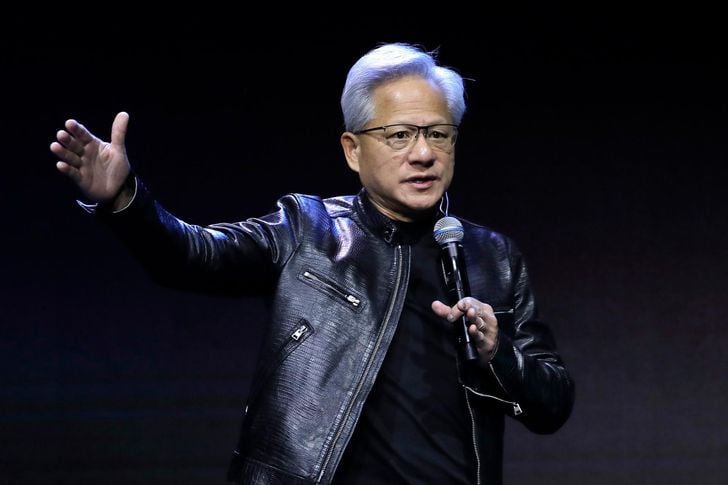
Jensen Huang spent this week in Taipei in his usual style. He spoke about chips, robotics, and the future of computing. But on Tuesday evening, he made time for something else. Behind closed doors at the Mandarin Oriental hotel, he addressed more than three hundred representatives of financial institutions and wealthy family offices. And the message of his talk was clear: anyone who still doubts the profitability of artificial intelligence is out of touch with reality.
“In just the last six months, the return on investment has completely changed. Now it is insanely profitable,” the Nvidia co-founder said, adding: “Give me a single example of some crazy person who is still saying that now. They will sound like a lunatic.”
The market has transformed over the past year
At the meeting, Huang recalled what the discussion looked like just a year ago. “Do you remember when we were together last time? The rhetoric around investment back then was: what is the return?” The question that resonated throughout the technology world at the time has reportedly lost its relevance today. According to him, AI has created trillions of dollars in value in recent years. And skeptics who until recently warned of an overheated market and irreversible losses from data centers are, according to Huang, simply failing to keep pace with how quickly the situation is changing.
Throughout the meeting, Huang repeated one idea in various forms. Computing power is ceasing to be a cost whose return nobody can be sure of. It is becoming a direct source of revenue. “Computing power is revenue. Computing power is profit,” he said on stage. According to him, AI agents have become genuinely useful over the past six months, and tokens—the basic units of AI computation—are turning into units of earnings.
This week, Nvidia unveiled the new DGX Spark chip platform for personal computers, is continuing to develop the Vera Rubin data platform, and confirmed that purchases from Taiwanese suppliers are heading toward $150 billion.
Nvidia’s CEO also praised memory-chip makers Micron Technology and South Korea’s SK Hynix. He also mentioned TSMC, the world’s largest chip manufacturer, which produces Nvidia’s most advanced processors. Nvidia’s contribution to TSMC’s total revenue is estimated to reach twenty percent. A comment about Marvell Technology attracted particular attention. Huang suggested that it could soon join the club of companies with a market value exceeding one trillion dollars. Marvell shares surged following the statement.
AI and layoffs
Huang also addressed an issue that has resonated throughout the corporate world in recent months. An increasing number of company executives are citing artificial intelligence as the reason for layoffs. Huang rejects this. According to him, the logic does not add up. AI only recently began to gain traction at companies on a larger scale. Businesses that laid off employees two or three years ago could not have done so because of AI. Instead, Huang points to excess staffing from the COVID era and the high costs associated with building AI infrastructure, which are putting pressure on corporate budgets.
Demis Hassabis, CEO of Google DeepMind, shares a similar view. He criticized companies for blaming layoffs on AI and called it a “lack of imagination” on the part of management.
Huang also indicated where he sees new sources of capital for the massive expansion of AI infrastructure. “You need land, energy, but also financing,” he said. Alongside pension funds and retail investors, he described wealthy family offices as “an entirely new sector of global wealth” entering this space.
That, after all, is consistent with the very format of Tuesday’s meeting. Huang chose precisely this audience to deliver his message directly to those who decide how large amounts of private capital are allocated.
Sources: seekingalpha.com, financialpost.com and ainvest.com