From the Grand Canyon (South Rim), we headed back toward Las Vegas, and along the way, about two and a half hours from Vegas, are the Grand Canyon West Rim and the Skywalk – the famous viewpoint advertised on seemingly every other billboard in Nevada.
I quite liked how it looked in the photos, the Skywalk is heavily promoted in various travel guides, and I also saw plenty of ads for it in Vegas itself. The marketing around it is really extensive. So I thought that since we would be passing nearby – “nearby” in quotation marks – we might as well stop there and see what the Skywalk actually looks like.
A Stop by the Joshua Trees – Iconic Trees of the Mojave Desert
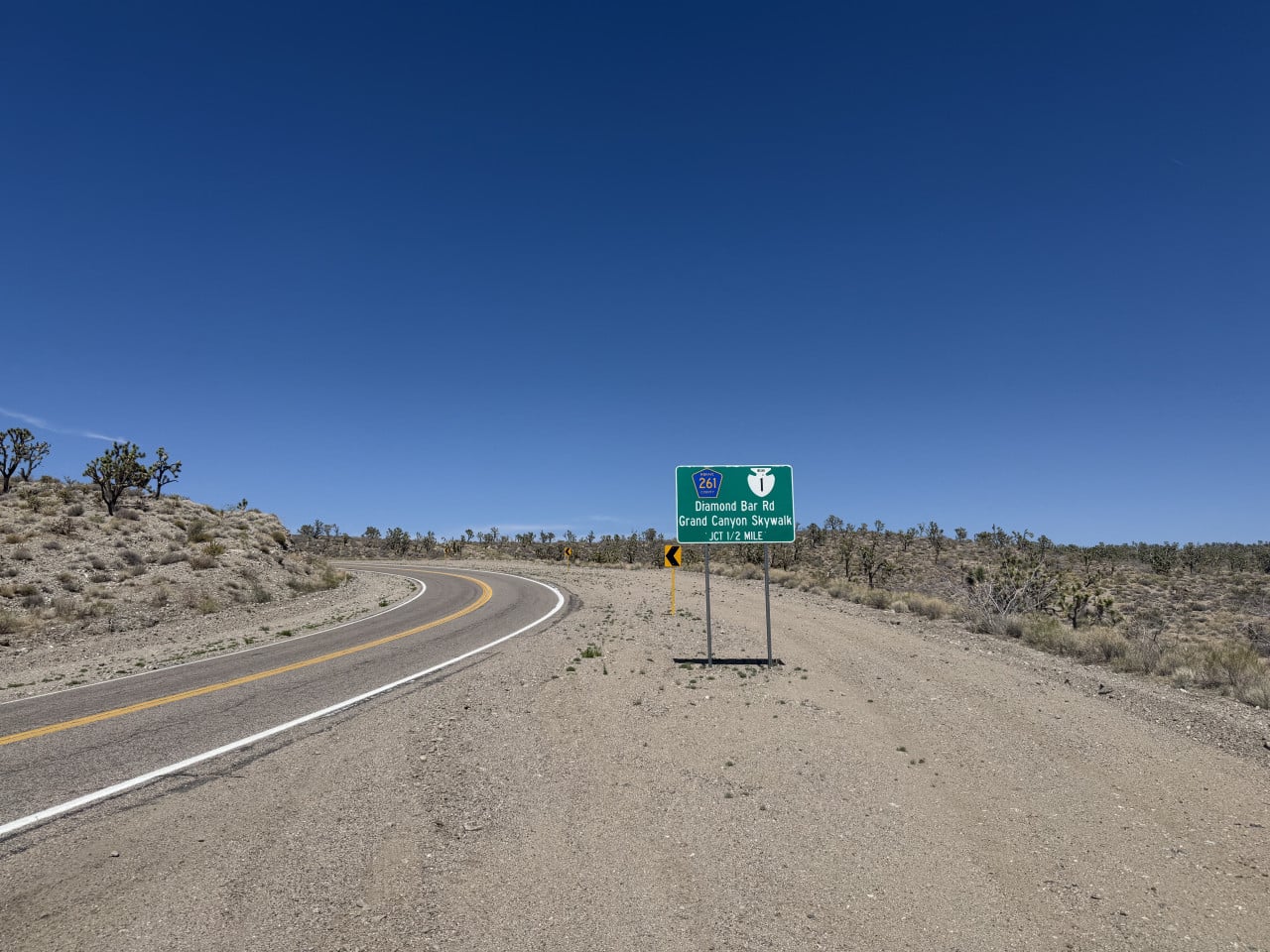
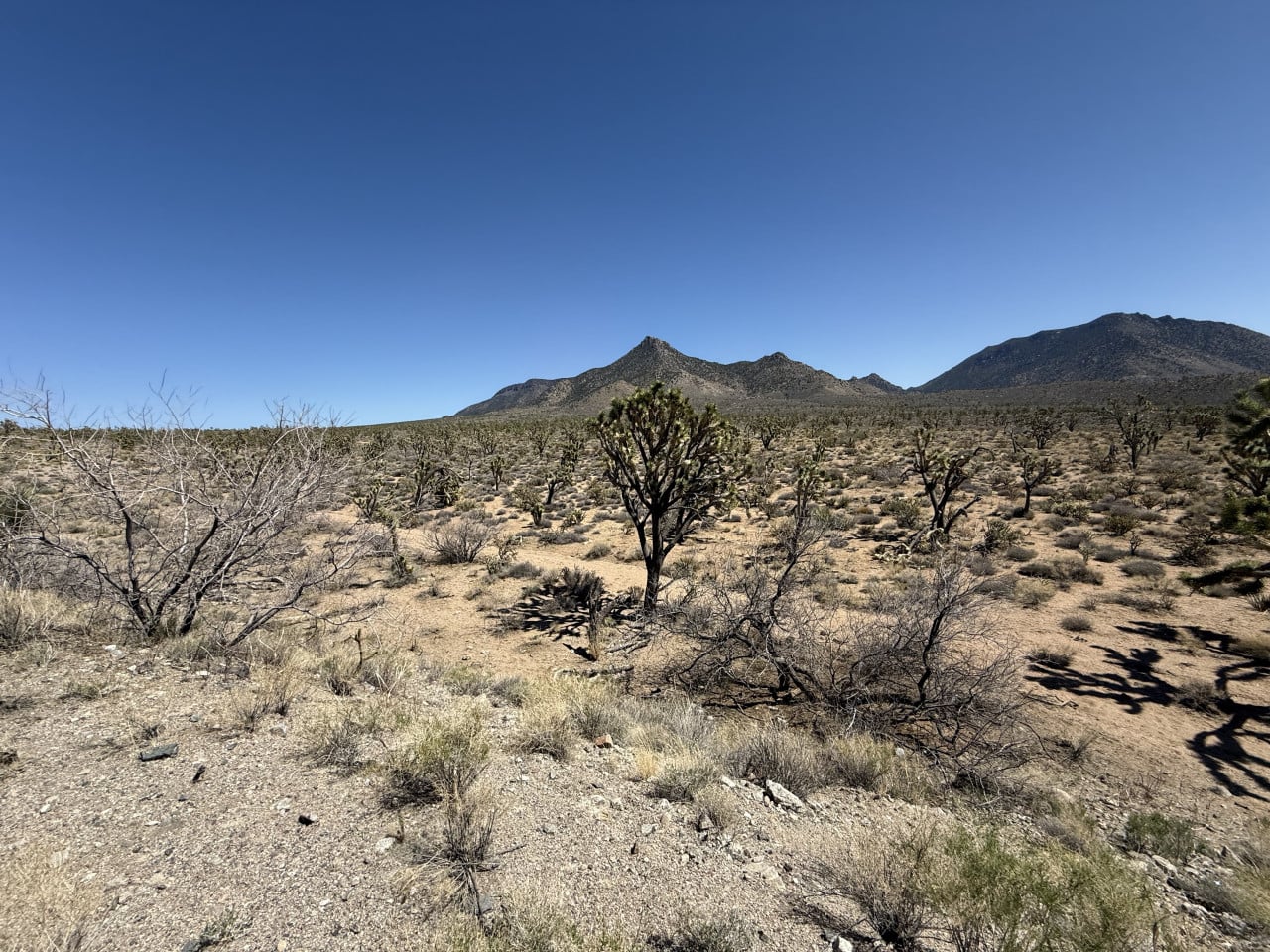
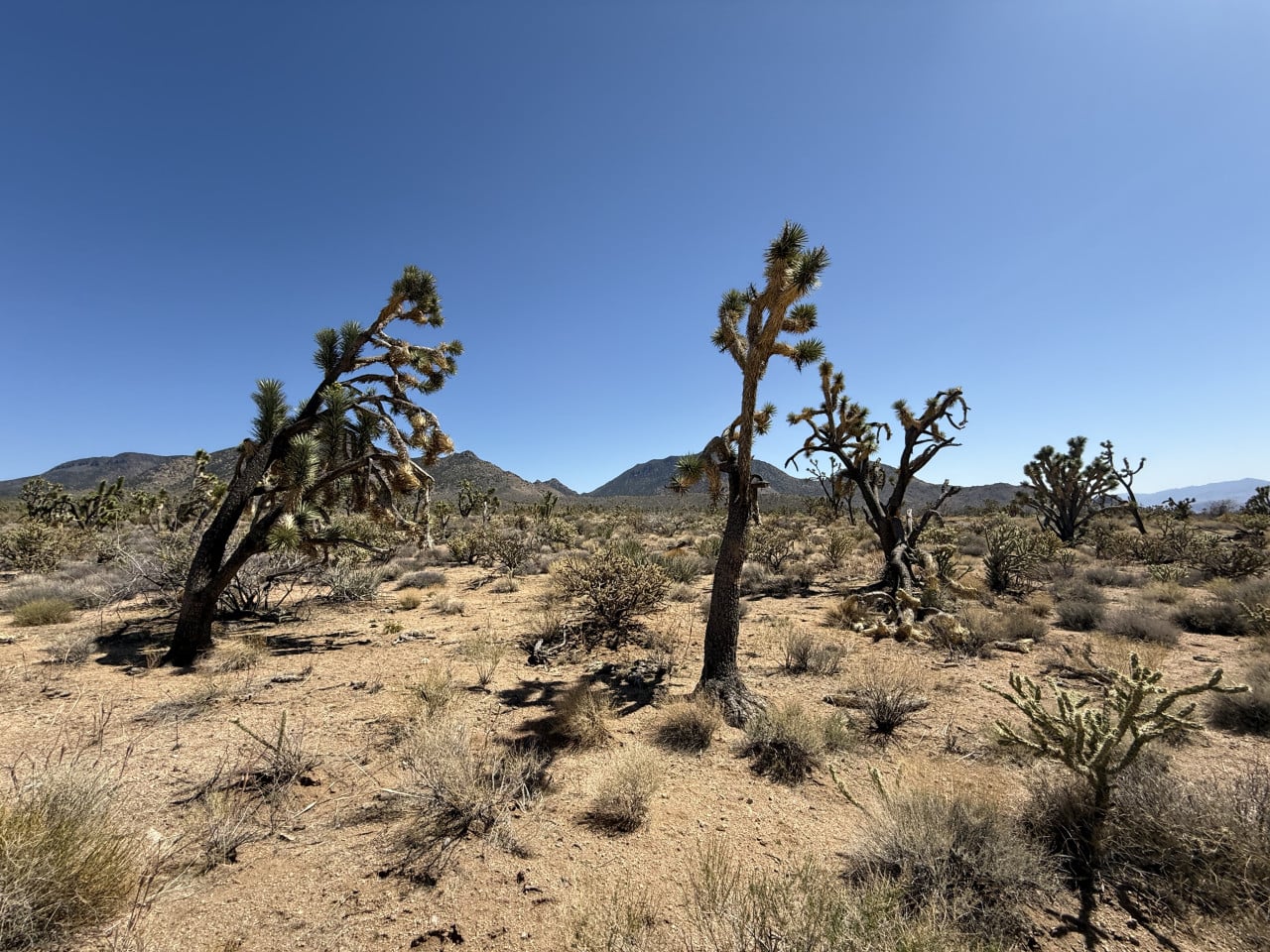
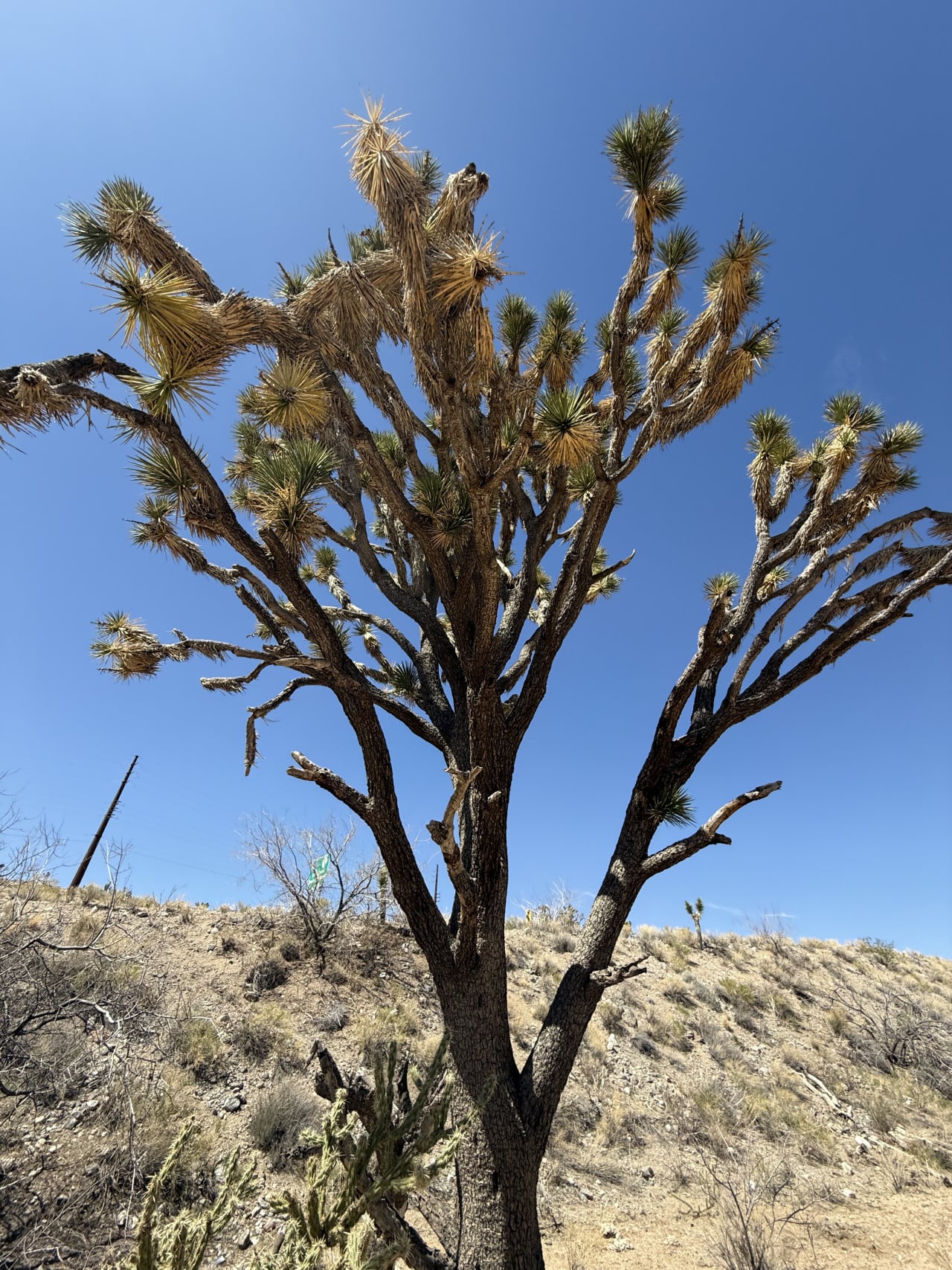
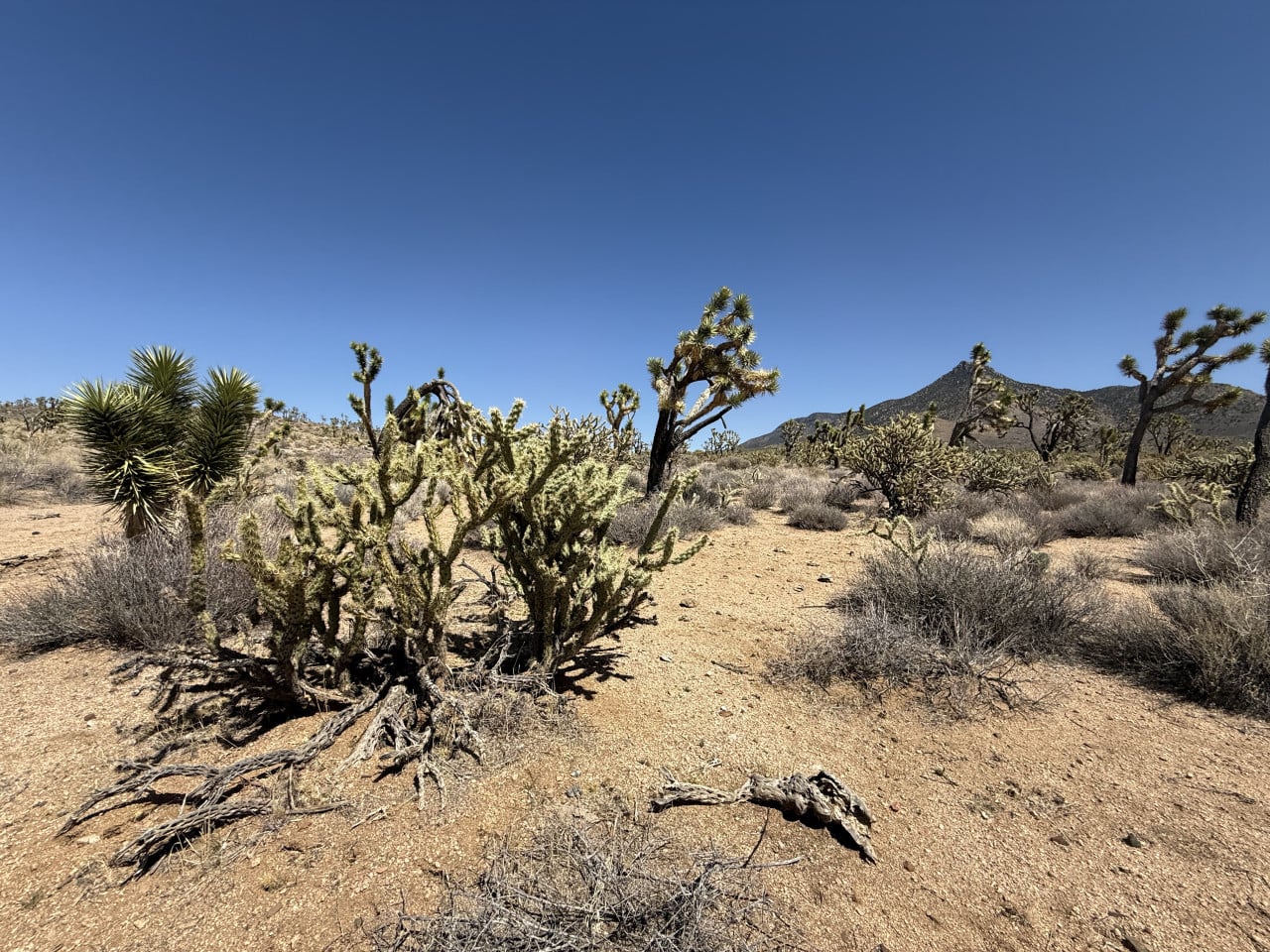
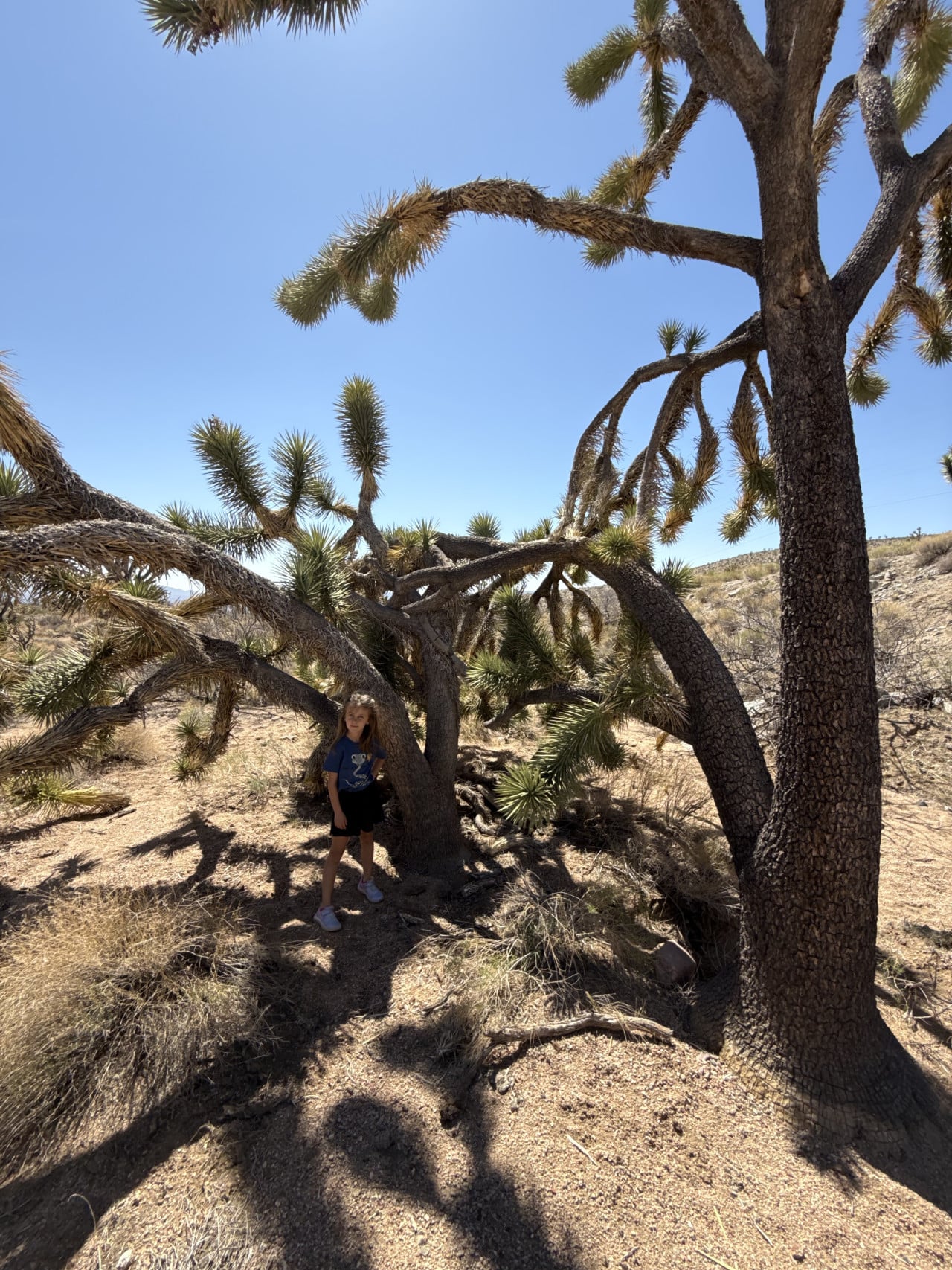
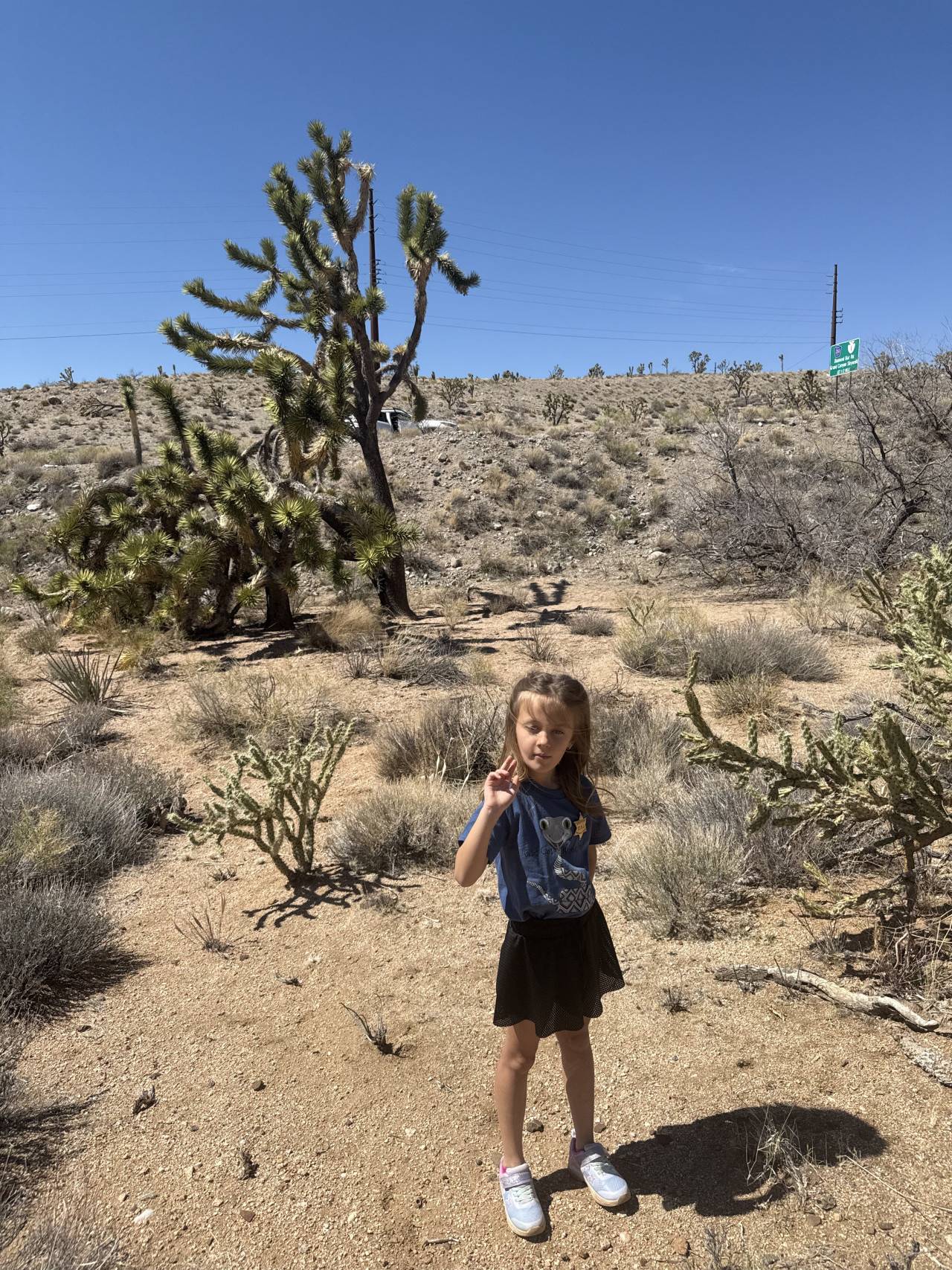
One interesting sight along the way from the Grand Canyon’s South Rim is the Joshua Trees – you can pull over by the road and literally step right out among them. We stopped there and took photos by the trees. It looked truly beautiful – the kind of typical desert scene you imagine when someone says “the American Southwest.”
The Joshua Tree, sometimes translated into Czech as “Jošuův strom,” is not actually a tree in the true sense of the word. It is a succulent plant from the Yucca genus (Yucca brevifolia) and is the largest of its kind in the world. Although botanically it is a monocotyledonous plant, in the inhospitable Mojave Desert it serves the role of a tree – providing shade, shelter, and food for dozens of animal species.
This unusual “tree” was given its name by Mormon settlers who traveled across the Mojave Desert in the mid-19th century. Its outstretched branches reminded them of the biblical story of Joshua, who raises his hands toward heaven in prayer and shows the Israelites the way to the Promised Land. In the same way, the Joshua Trees showed them the way west through the desert.
Joshua Trees grow very slowly – during their first ten years, they grow by about 7.5 centimeters per year, and later by just under four centimeters annually. They do not have growth rings like ordinary trees, so it is difficult to determine their exact age, but some specimens are estimated to be over a thousand years old. They commonly live for around 150 years. They grow to a height of 6 to 21 meters, although most do not exceed 12 meters.
What is absolutely fascinating about Joshua Trees is their dependence on a single insect species – the moth of the genus Tegeticula, known as the yucca moth. Without this tiny moth, the trees would not be able to reproduce. The moth transfers pollen between flowers and, in return, lays eggs inside them. The larvae that hatch feed on some of the seeds. The remaining seeds can then germinate and grow into new trees. It is a beautiful example of a symbiotic relationship in nature. Another interesting fact is that the original dispersers of Joshua Tree seeds were probably giant ground sloths, which became extinct at the end of the Ice Age approximately 11,000 years ago.
Joshua Trees are found exclusively in the Mojave Desert in the southwestern United States – in California, Nevada, Utah, and Arizona – and only at elevations between 600 and 1,800 meters. They are so iconic that an entire national park was named after them – Joshua Tree National Park in California. And incidentally, the Irish band U2 also named its legendary album after these trees.
Arrival at Grand Canyon West and First Impressions
After stopping by the Joshua Trees, we continued to the Skywalk. We arrived at the parking lot and, of course, immediately had to pay for parking before entering – and that was how it began.
From the parking lot, we walked to a reception area where we bought our tickets, paid quite a lot, and had to wait at a small “station” for a bus that took us directly to the Skywalk. It was a five-minute journey, ten at most – nothing special, and we were there in no time. The bus was air-conditioned, so the ride was perfectly manageable.
Of course, the reception area where tickets were sold had a souvenir shop and refreshments – you could buy water there, for example. We bought some souvenir magnets – I always put them on the refrigerator.
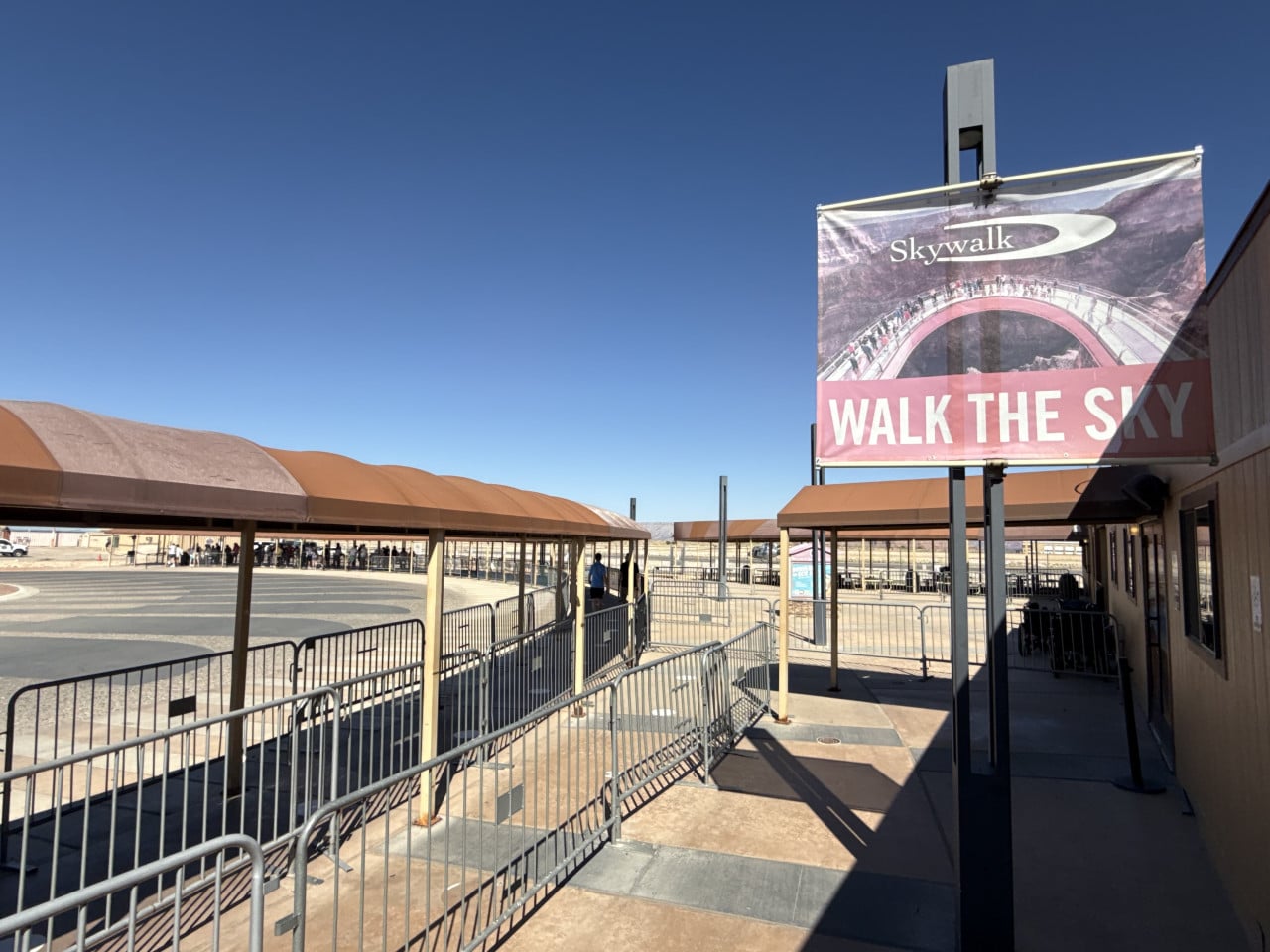
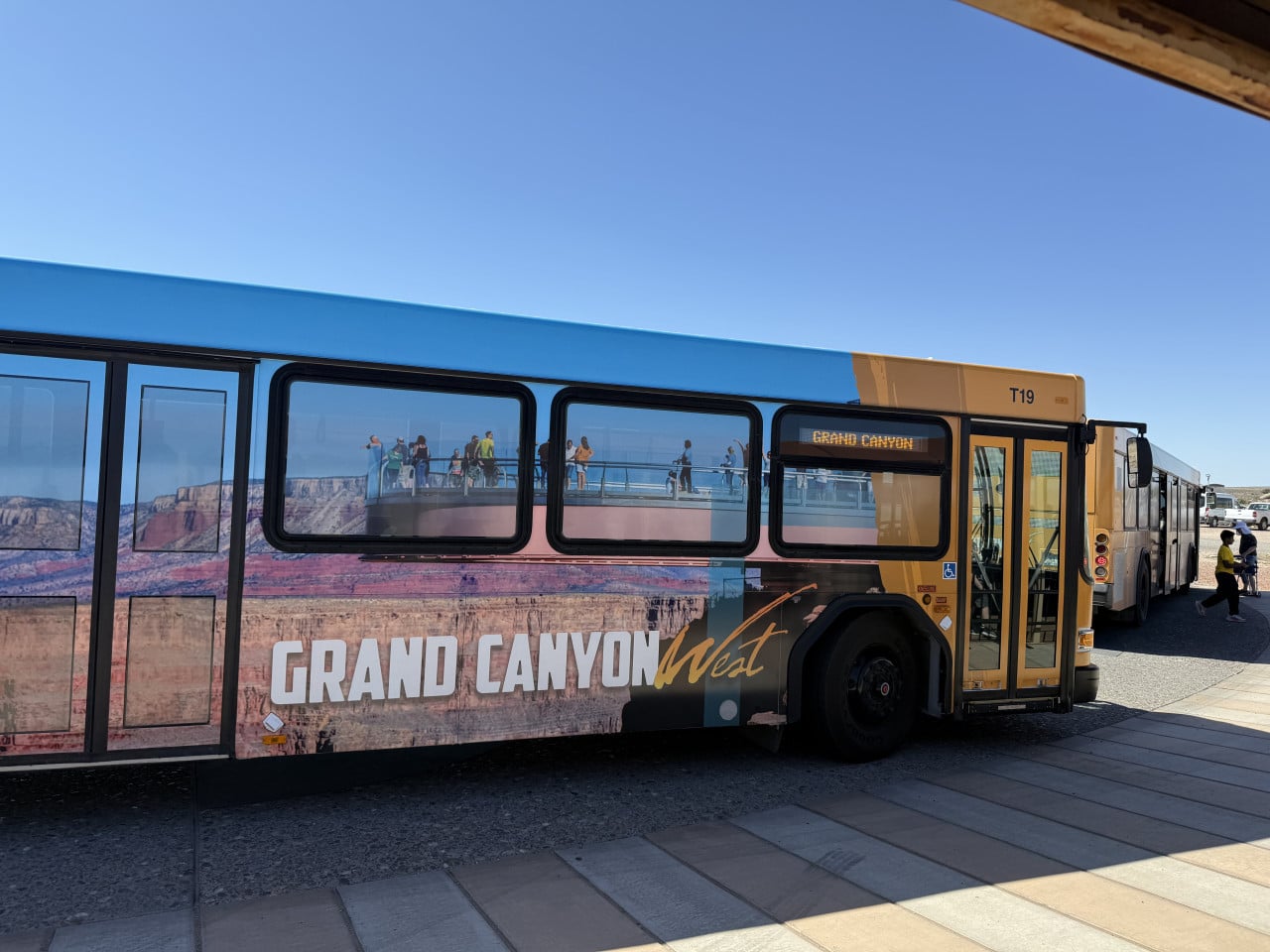
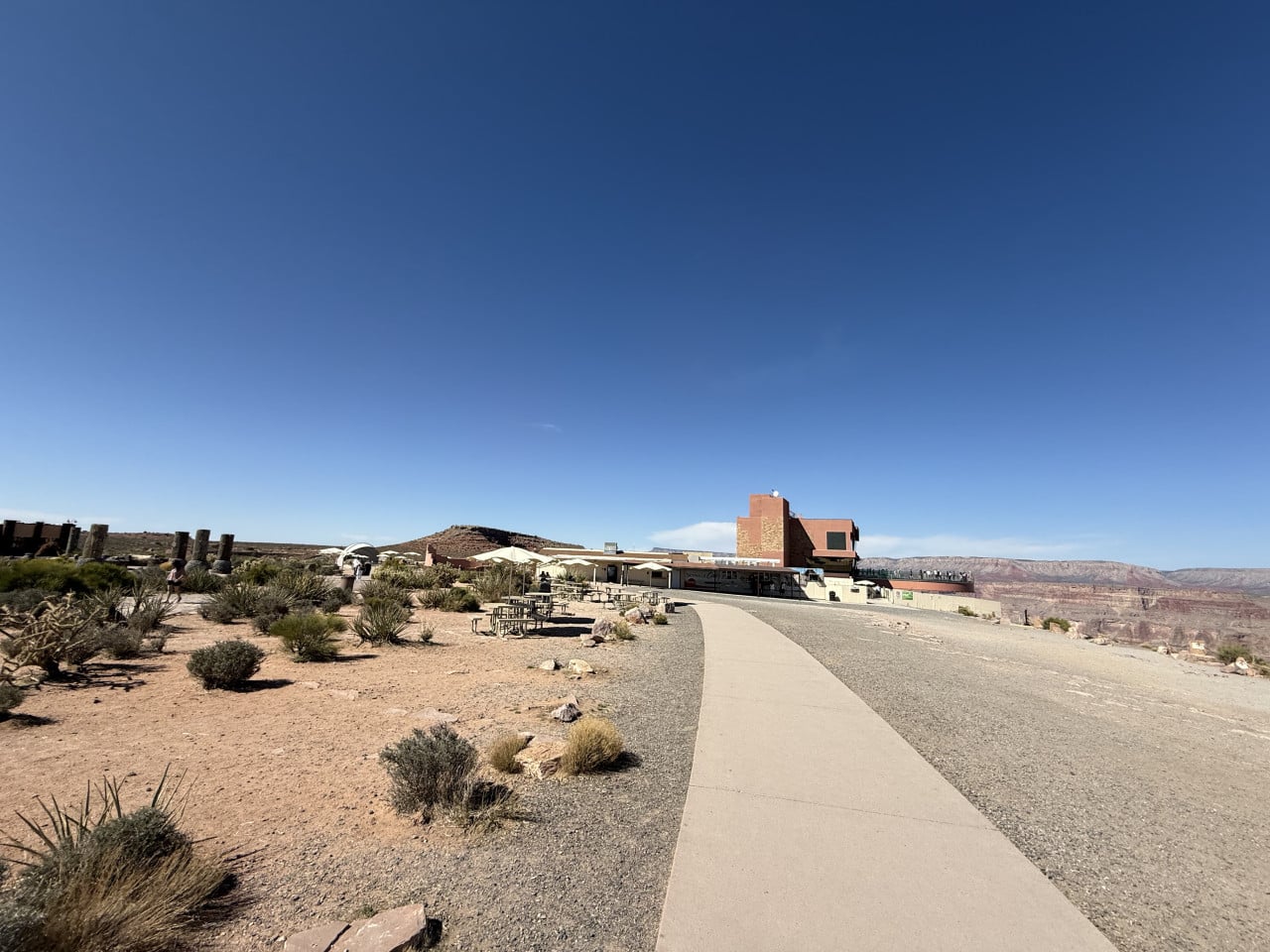
Grand Canyon Skywalk – A $30 Million Engineering Marvel
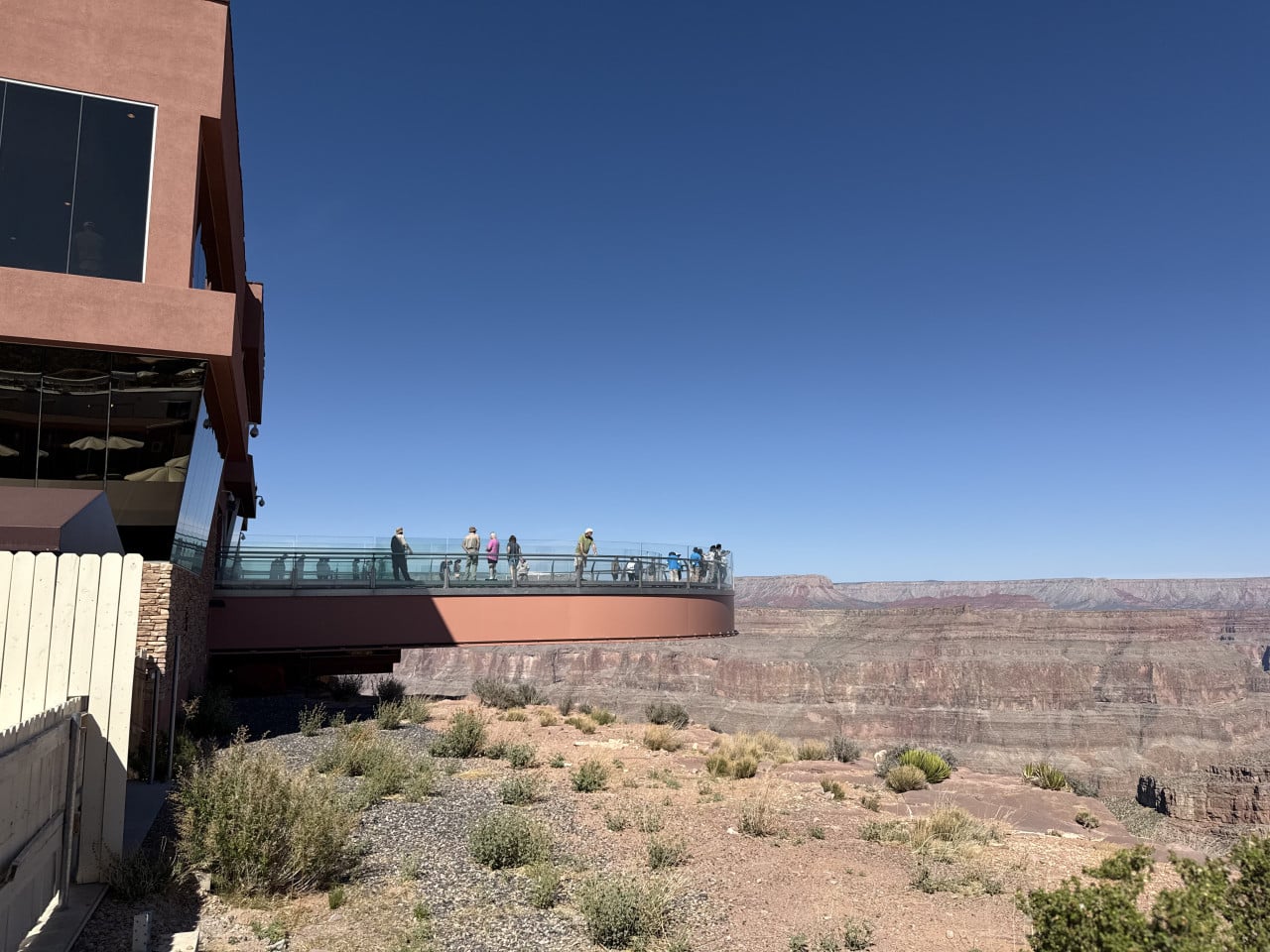
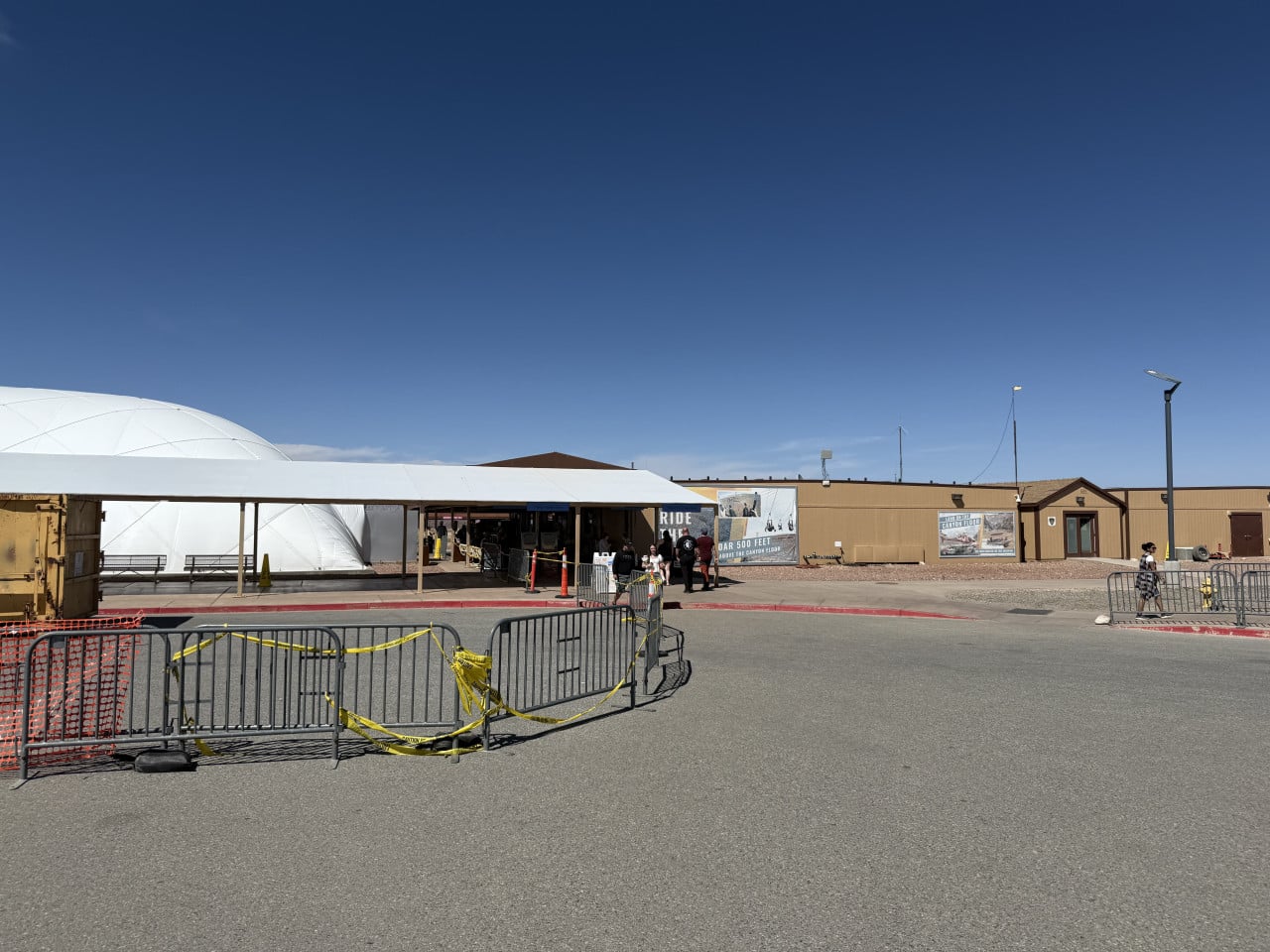
The bus took us to a building marked The Skywalk at Eagle Point – Grand Canyon West. Around it were covered seating areas and a restaurant where we later had ice cream.
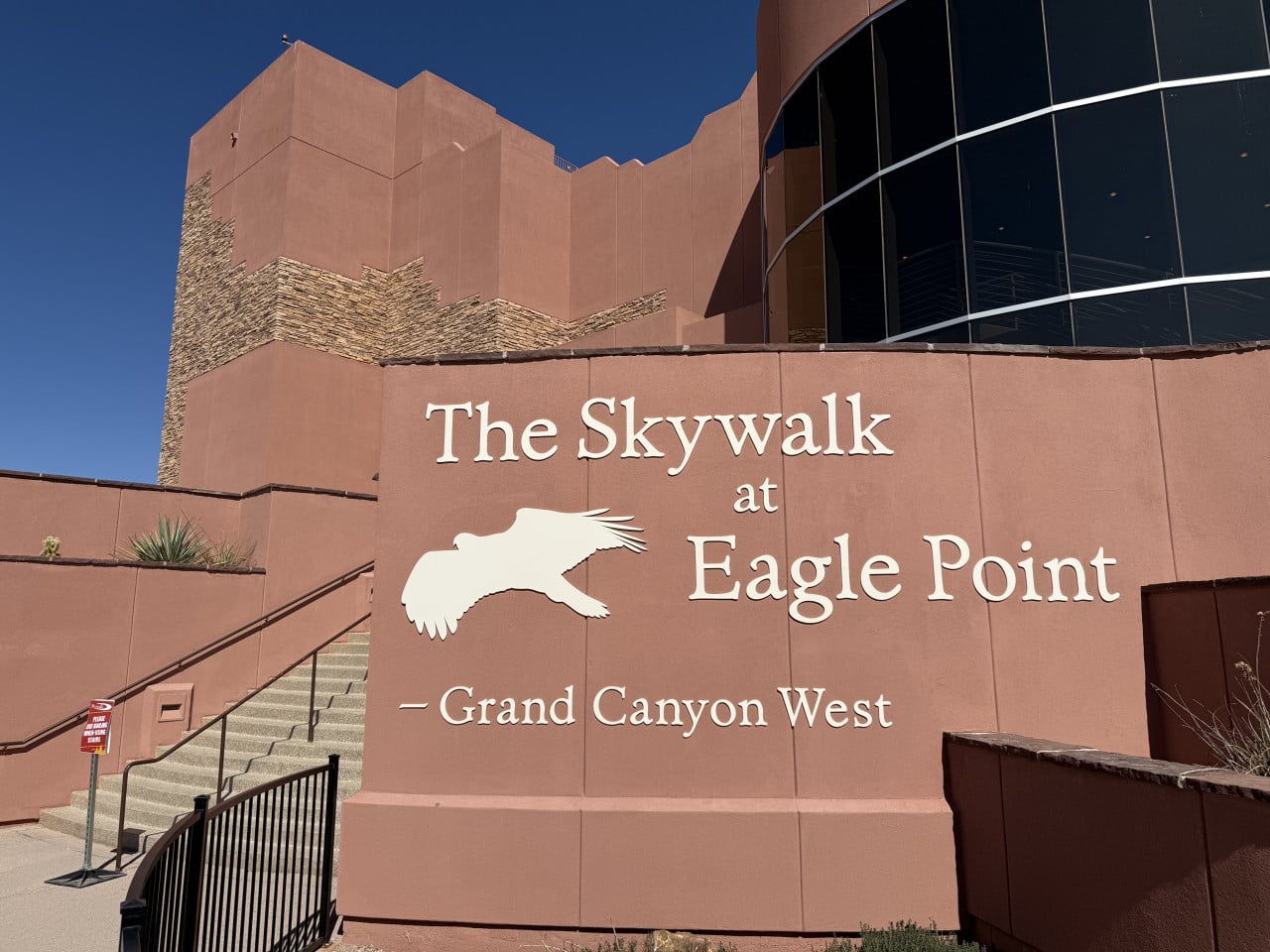
Before I get to the experience itself, it is worth mentioning a few interesting facts about what the Skywalk actually is and how it came to be.
The Grand Canyon Skywalk is a horseshoe-shaped glass bridge suspended over the western rim of the Grand Canyon at a place called Eagle Point. It extends 21 meters (70 feet) beyond the edge of the cliff, with a drop of 150 to 240 meters beneath it – approximately 500 to 800 feet. The Skywalk stands at an elevation of around 1,450 meters, while the Colorado River below flows at only 350 meters above sea level. The total elevation difference between the Skywalk and the river is therefore more than 1,100 meters.
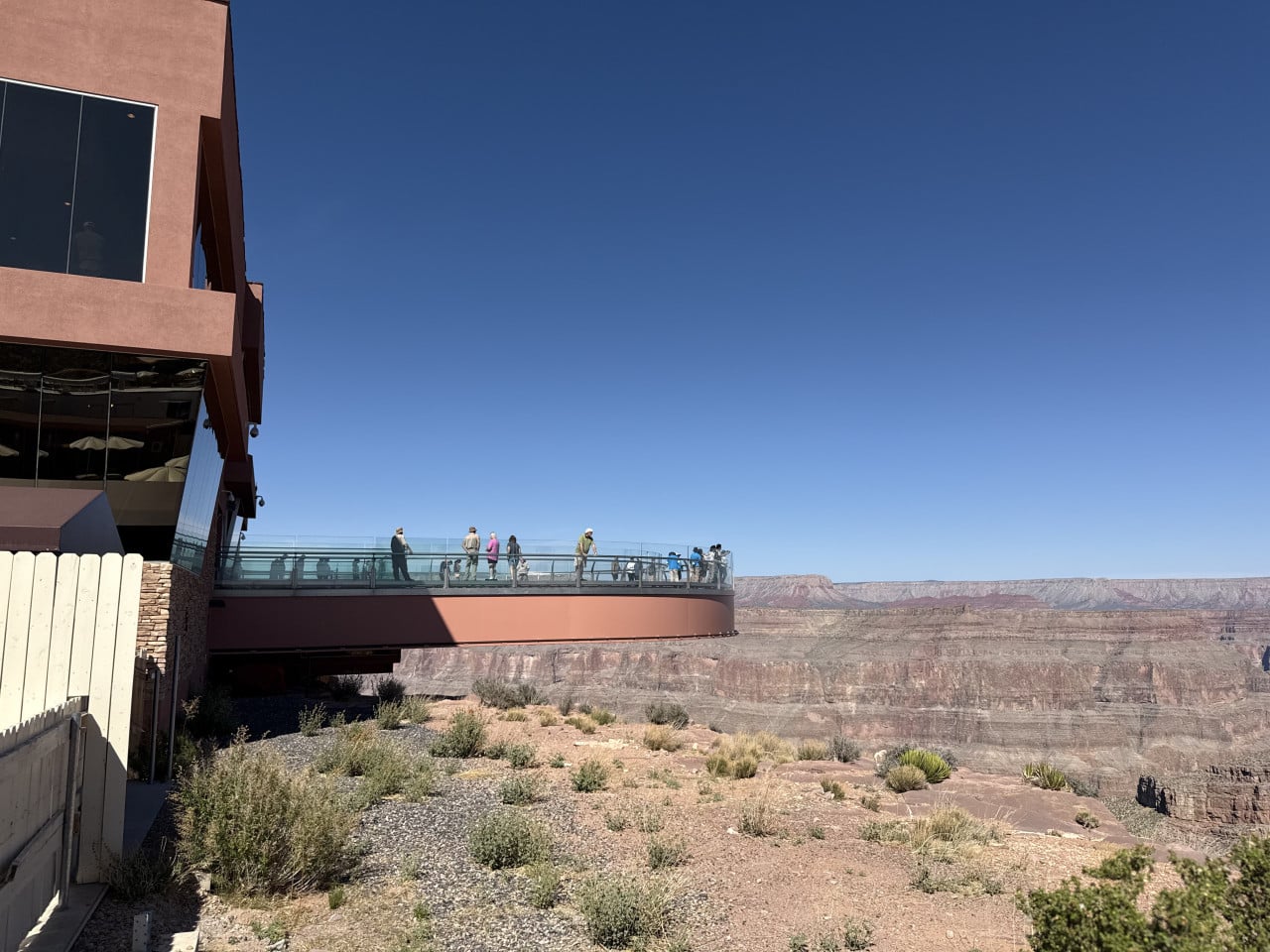
Construction took four years and cost around $30 million. The entire project was initiated by Chinese-American businessman David Jin, who worked with the Hualapai Tribe, on whose reservation the Skywalk is located. Under the agreement, Jin financed the construction himself and received the right to operate and manage it for 25 years – after which all rights will pass to the tribe.
Technically, the Skywalk is fascinating. The steel structure weighs more than 450 tons, while the glass floor adds approximately another 36 tons – a total of 46 glass panels. Engineers used a method inspired by the construction of the Egyptian pyramids – the entire structure was assembled at the edge of the cliff and then rolled into position over the chasm using a special “jack and roll” mechanism. The entire process took just two days.
The bridge is designed to support the weight of 71 fully loaded Boeing 747 aircraft and withstand an 8.0-magnitude earthquake or winds of 160 km/h. Up to 120 people may stand on the bridge at once, even though it is engineered to support more than 800 people.
The Skywalk officially opened on March 20, 2007, in the presence of astronauts Buzz Aldrin (the second person to walk on the Moon) and John Herrington, the first astronaut of Native American heritage. More than 10 million people have visited the bridge since it opened.
The Experience Itself – Honestly and Without Sugarcoating It
What I personally did not particularly like was that, from beginning to end, the place had a strong atmosphere of commercialism. Compared with the South Rim or North Rim, where I had been many years ago, you are free there and can walk around wherever you want and essentially do whatever you like. The problem here was that they strictly made us line up, and we had to wait just to get onto the Skywalk at all.
Then came the main issue – there were signs everywhere saying that photography was prohibited. I did not understand why. Perhaps it was because someone might drop a phone into the canyon, or for some other reason, but I did not understand the ban.
We had to put our phones, camera, video camera – absolutely everything – into lockers, and we were basically not allowed to take anything onto the Skywalk. You also have to put protective covers over your shoes to prevent the glass from being scratched.
As we gradually made our way toward the Skywalk, we waited in a line that took an incredibly long time – around an hour by my estimate. By then, it was truly exhausting, just so I could look into a hole that I had already seen from the South Rim, which is simply a hundred times better – I already knew that by then.
When we finally reached the Skywalk, there were employees there – local members of the Hualapai Tribe – who took our photo. Of course, they took our photo and then wanted money for the pictures at the exit. And that was the whole trick. The only reason they took away our phones and cameras was so they could photograph us themselves and then charge us around $50 for a printed photo at the exit.
There were crowds of people, and they photographed absolutely everyone, so it all moved like a production line. In any case, they photographed us terribly – half of our heads were missing from the picture, the whole thing was thrown together, and they made no effort whatsoever. If I had taken the photo myself, I would have had a hundred times better picture.
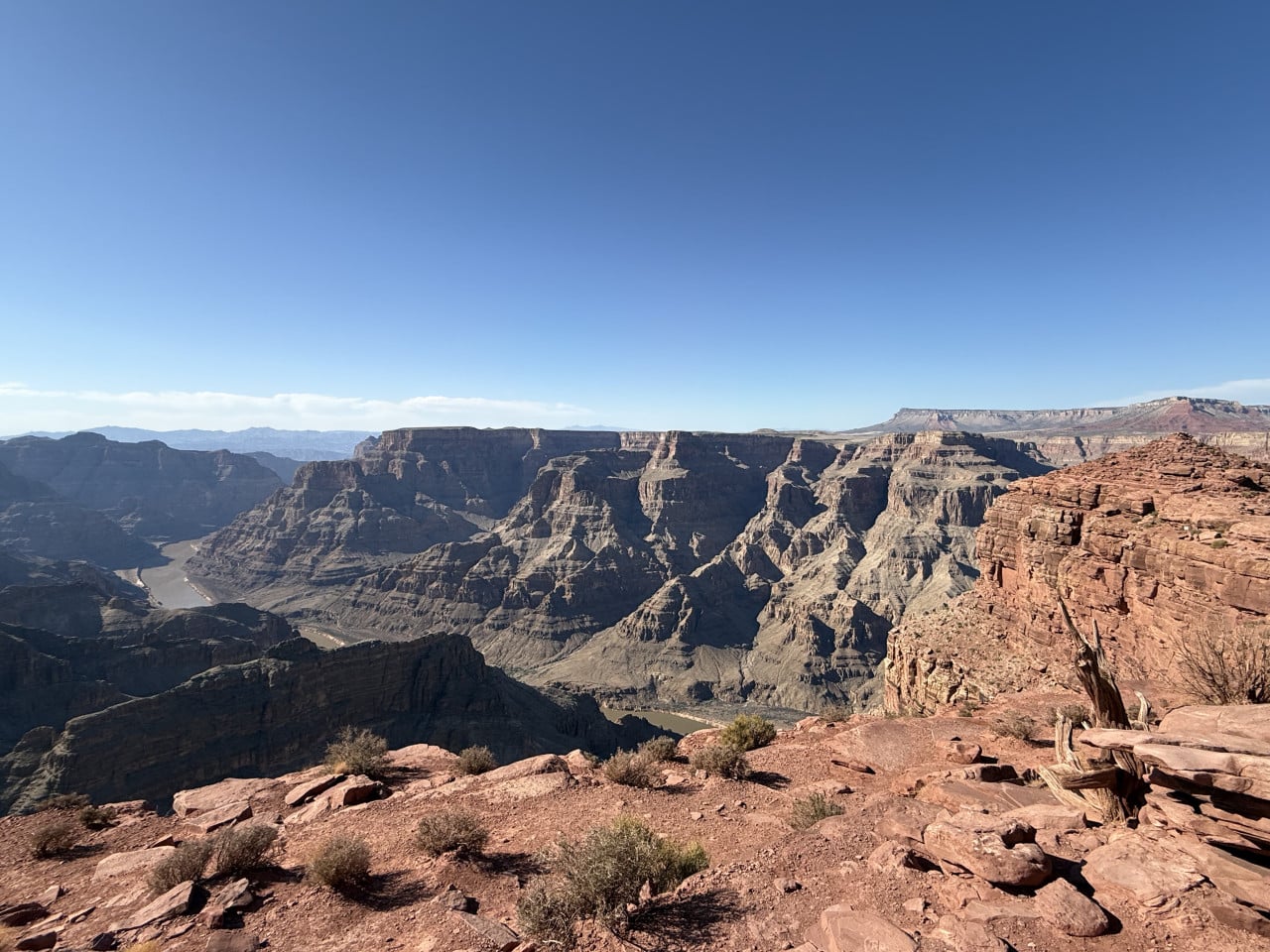
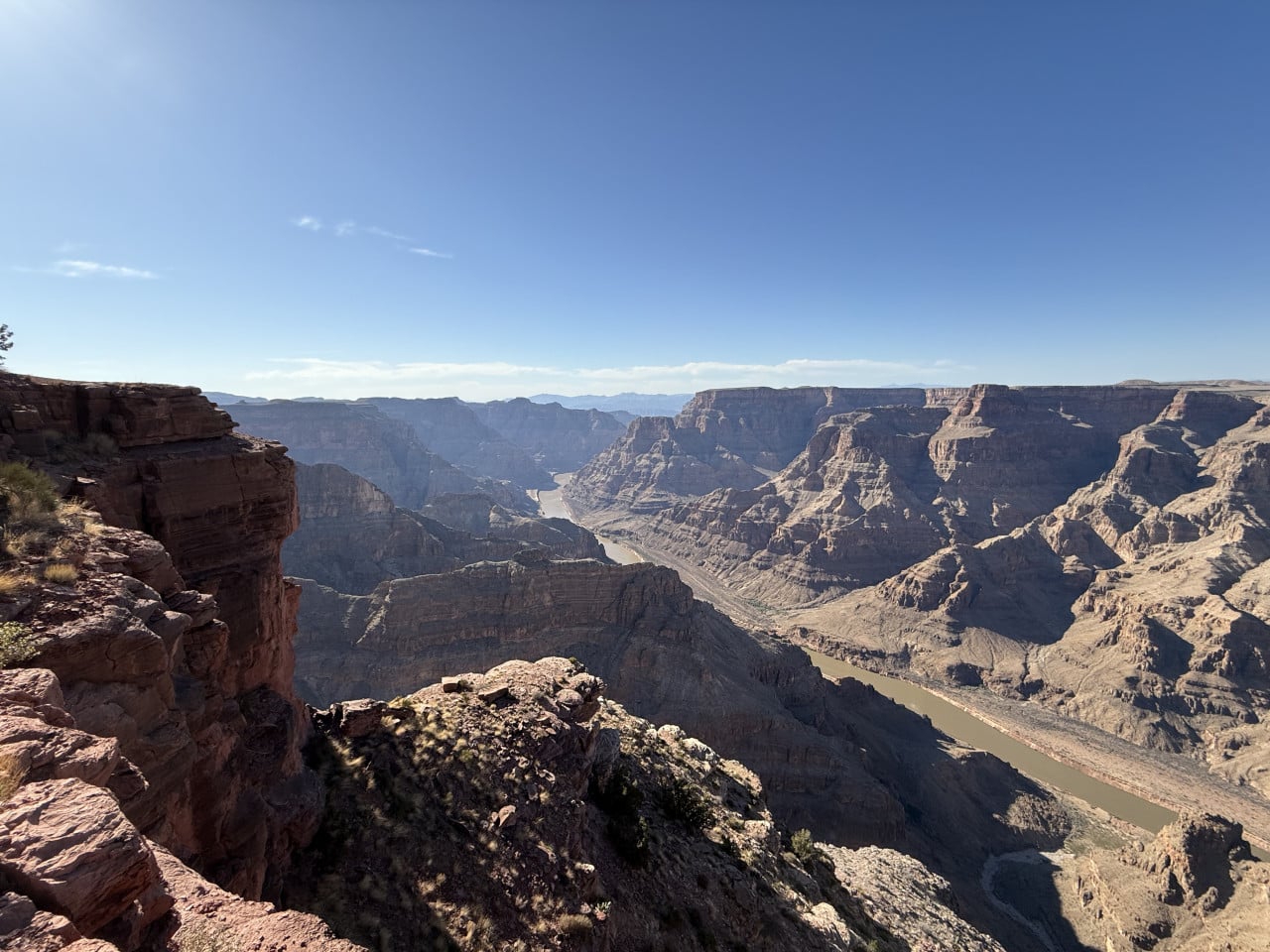
The view itself was not bad – you could see the entire “chasm” beneath you and the Colorado River – and that was, of course, the interesting part. But it could not compare with the South Rim at all. I honestly cannot say that I need to see it again, even though I absolutely love the Grand Canyon itself. Here, it was obvious that it had been created solely for the money and nothing else.
Because there were so many people, they did not even let us stand there for five or ten minutes – they kept urging us onward, saying “keep forward,” so we had to walk through quickly and leave very soon. We waited in line for more than an hour, and within a few minutes it was all over. We basically saw almost nothing and did not get a photo from it either – I did not buy one because they were so ugly that they would not have been suitable for displaying anywhere at home.
We paid quite a high admission fee, and for my taste – considering what we saw – it was not worth it at all.
What Does Grand Canyon West Offer Besides the Skywalk?
Grand Canyon West is an area of approximately 70 square kilometers managed by the Hualapai Tribe. Unlike the South Rim and North Rim, which are administered by the national park, Grand Canyon West is entirely under the tribe’s control. The entire Hualapai Reservation has just under two thousand residents, and the Skywalk was intended as a response to serious economic problems – 50 percent unemployment, poverty, and addiction affecting the community.
At the parking lot, we saw helicopters landing – you can pay for a flight over the canyon or even land at the bottom near the Colorado River and then take a pontoon boat ride. There is also Hualapai Ranch, with its Western atmosphere, and Guano Point, another viewpoint offering breathtaking views.
Eagle Point, where the Skywalk stands, is named after a rock formation that resembles an eagle with outstretched wings. According to a Hualapai legend, a giant eagle once saved their people from a great flood – it descended from the sky, carried the people on its back, and took them to the safety of the canyon’s western rim. When you stand in the middle of the Skywalk or inside the Sky View restaurant, you can actually see this “eagle” in the rock.
Walking Around the Area – This Was Worth It
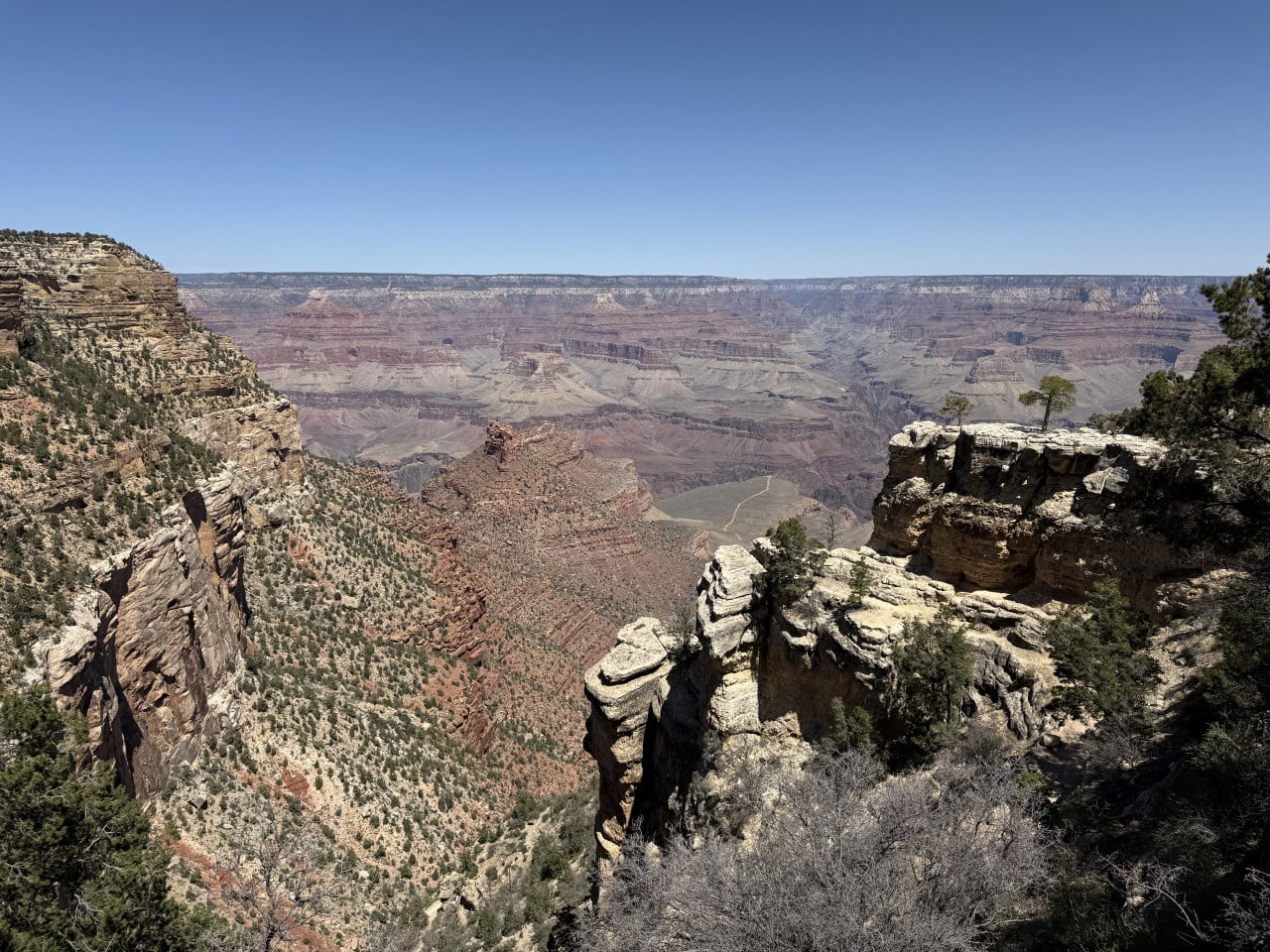
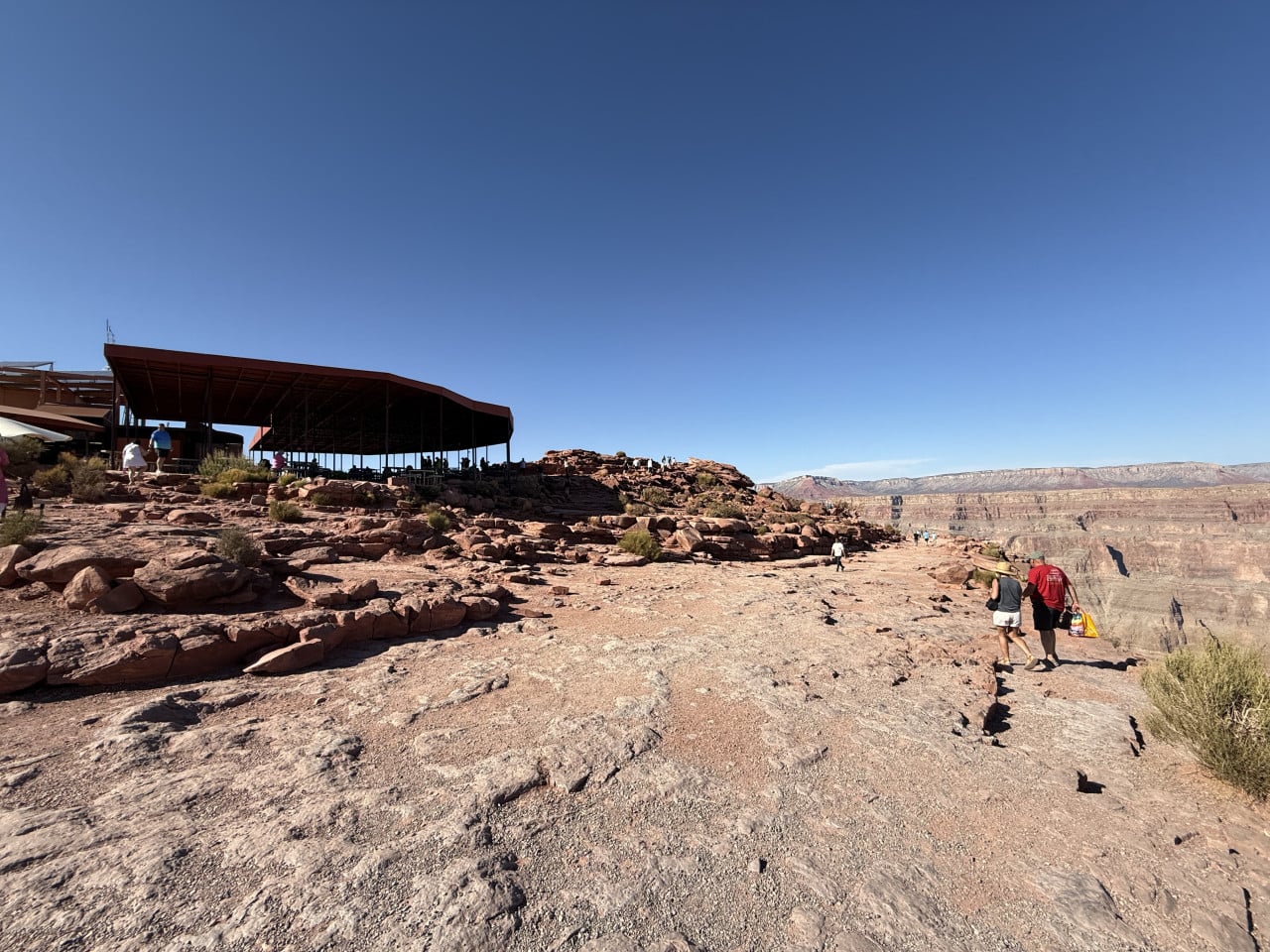
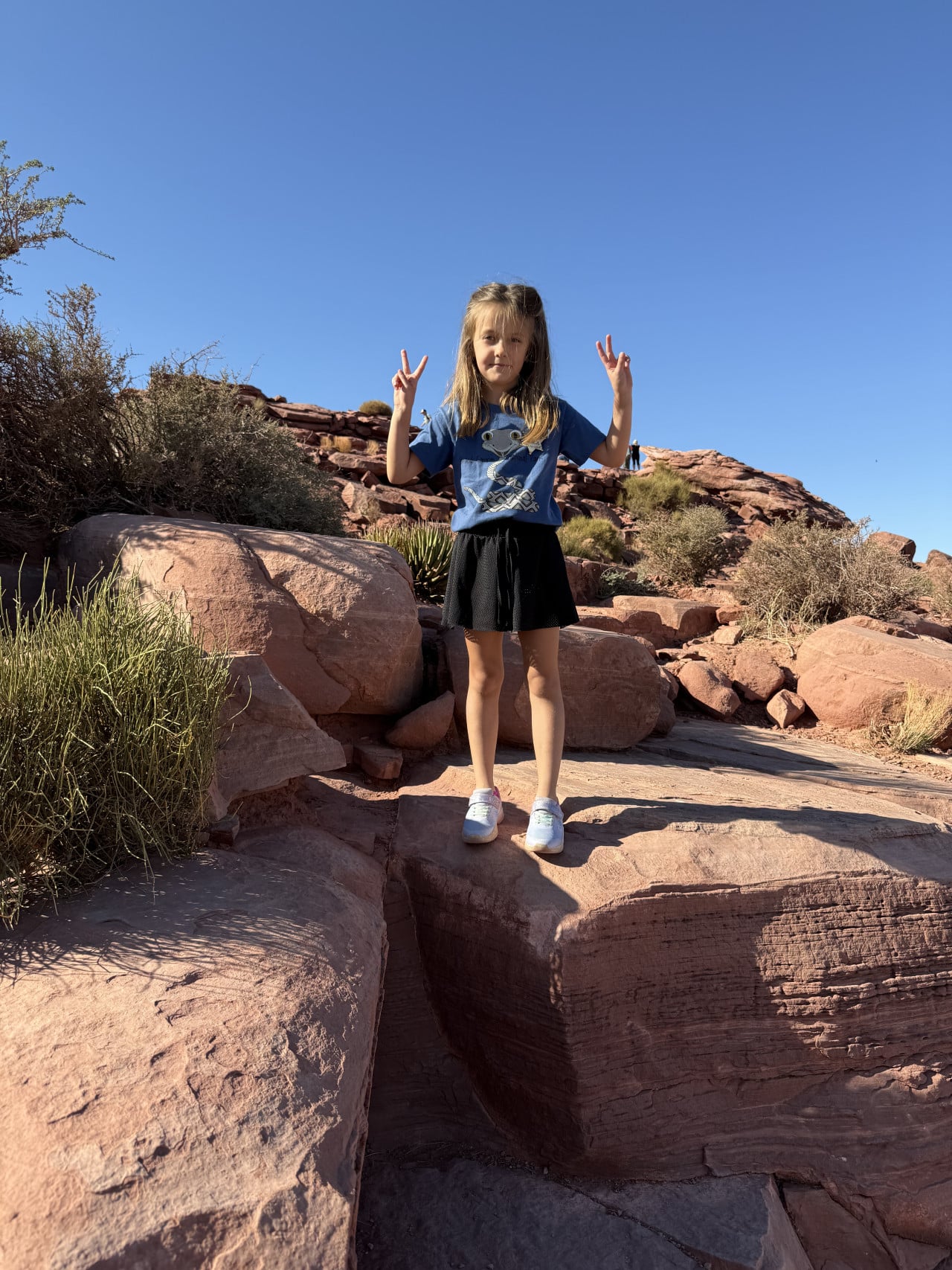
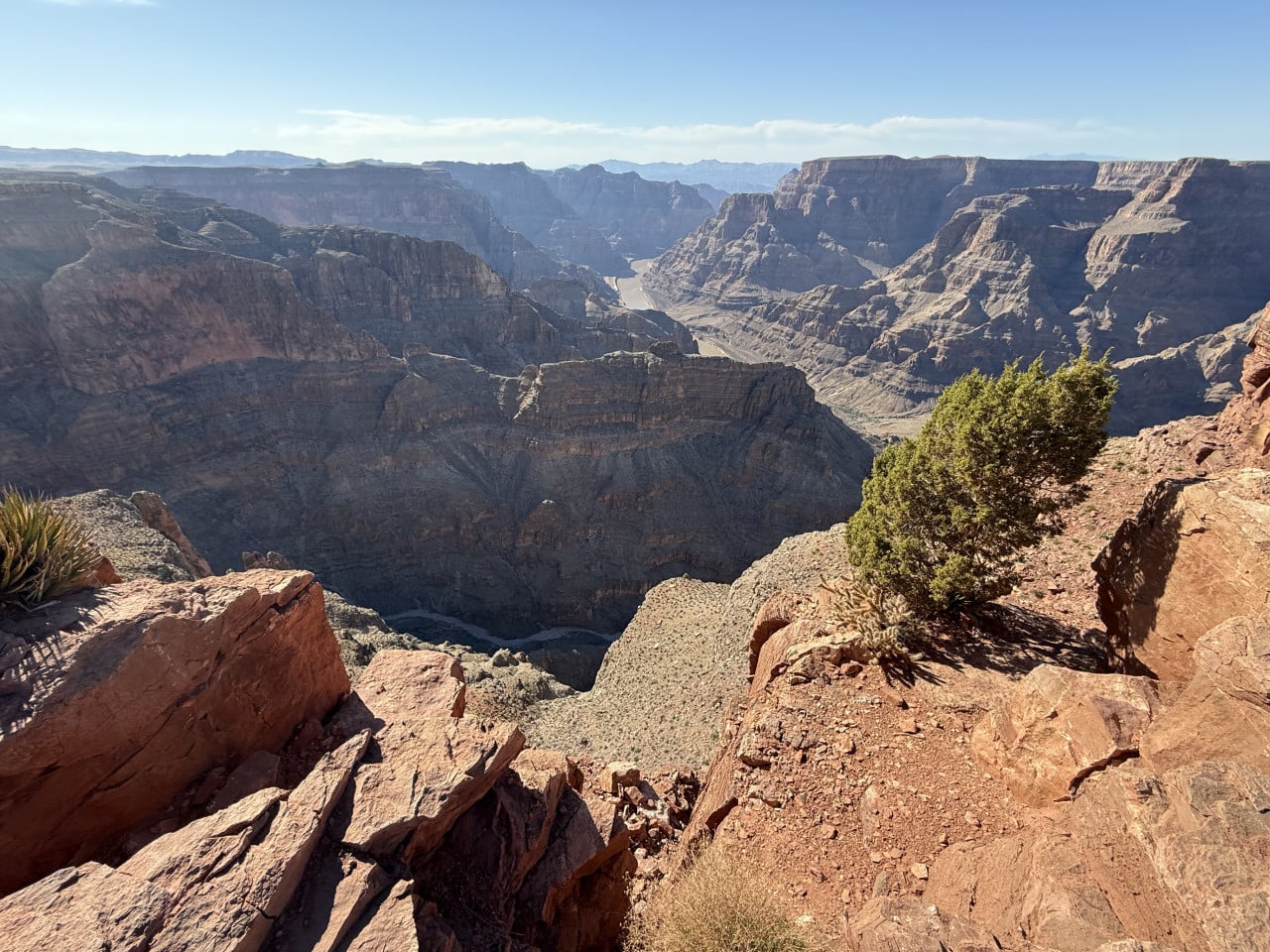
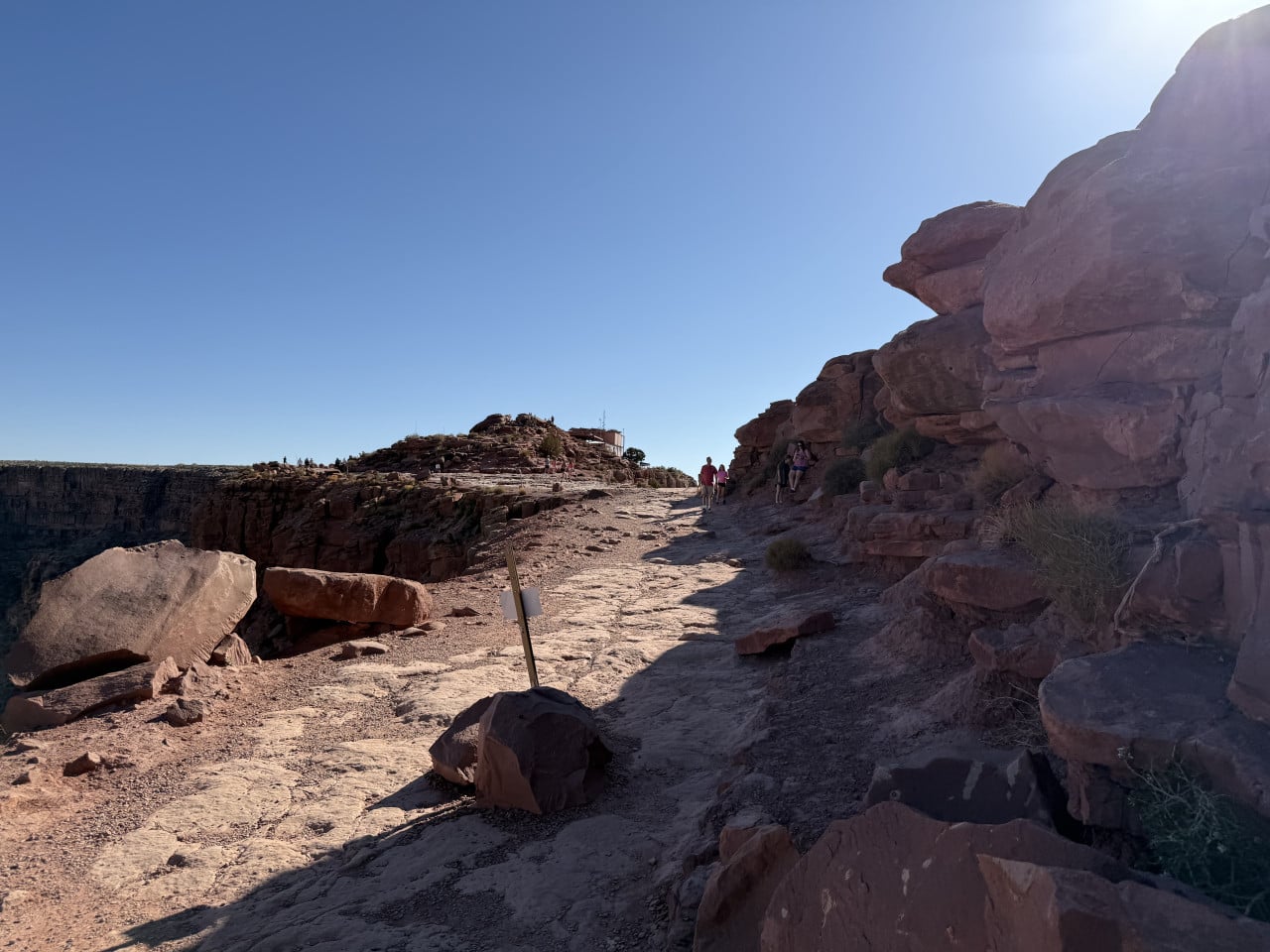
What was truly beautiful, however, was that after leaving the Skywalk, we could still walk all the way around the area. There were beautiful views, and we could walk right up to the very edge of the cliff.
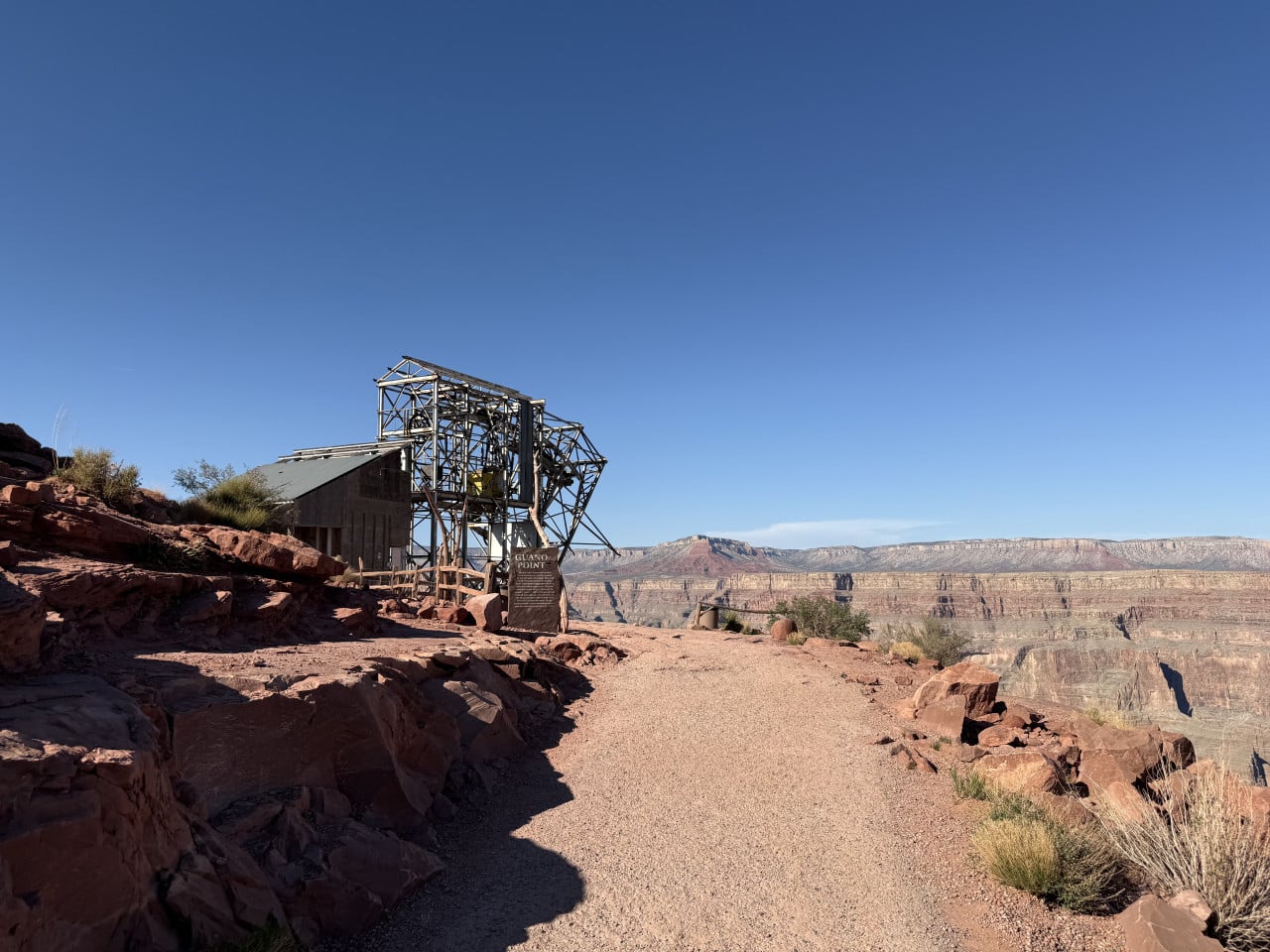
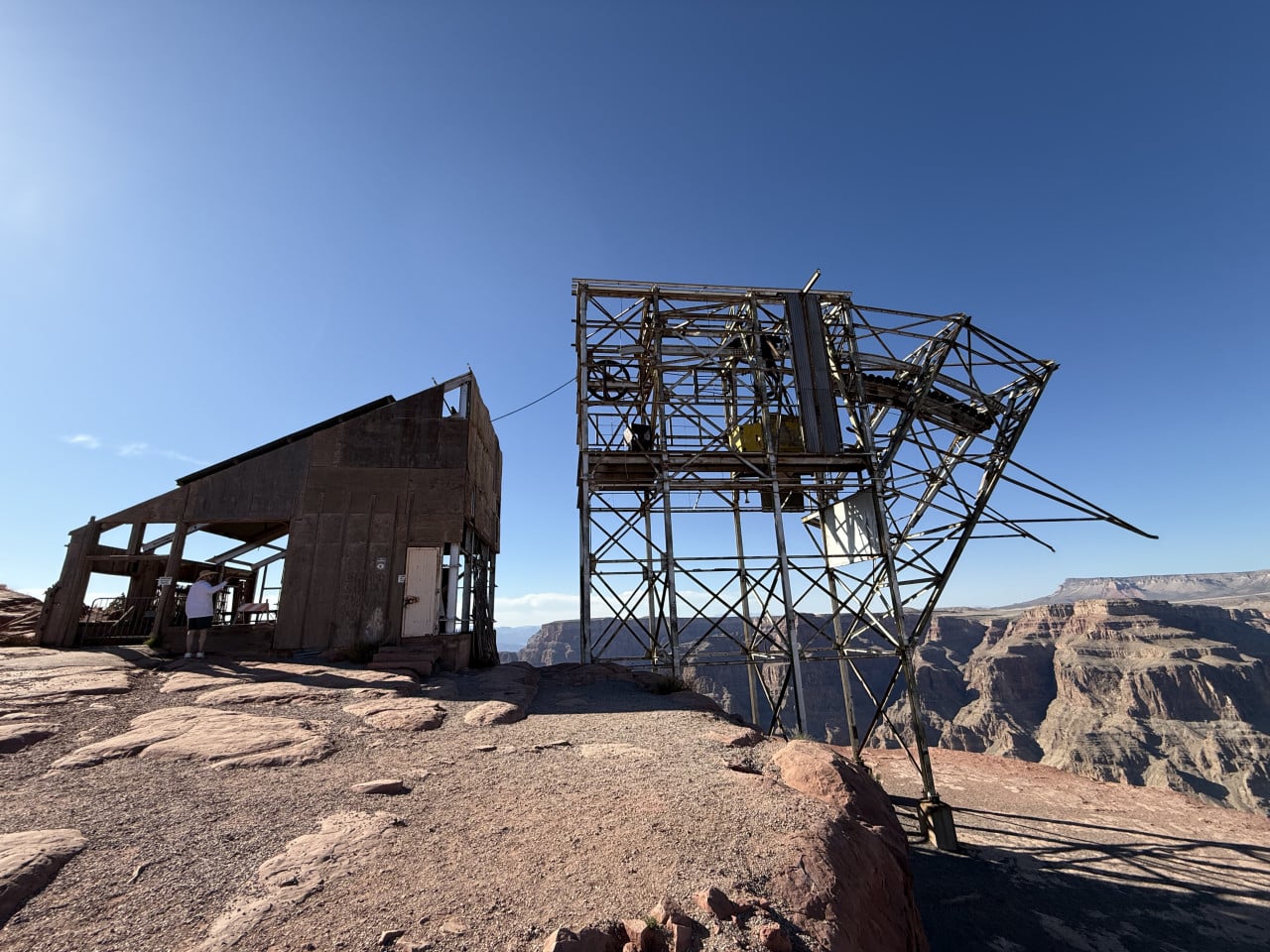
There was also something resembling the remains of an old mining station – part of the local history, as various minerals were mined around the Grand Canyon during the 19th and early 20th centuries. In the end, we enjoyed the walk around the Skywalk much more than the Skywalk itself. Here, you could breathe freely, photograph whatever you wanted, and truly appreciate the enormous chasm beneath you.
Incidentally, an interesting fact is that at Guano Point – another viewpoint at Grand Canyon West – there are remains of a cableway that was once used to transport bat guano (droppings) from a cave on the opposite side of the canyon. This natural fertilizer was mined in the 1940s and 1950s, and the cableway stretched across the entire width of the canyon.
In Conclusion – Is It Worth Visiting?
Of course, the South Rim was definitely better in my opinion – and my overall impression was simply that Grand Canyon West is worth seeing, like everything else around the Grand Canyon. But would I want to return there as I would to the South Rim? Probably not. There are no hiking routes, no trails – it is simply a purely commercial attraction where you pay for absolutely everything. A bus arrives, you walk across the Skywalk, and that is the end of it.
However, if you do not have time to drive to the South Rim (which is approximately 4.5 hours from Vegas by car), Grand Canyon West, at around 2 to 2.5 hours from Las Vegas, is definitely a more accessible alternative. And the walk along the cliff edge around Eagle Point – that is certainly worth it.