What if artificial intelligence could improve itself? A Chinese company called MiniMax has just taken the first step in this direction. Its new model, MiniMax M2.7, is not just another model in the M2 series. It not only helps users, but also itself.
A model that learns by itself
M2.7 is MiniMax's first AI model to contribute to its own evolution. During development, it was able to build and improve agentic structures and handle demanding tasks, including updating its own memory and developing skills for reinforcement learning.
If you are not sure what that means, put simply, the model succeeded in improving itself. During development, it independently completed more than 100 optimization cycles and achieved a 30% improvement in evaluations, without any human intervention! This does not mean that the model rewrote its code from scratch. Rather, it helped improve the environment in which it operated.
What can MiniMax M2.7 do?
MiniMax M2.7 was designed as a model for everyday professional use. This is reflected precisely in the areas where it excels. In some of them, it even achieves results one would expect from a much more expensive model.
-
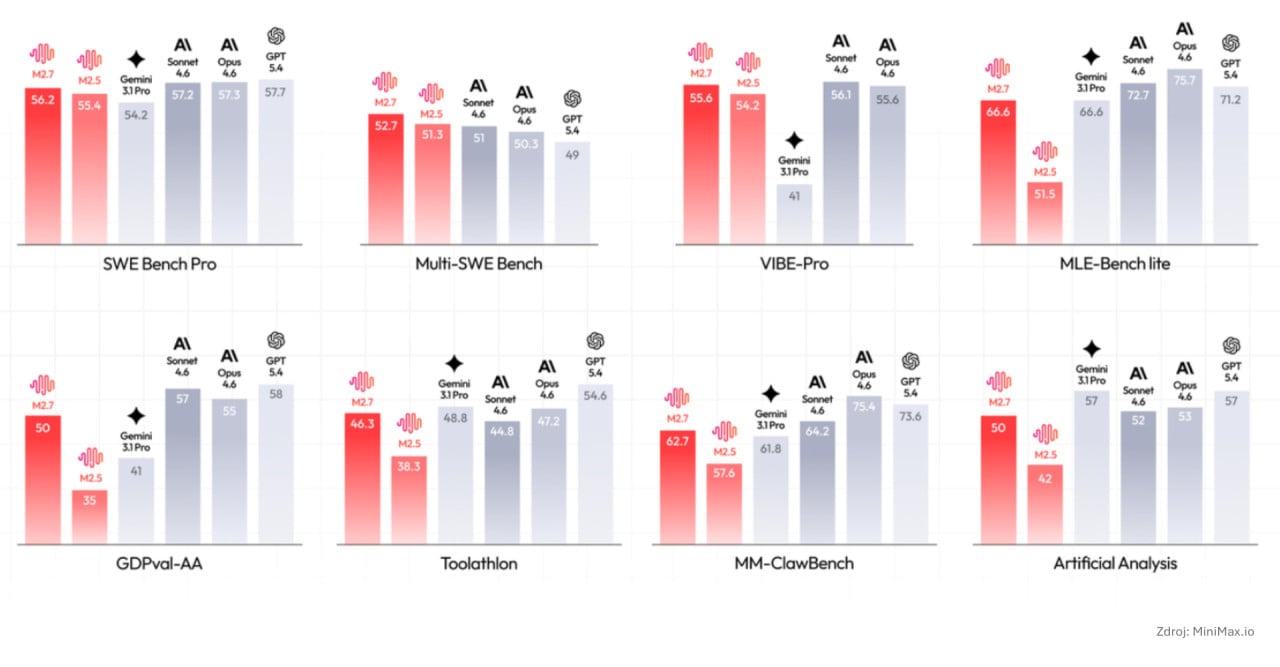
Programming and software engineering: On the SWE-Pro benchmark, which tests real-world programming tasks, M2.7 achieved a score of 56.22%, matching GPT-5.3-Codex. In the Multi-SWE Bench benchmark, its score of 52.7% even surpassed Claude Opus 4.6 at 50.3% and GPT-5.4 at 49%. It performs equally well in the end-to-end delivery of entire projects (VIBE-Pro 55.6%). M2.7 therefore keeps pace with the best. And in some areas, it even outperforms them.
-
Office tools: In the GDPval-AA benchmark, which evaluates real-world tasks in Excel, PowerPoint, and Word, M2.7 achieved the highest score among available open-source models. It handles complex, multi-step document editing tasks that challenge most models with 97% accuracy.
Fewer hallucinations: The M2.7 model achieves a lower hallucination rate of 34%. That is lower than Claude Sonnet 4.6 at 46% and Gemini 3.1 Pro Preview at 50%.
Why M2.7 is worth your attention
MiniMax M2.7 can undoubtedly be considered a capable competitor to popular Western AI models. Its greatest strengths undoubtedly include a good price-to-performance ratio, content generation, and skilled work in areas such as programming.
The only drawbacks may be its smaller context window or lack of multimodality. It is therefore better suited to smaller tasks than exceptionally large-scale data analysis. However, its benchmark results demonstrate that it is certainly a competitive model in terms of knowledge and skills.