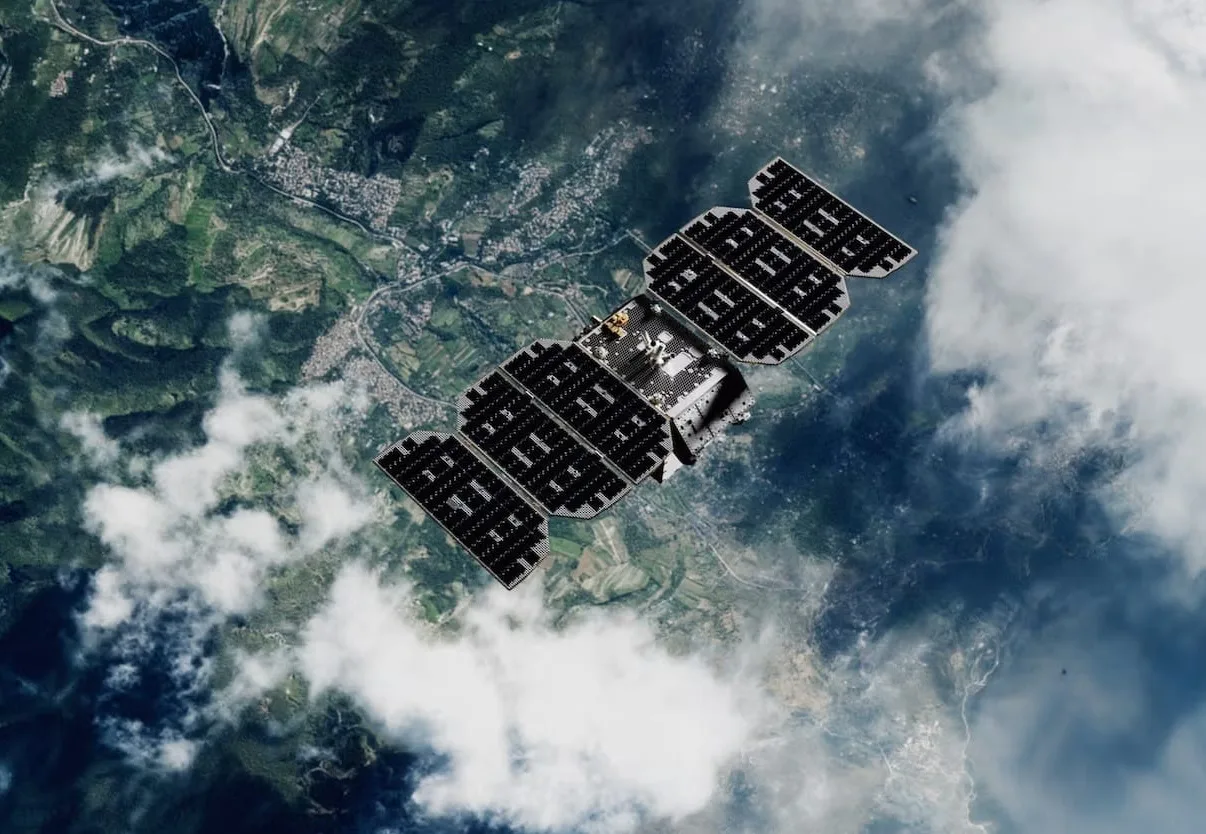
This week, Google engineers sent an unusual instruction into orbit. They asked the artificial intelligence running aboard their test satellite to write a haiku about what it is like to be in space. The satellite responded with three lines and sent them back to Earth. Behind this innocent bit of fun, however, lies a serious experiment. Google wants to find out whether large AI data centers could one day operate directly in space.
A satellite with AI chips
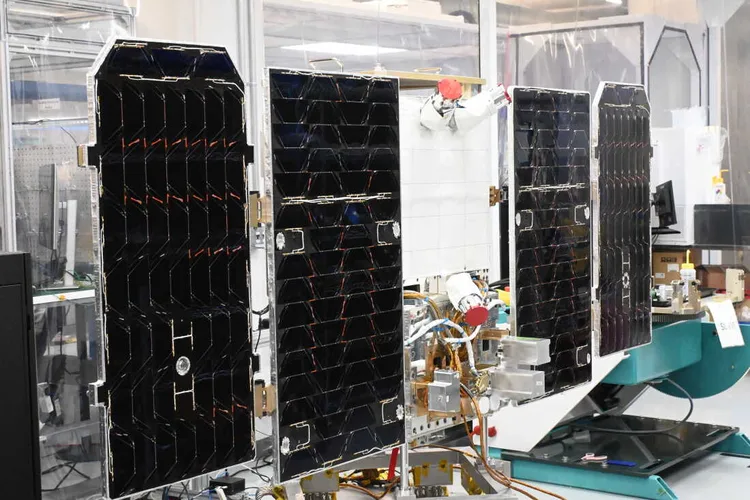
The spacecraft is part of the Suncatcher research project, through which Google is exploring what orbital computing centers might look like. It reached space in early October aboard a SpaceX Falcon 9 rocket, alongside more than one hundred other spacecraft and satellites. It was built by Planet Labs.
It carries four TPU chips on board. These are processors that Google designs specifically for artificial intelligence. While a standard computer processor handles everything from word processing to games, a TPU is built for one thing: the enormous volume of calculations that AI models need to operate. These chips power a large portion of Google’s services on Earth.
The satellite generates roughly one kilowatt of electricity. That is not much for such powerful chips, so the engineers can activate only one of the four processors at a time and let it run for about twenty minutes. After that, there is not enough power. This also complicates communication with Earth, which is challenging for satellites in itself because the spacecraft remains above a ground station for only a limited time.
A blue marble and starlight
The launch was followed by roughly three weeks of testing. Technicians gradually checked the satellite’s individual systems and verified that everything was working as planned. Only then was it time for the artificial intelligence.
They had preloaded Google DeepMind’s Gemma 4 model onto the satellite. It is an open model, meaning Google makes it freely available to other developers as well. During a window when the satellite was in contact with the ground station, the engineers sent it its first prompt. Loosely translated, its English response said that beneath it was a blue marble, data flowed in silent grace, and starlight fed its core.
It is hardly great poetry, and TechCrunch could not resist asking whether Google might have been better off sending a real poet into space. The model also had to produce several humorous space-themed rhymes. Another test, however, was more important. The engineers asked the satellite about the conditions in which it was operating in orbit, and it sent them data about its status. A Google spokesperson confirmed that the spacecraft was operating without any problems.
The entire experiment thus demonstrated that the satellite can receive an instruction from Earth, process it independently on board, and send the result back. That is exactly what a space-based data center will one day do on a large scale.
Space radiation and its effect on memory
Now comes the more demanding part of the testing. Google wants to find out how well its chips withstand extreme temperature fluctuations and, in particular, cosmic radiation.
High-energy particles are constantly traveling through space, while on Earth we are protected from them by the atmosphere and magnetic field. When such a particle strikes a chip, it can change a one into a zero in the computer’s memory, or vice versa. Experts call this a bit flip. The insidious part is that even standard monitoring tools often fail to detect such an error. The computer may then continue working with corrupted data without anyone knowing.
Google has previously tested its chips in particle accelerators on Earth, where radiation can be artificially simulated. The results indicated one important thing. In artificial intelligence, there are two types of work. The first is training, during which the model is still learning and processes enormous amounts of data for days or even weeks. The second is known as inference, which is when a completed model responds to queries, for example when you ask a chatbot a question. Laboratory tests showed that radiation has almost no effect on inference, while training could encounter difficulties. This makes sense because a single error during training can subtly propagate throughout the entire model. Google will now verify these assumptions in actual space rather than in a simulation.
Satellites connected by lasers
If the chips perform well, Google will launch two more satellites in 2027. They are expected to generate more power and, most importantly, exchange data using light, meaning a direct optical link between the satellites.
This is where Google differs from the others. Its vision involves a swarm of satellites flying close together and dividing the work among themselves through high-speed connections, as though they were a single large computer. Data centers on Earth work in a similar way, with thousands of chips collaborating on a single task. Although SpaceX also plans to use laser links for its space-based data centers, its satellites are expected to orbit too far apart to divide computational tasks efficiently. Companies such as Starcloud and Cowboy Space, meanwhile, want each satellite to process AI queries independently.
It will not work without Starship
Turning the experiment into a real space-based data center will require putting an enormous amount of equipment into orbit at low cost. Google and SpaceX are therefore relying on Starship, Elon Musk’s giant rocket, which is still under development. It must become fully and rapidly reusable, otherwise the entire concept will not be financially viable.
This October, researchers from the Suncatcher project published a peer-reviewed analysis. They calculated that Starship would need to fly roughly 1,800 times for SpaceX to achieve cost reductions comparable to those gained through experience with its earlier rockets. Google therefore views its project as a long-term experiment. It is designing the infrastructure to become economically viable only in the 2030s.
Google’s and SpaceX’s projects are also financially connected. Alphabet, Google’s parent company, owns a significant stake in SpaceX. Whether Google will have the patience for such long-term projects, however, may depend on how successful it is with artificial intelligence today. Alphabet shares fell sharply this week after the company acknowledged that integrating AI into search is slowing the growth of advertising revenue.
Source: interestingengineering.com