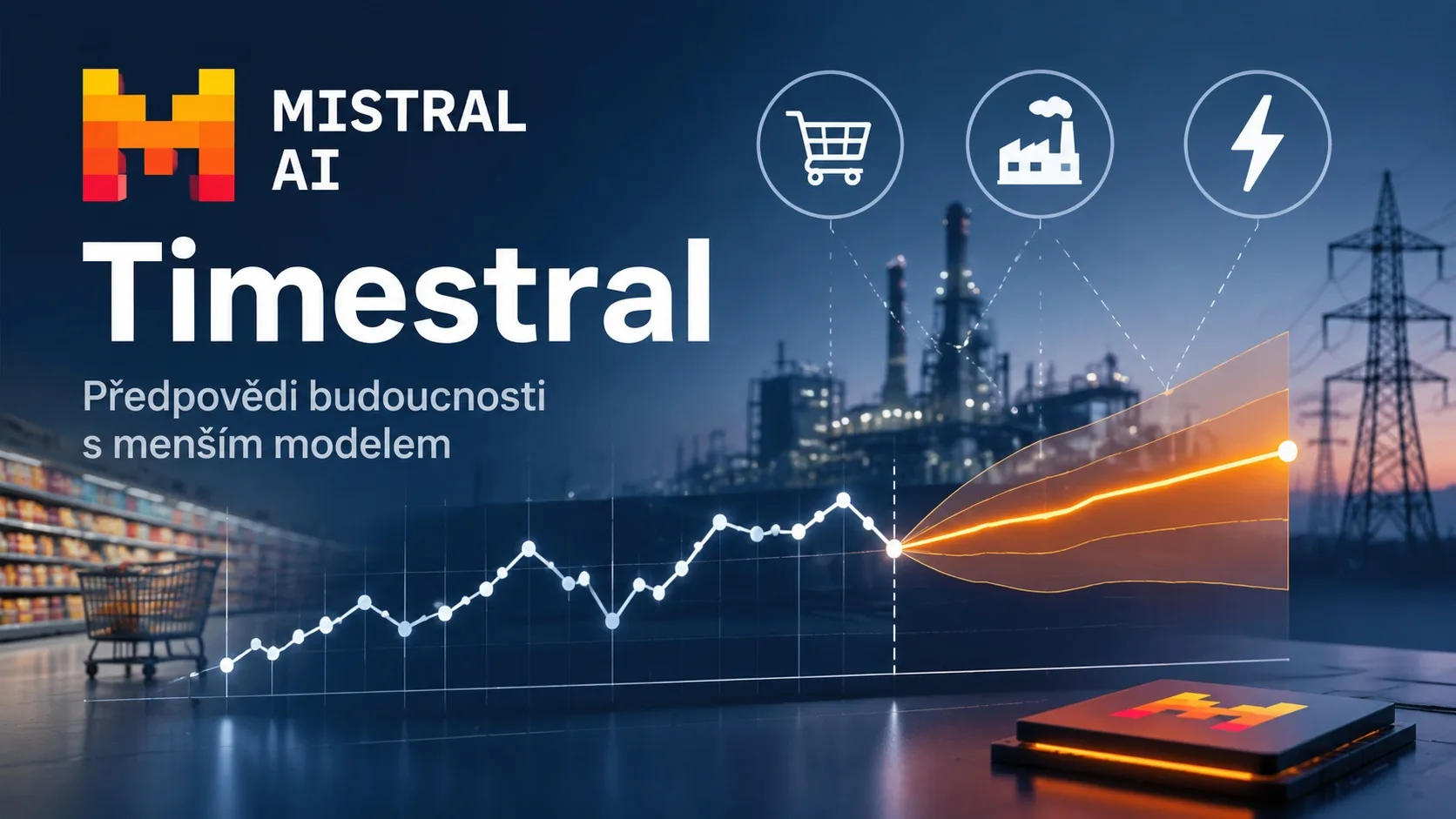
In mid-October, French company Mistral AI released Timestral, its first family of artificial intelligence models. These models do not generate text, but use historical numerical data to forecast future developments. This could include retail sales, electricity consumption, or the temperature of a pump in a factory. The largest version has only 209 million parameters, yet according to its creators, it ranked first in all three major public forecasting accuracy benchmarks.
A chatbot alone is no longer enough for forecasting
Companies work with so-called time series every day. These are numbers recorded at regular intervals, such as daily revenue, hourly electricity consumption, or sensor readings. They inform decisions about ordering goods, maintaining machinery, or purchasing energy.
Established statistical methods, such as ARIMA, are usually configured separately for each series and learn only from its own history. Deep learning models can identify more complex patterns across many series, but they are generally trained from scratch for each dataset and do not transfer what they have learned to another field. For thousands of products or machines, this means a great deal of work. Large language models do not help in this case because they have learned to predict the next word, not specific numbers.
Timestral brings the principle behind language models into the world of numbers. It first learns general patterns from a vast amount of diverse data and then applies them without further training to data it has never seen before. Mistral claims this works even in fields where data is scarce.
For example, a retailer may be planning inventory for the next month. A developer uploads the history of daily sales to the model and requests a 30-day forecast. They can also add contextual data, such as past promotional campaigns or holidays during the forecast period. The model does not return a single number, but 21 estimates ranging from pessimistic to optimistic. The inventory system can then use a higher estimate to ensure it is prepared for stronger demand.
A small model outperformed larger competitors
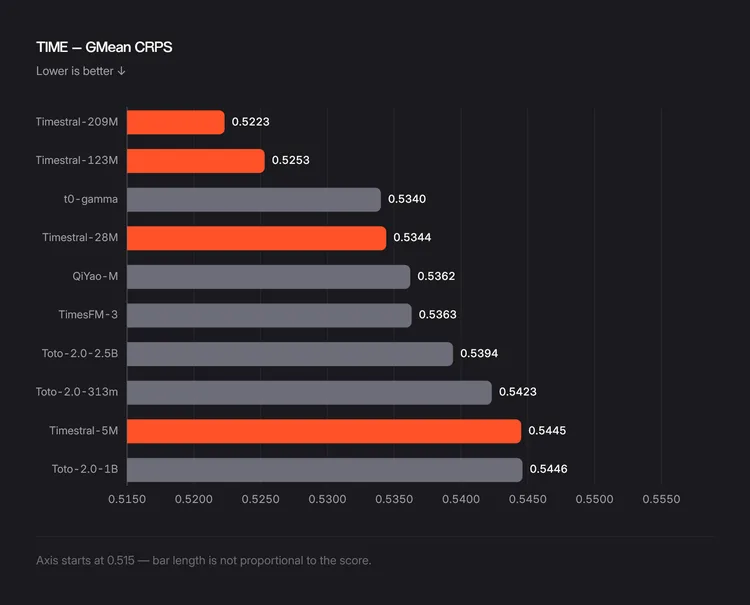
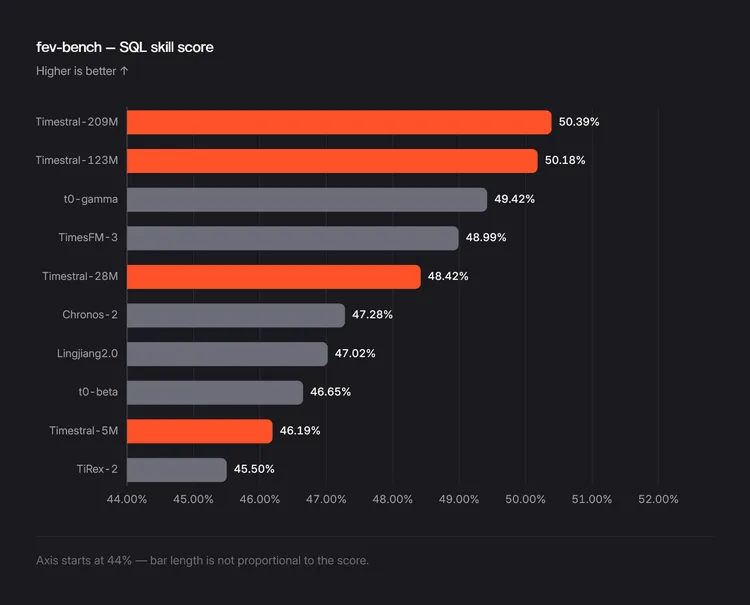
In the GIFT-Eval, TIME, and fev-bench tests, Timestral ranked first among pretrained models across all five evaluated metrics. It outperformed the previous leader with two-thirds as many parameters, using a single model version without combining multiple models.
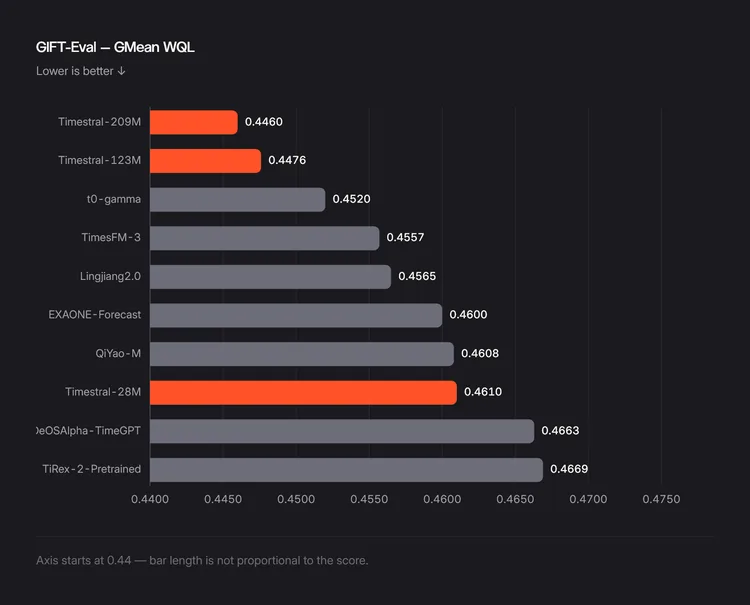
Timestral comes in four sizes, with 5, 28, 123, and 209 million parameters. Larger versions forecast more accurately, while smaller ones are faster and less expensive. According to Mistral, no publicly available model of the same size makes better forecasts. The version with 28 million parameters outperformed the roughly four-times-larger Chronos-2 in the GIFT-Eval and TIME tests, while the largest version surpassed both TimesFM-3 and Falcon-2.0 despite having fewer parameters.
The model does not require a powerful graphics card. On a standard server processor with eight threads, forecasting one day ahead from three weeks of data recorded at fifteen-minute intervals takes the smallest version 17 milliseconds and the largest 113 milliseconds. The version with 123 million parameters trails the largest by only 0.2 percent and uses about three-quarters of its processing time.
Timestral is based on the same architecture as language models, known as a transformer. Instead of words, however, it processes chunks of 32 numerical values and can examine up to 32,768 time steps at once.
During training, older models hide the values they are supposed to predict. These then appear as missing data and are also lost as context for subsequent forecasts. Timestral keeps the entire history in place and adds special elements representing future values. Each measured number therefore serves as both a target and context, while actual gaps in the data remain marked.
Each input series is assigned a role. It is either the value being forecast, a variable known only from the past, or a variable also known in advance, such as a holiday calendar or weather forecast. Information flows only from the contextual data to the forecast values, so the model cannot peek into its own future.
Most of the training data consisted of artificially generated numbers with trends, seasonal fluctuations, and noise, among which Mistral also created more complex interrelationships. In the first phase, the model learned only from artificial data; in the second, it learned from a combination of real and artificial data with a four-times-longer historical window.
Timestral and the factory
Mistral demonstrates the model at an industrial plant with thousands of sensors. The vibration, temperature, and pressure of a pump are interrelated, so Timestral monitors them together. It can also handle non-numerical data, such as the day of the week or machine status, and accounts for factors known in advance, such as production schedules or planned shutdowns. It will therefore not interpret a scheduled increase in load as a problem.
The model can run in monitoring systems and continuously track sensor data. When it detects suspicious pump behavior, a software agent built on a language model takes over. It looks up similar past failures, has other agents review maintenance records, shift logs, manuals, and data from related machines, and produces a proposed diagnosis with supporting evidence and next steps. Instead of receiving only an alarm, the plant manager gets an explanation and a plan.
A different model for every task
Timestral is part of the trend toward specialized models. TabPFN fills in values in tables and has outperformed conventional machine learning methods in experiments. Kumo Relational works with interconnected databases of customers, orders, and products, and outperformed benchmark models in 41 tasks across 15 databases. Depending on the state of an application, Jev selects from predefined decisions and classifies records.
Until now, adding forecasts to an application meant collecting and preparing data, training a custom model, and maintaining it. An agent searching for products at risk of selling out could now divide the work. Timestral would estimate demand, TabPFN the risk of selling out, Kumo Relational supplier delays, and Jev would classify the results into routine monitoring and cases requiring human attention. A language model would bring everything together and flag decisions that require approval.
However, these models still require clean data, independent testing, and continuous monitoring. They are not always faster or less expensive than traditional tools such as XGBoost or CatBoost; their main advantage is the development work they save.
Availability and customization
A specific company's data may behave differently from the data used in benchmarks and may change over time. Companies can therefore fine-tune Timestral on their own data using Mistral Forge, add their own contextual data, or generate artificial data resembling that of their industry. The entire solution can be run on the company's own servers, including in environments completely disconnected from the internet.
The model is available to try on GitHub under a modified MIT license. Mistral promises to publish a detailed technical report with complete results at a later date.