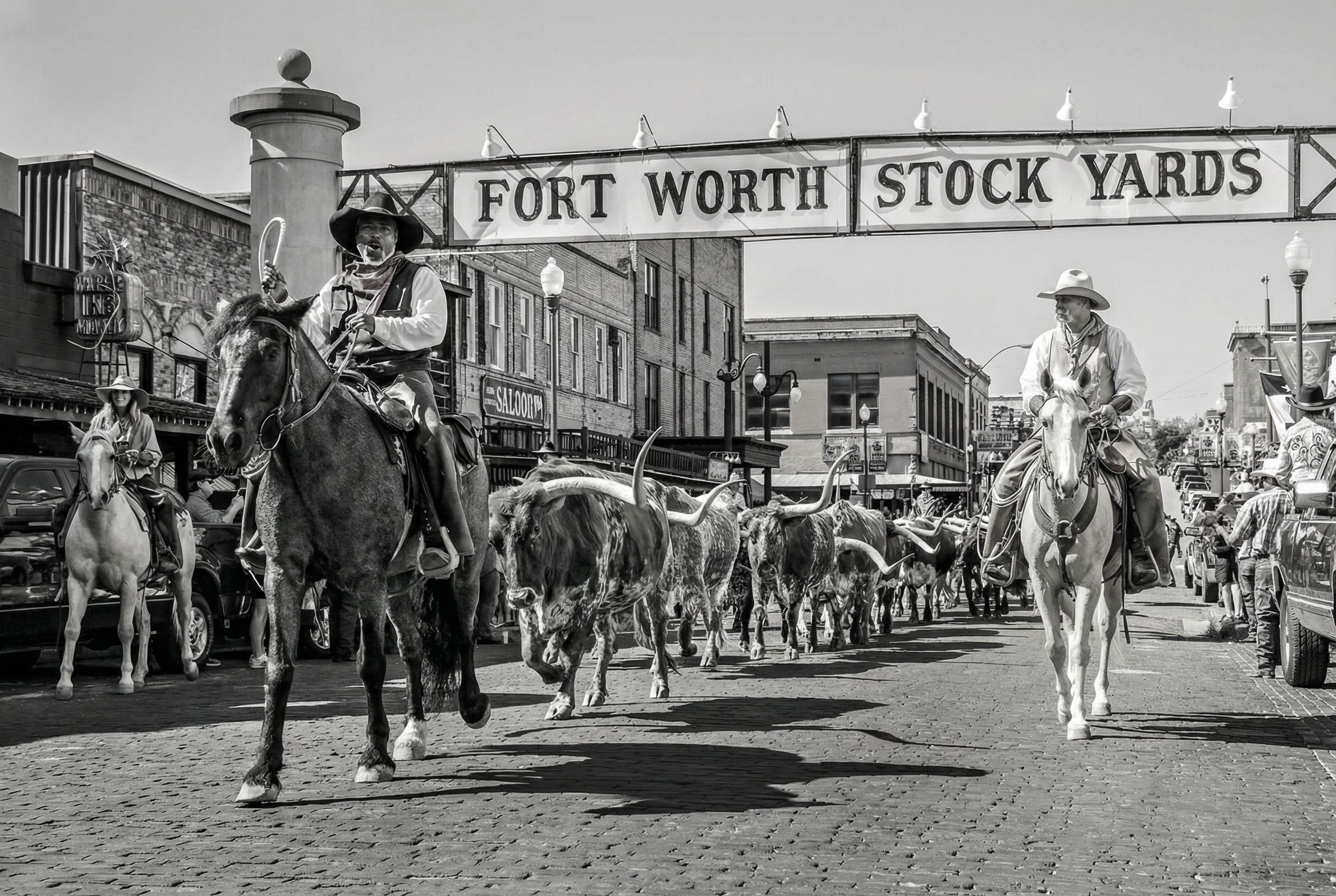
The Fort Worth Stockyards boasts a distinction that few once-prosperous livestock markets can claim: it created a city. Yes, Fort Worth began as a small fort in 1849, but the army moved out four years later, and the little settlement fell into decline. It was not until cattle began moving north from South Texas nearly two decades later that this small community of about 20 log cabins found its purpose. Two local grocery stores anticipated the large herds passing along a route first known as the Great Trail or Texas Trail, before the name Chisholm Trail eventually became established.
Prominent men, including Khleber Van Zandt, worked hard to bring a railroad, meatpacking plant, and livestock market to the city. By the beginning of the 20th century, as many as 10 railroads converged in Fort Worth, bringing cattle, calves, hogs, sheep, horses, and mules to market at the Fort Worth Stockyards on the city's north side.
Hard work—and an offer that each would own one-third of the stockyards—persuaded meatpackers Philip Armour and Gustavus Swift to build modern slaughtering facilities in Fort Worth in 1902.
The promotional efforts of the stockyards' publicity director, Charles C. French, contributed significantly to increased revenues. French traveled across Texas by train and carriage, visiting farming and ranching regions and promoting the livestock show. The show itself began at the stockyards in 1896 with the participation of the North Texas Cattle Raisers Association, later renamed the Texas and Southwestern Cattle Raisers Association. French also visited farming families and persuaded fathers to help their children join calf clubs, pig clubs, and similar forerunners of the 4-H movement, so they could raise animals and sell them at the Fort Worth Stockyards.
By 1915, as World War I raged in Europe, soldiers in the uniforms of as many as 15 countries could be seen buying horses and mules for their armies and for food. The Fort Worth Stockyards became the largest horse and mule market in the country, which at the time also meant it was the largest in the world. In 1917, a total of 3.5 million animals of all kinds arrived. Business slowed during the Great Depression, but the company did not lay off workers; it merely reduced their working hours. By the 1940s, the country was engulfed in World War II, and the stockyards were ready to serve the needs of the war effort. In 1944, the stockyards received more than two million sheep and became the largest sheep market in the world. A record 5.25 million animals arrived that year; the record still stands.
After the war, livestock marketing began to change, and local auctions spread to rural towns. By the 1950s, feedlots had become a growing phenomenon, especially in Texas. Meatpackers began buying directly from feedlots, bypassing the large stockyards. Markets across the country began losing sales. They tried to reverse the trend but were unsuccessful. By the 1970s, even the large markets in Chicago and Kansas City began to close. Fort Worth held on until 1992.
As early as the mid-1970s, people on Fort Worth's north side recognized the stockyards' value to the area and wanted to preserve the buildings even if actual livestock sales came to an end. Fortunately, civic- and history-minded people such as Holt Hickman, Steve Murrin, Joe Dulle, and others bought properties and established businesses in the area. Thanks to the efforts of Charlie and Sue McCafferty and like-minded people, the North Fort Worth Historical Society was founded in 1976 to preserve the area's history. From a small office in the southeast corner of Cowtown Coliseum, volunteers welcomed the first trickle of tourists who began to arrive. Congressman Jim Wright helped secure grants to restore the stockyards area. New businesses opened, including Billy Bob's Texas, “the world's largest honky-tonk,” proving that everything is bigger in Texas.
All their combined efforts produced the remarkable results people still see today when they visit the Fort Worth Stockyards National Historic District. Locals enjoy special events, and tourists rank it among their favorite destinations.