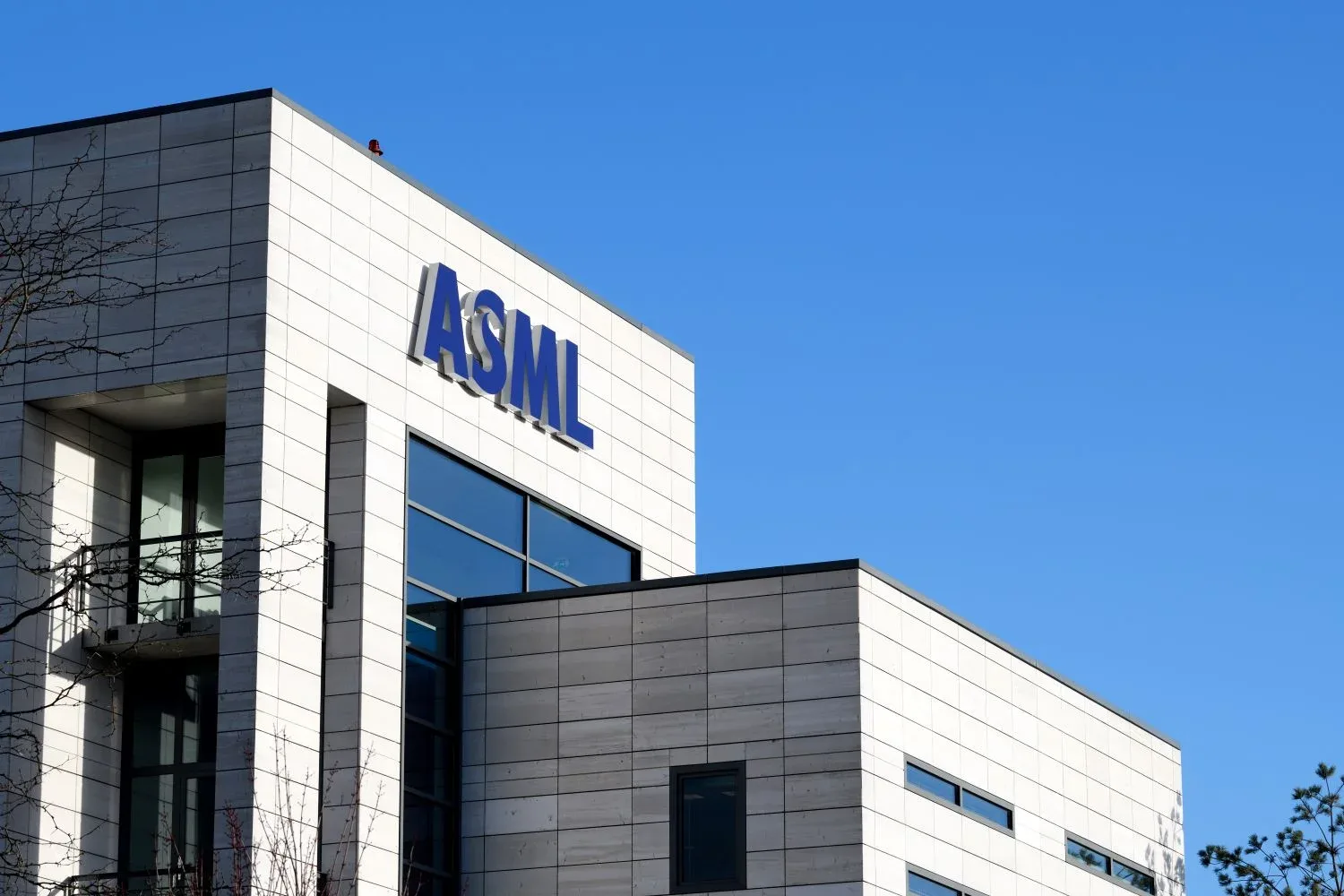
Dutch company ASML makes machines without which the most powerful artificial intelligence chips cannot be produced. It has now announced record results, but also admitted that it cannot keep up. Customers are demanding more equipment than it can assemble over the next two years, and some are already trying to reserve machines for 2029 and 2030. The reason is that the whole world is building data centers for artificial intelligence, and they require enormous amounts of hardware.
The company without which AI chips cannot be made
A chip is a small silicon wafer containing billions of tiny components. These are etched onto it using light, much like photographs were once developed. The finer the pattern, the more powerful the chip. The finest circuits require a special machine that uses extreme ultraviolet radiation, abbreviated as EUV. Only one company in the world produces these machines: ASML.
Its customers include the world's largest technology companies. They include Taiwan's TSMC, which manufactures chips for Nvidia, as well as Samsung, Intel, and memory producers SK hynix and Micron. Whenever any of these corporations decides to build a new factory, it must first order the technology from the Netherlands. That is why the entire technology industry views ASML's financial results as a barometer of the strength of the artificial intelligence boom.
Customers want more and more
ASML CEO Christophe Fouquet said that customers are constantly raising their estimates of their future need for machines. The main reason is that they expect large and long-term investments in artificial intelligence. The company is already receiving orders for 2028, and some prospective customers are even asking about deliveries in 2029 and 2030.
Fouquet also explained the broad-based growth in demand. According to him, manufacturing AI chips requires both memory and computing processors. It is therefore not enough for processor manufacturers alone to expand capacity; factories producing memory components must also increase their output.
His statement from last week illustrates how quickly the situation in the industry has changed. Until recently, manufacturers had expected the market to stagnate, but according to Fouquet, they are now unable to keep up with demand. ASML's CEO estimates that spending on artificial intelligence infrastructure will continue to drive demand for chips for another two to five years.
Even 30 percent more machines will not be enough
ASML responded to rising demand as early as the summer. It pledged to produce 30 percent more EUV systems in 2027 than this year, when it will complete approximately 65. It also plans to increase production of older and less expensive DUV equipment, which is used for less demanding parts of semiconductors. It will deliver about 130 of these this year. The company was considering a further 30 percent increase for 2028.
It is now clear that even this will not be enough. ASML expects that it will be unable to meet demand from all customers in 2027 and 2028. It is therefore looking for a way to increase production even more significantly in 2028. However, only the increase for 2027 has been firmly committed so far; the company is still calculating its plans for the following year.
ASML wants to produce the higher volume primarily at its existing facilities. It is not planning an entirely new manufacturing site until the period after 2028. It is also helping customers in other ways by upgrading the equipment they already have in their factories so that it can produce more chips.
Record revenue
The enormous demand is clearly reflected in the company's financial performance. In the summer quarter, the company generated record revenue of nearly 12 billion euros and posted a net profit of 5 billion. However, about half a billion euros of this amount did not come from technology sales. It was a gain from the increased value of ASML's stake in French artificial intelligence company Mistral AI. The number of new machines sold rose to 113, compared with 86 in the previous quarter.
Forecasts for the end of the year are even more optimistic. The company expects revenue of between 14 and 15 billion euros in the final quarter, exceeding analysts' forecasts. For the full year, it expects revenue of 44 to 45 billion euros.
When machines are scarce, the supplier calls the shots
For chipmakers, the equipment shortage has a clear consequence. Anyone who does not receive an EUV system from ASML has no alternative, because no other company makes one. Customers therefore have to wait longer, and the Dutch supplier has more power to dictate prices. Management admitted back in July that it had greater flexibility in setting them than before.
However, not everything is going smoothly for ASML. China could pose difficulties, as it was expected to account for roughly one-fifth of revenue this year and exports there are restricted by both U.S. and European export regulations. The company is also dependent on a small number of major customers. The memory market also requires caution, as periods of massive purchasing regularly alternate with downturns. Sales of technology used in memory production were expected to rise by more than 75 percent this year, and if demand suddenly declines, ASML could be expanding capacity just as demand is falling. Moreover, interest in deliveries for 2029 and 2030 has not yet translated into actual orders.
Shares and market reaction
ASML shares have gained more than 60 percent since the beginning of the year, but have lost over 6 percent in the past week. A day before the results were published, shares of other corporations that supply equipment to semiconductor factories also declined. U.S.-based Applied Materials fell nearly 7 percent, while Lam Research and KLA lost about 3 percent. According to analysts, Applied Materials' decline was mainly due to investors taking profits after the stock's 80 percent rise this year.
ASML is also returning capital to its shareholders. During the quarter, it repurchased approximately 4 billion euros of its own shares and will pay a dividend of 1.88 euros per share. The next important date will be June 10, 2027, when the company is expected to present its final production plan for 2028 at an investor meeting.
Sources: cnbc.com and reuters.com