

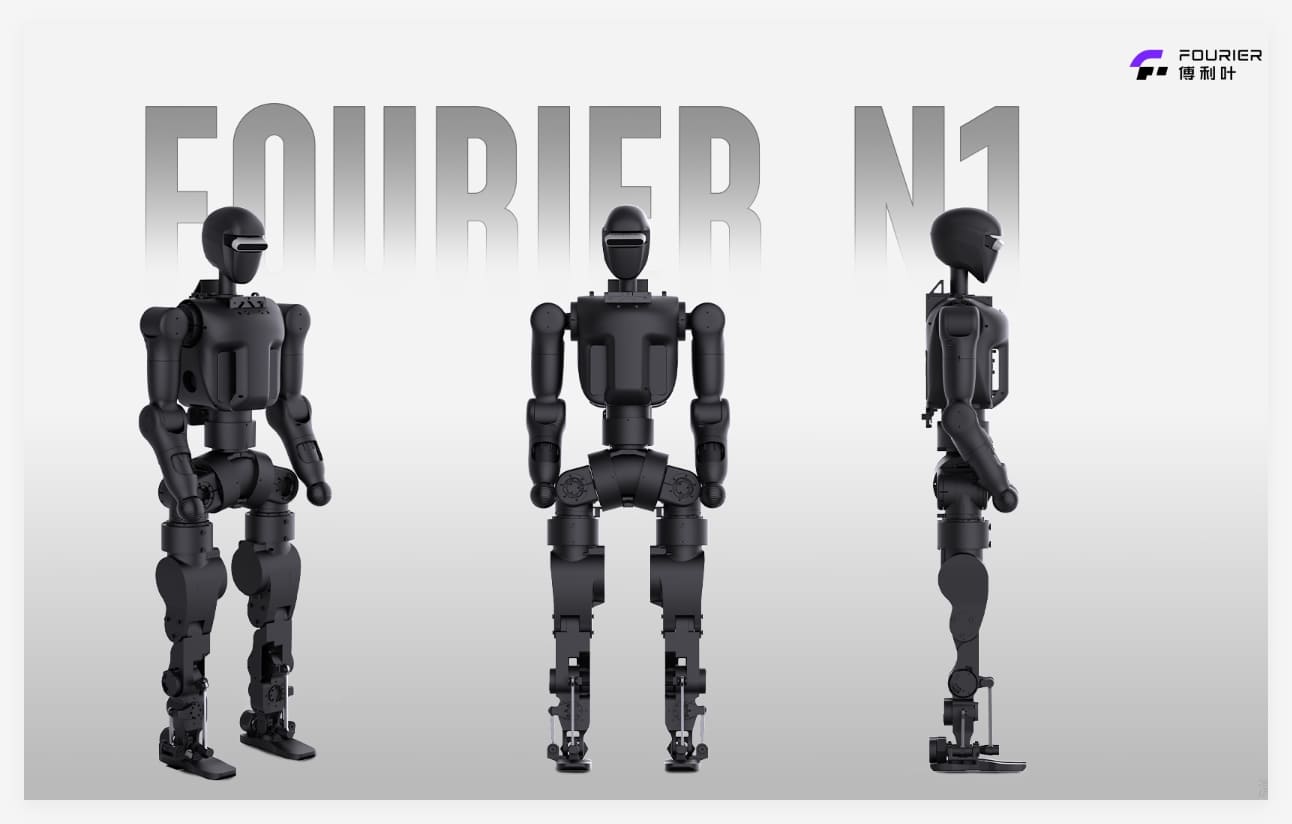
The world's first open-source humanoid robot is changing the rules of the game
In April 2025, events took place that could change the world of robotics forever. The Shanghai-based company Fourier Intelligence introduced N1, the world's first fully open-source humanoid robot. This step could make the development of advanced androids significantly more accessible and accelerate innovation through global collaboration.
What makes N1 so significant?
While most major technology companies carefully guard their technologies behind a wall of patents and trade secrets, Fourier Intelligence has decided to take the exact opposite approach. The company has made complete plans available, including a list of all materials, structural drawings, assembly instructions, basic control systems and the source code for the operating software. As a result, anyone—from students and enthusiasts to small companies—can build and modify their own humanoid robot. "We hope to attract more participants to jointly create the ecosystem by reducing technical barriers," said Cai Yusheng, director of research and development at Fourier Intelligence. This strategy enables not only large corporations but also ordinary innovators to actively participate in the research and development of humanoid robots.
Technical specifications worth noting
N1 is not just a concept model, but a fully functional humanoid robot with impressive specifications:
- Height: 1.3 meters
- Weight: 38 kilograms
- Construction: Lightweight frame made of aluminum alloy and composite engineering plastics
- Joint system: 23 degrees of freedom ensuring high agility and flexibility
- Battery life: More than two hours of continuous operation on a single charge
- Maximum running speed: up to 3.5 meters per second
The robot is equipped with its own integrated FSA2.0 actuator and a proprietary control system developed directly by Fourier, ensuring increased movement stability and resistance to impacts.
Fourier Intelligence: A pioneer in robotic rehabilitation
Fourier Intelligence is no newcomer to the robotics industry. The company was founded in 2015 in Shanghai and originally focused on rehabilitation robotics. Over the past decade, it has established a strong position as a leading developer of exoskeletons and rehabilitation devices used in hospitals and rehabilitation centers around the world. The company secured substantial investment, enabling it to expand its focus from purely medical robotics into the field of humanoid robots. Its experience developing precise motor systems for rehabilitation purposes has proved invaluable in designing N1's natural movements and stability. Zengcheng Gu, founder and CEO of Fourier Intelligence, said in an interview: "Our journey began with rehabilitation robots that help people regain mobility. Now we are ready to bring robotics into everyday life in ways we previously could not have imagined."
What makes Fourier Intelligence's strategy particularly interesting is its gradual approach to open sharing. While the basic hardware and software are already freely available, the company plans to gradually release more advanced modules, such as systems for full-body motion control and multi-task coordination. This approach resembles strategies from open-source software communities such as Linux or Android, where the basic system is freely available and a community of developers and companies builds upon it. Fourier Intelligence is thus creating the conditions for a vibrant ecosystem around the development of humanoid robots. Modularity is also reflected in N1's construction itself. Individual components can be easily replaced or upgraded, allowing experimentation without the need to replace the entire robot. For developers, educational institutions and small companies, this means a significant reduction in development and testing costs.
Impact on industry and expert expectations
The year 2025 is shaping up to be a turning point for humanoid robotics worldwide. While companies such as Tesla (with their Optimus model) and Boston Dynamics have announced plans for mass production, most competitors remain closed or provide only limited access to their technologies. "Fourier N1 could be remembered as the moment when humanoid robotics moved from the exclusive domain of well-funded corporations to a truly collaborative effort involving thousands of minds around the world," said one leading robotics expert. An open ecosystem reduces the costs of hardware production and software development while simultaneously accelerating progress through shared knowledge among independent developers from around the world. This approach could lead not only to faster technological progress but also to broader practical use in homes, schools, research laboratories and healthcare facilities.
Practical applications and future potential
Although N1 is primarily intended for developers and enthusiasts, its potential applications extend much further. Possible uses include:
- Education: Robotics and programming in schools and universities.
- Research: A platform for testing new artificial intelligence algorithms.
- Home assistance: Basic household tasks and assistance for seniors.
- Retail and services: Interaction with customers in shops or at reception desks.
- Industry: Light assembly work and inspections in hazardous environments.
"Unlike proprietary solutions, which usually target specific uses, the open-source approach allows the community to discover unexpected applications," explains Fourier Intelligence's technical director. "We expect to see N1 used in ways we could not even have predicted."
Further development
Despite all the promises of an open ecosystem, N1 will face challenges. Safety is the primary concern, especially if humanoid robots are to become a common part of our environment. Open-source code could potentially lead to security risks if it is not properly monitored and maintained. There are also ethical questions concerning artificial intelligence in humanoid bodies and their interaction with humans. Fourier Intelligence emphasizes that it is creating only a platform and that responsibility for the ethical use of the technology also lies with the developer community.
By opening up its designs and source code, Fourier Intelligence is potentially changing the dynamics of the entire industry. Instead of several closed ecosystems controlled by large corporations, we could witness the emergence of a global community working together to improve humanoid robots. At a time when technology companies are competing to create the most advanced humanoid robot, Fourier Intelligence has chosen a path that could accelerate progress exponentially. As one commentator put it: "Open-source software changed the world of software. Open-source hardware could change the world of robotics in the same way." For the Czech Republic, which has a strong tradition in industrial automation and a growing technology startup sector, N1 represents an interesting opportunity. Czech companies and research institutions can now experiment with advanced humanoid robotics without the enormous initial investments that were previously required. As the ecosystem around N1 develops, we will watch with anticipation to see whether it truly fulfills its potential to become the "Android" of the robotics world—an open platform that democratizes access to advanced technologies and accelerates innovation for everyone.


