


MIT presents a “periodic table” of machine learning that could accelerate discoveries in artificial intelligence
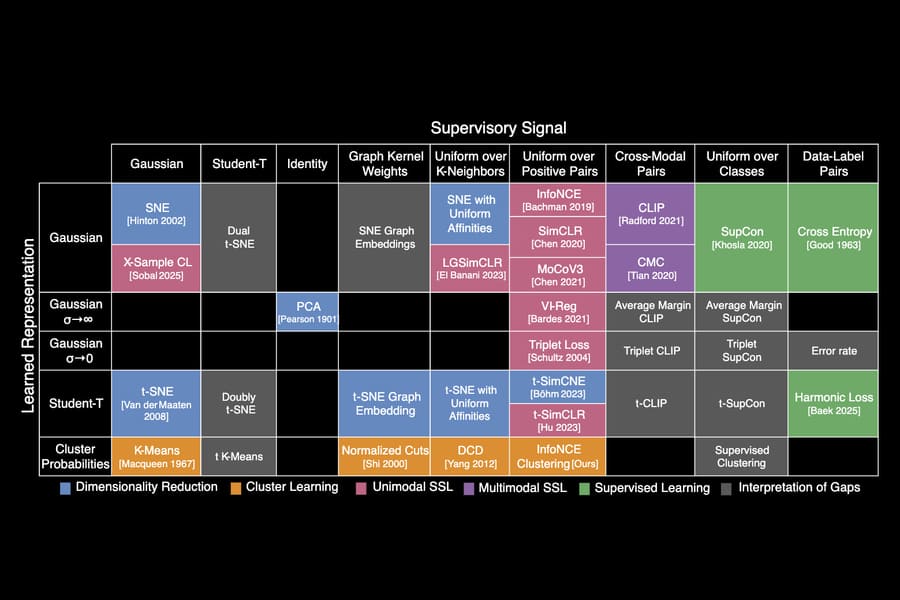
Researchers from the prestigious Massachusetts Institute of Technology (MIT) recently unveiled a groundbreaking concept that could change the way we understand and develop machine learning algorithms—the so-called “periodic table of machine learning,” which represents a comprehensive framework systematically organizing and connecting more than 20 classical machine learning algorithms based on the relationships learned between data points. This innovative framework, called Information Contrastive Learning (I-Con), offers a unified mathematical perspective that could significantly accelerate the discovery and design of new artificial intelligence models, while its arrangement strongly resembles Mendeleev’s periodic table of elements, which has served chemists as a fundamental organizing principle for more than a century.
A unifying mathematical perspective on algorithms
The key benefit of the I-Con framework is its ability to reveal that many popular machine learning algorithms—including classification, regression, clustering, dimensionality reduction, large language models, and spectral graph theory—are essentially variations on a single mathematical theme: learning relationships between data points. This finding provides researchers with an entirely new perspective on seemingly unrelated methods that were developed independently over the past hundred years of machine learning research. “We showed that a single very elegant equation... gives you rich algorithms encompassing 100 years of machine learning research, opening up many new avenues for discovery,” said the MIT researchers led by lead researcher Hamilton, emphasizing the mathematical simplicity hidden behind the apparent complexity of diverse approaches.
Revealing “empty spaces” and predicting new algorithms
Just as the chemical periodic table was able to predict undiscovered elements by pointing out gaps in its systematic arrangement, this “periodic table” of machine learning identifies “empty spaces” where new algorithms should exist but have not yet been developed. These gaps represent specific directions for future research and algorithms waiting to be discovered, which could significantly accelerate innovation in this rapidly developing field. The flexibility of this framework allows new rows and columns to be added as additional types of data relationships are studied or new algorithmic strategies emerge, ensuring that the framework remains relevant as the field continues to evolve and can reflect new discoveries without the need for fundamental restructuring of the entire system.
Immediate practical benefits and advances
The value of this unifying approach has already been demonstrated in practice—by combining elements from various existing algorithms using this framework, MIT researchers created a new algorithm for image classification that outperformed state-of-the-art methods by a remarkable 8%, representing a significant leap in a field where even a one-percent improvement can have far-reaching consequences. The fundamental principle of the I-Con framework lies in a single elegant equation rooted in information theory, which reformulates diverse algorithms as different ways of approximating the true relationships between data points while minimizing errors. Researchers often use an analogy involving clustering at a party: each guest (data point) wants to sit with friends (similar data points), thereby creating clusters based on their mutual relationships—this metaphor clearly illustrates how these diverse approaches can be understood through relationship approximation.
Significance for future artificial intelligence research
This unifying approach simplifies the way scientists can combine ideas from diverse methods without rediscovering existing concepts or overlooking potential innovations hidden among established techniques. As Yair Weiss of the Hebrew University notes: “Work that unifies and connects existing algorithms is highly significant... I-Con provides an excellent example... and hopefully inspires others to apply similar approaches.” By providing both clarity amid the overwhelming volume of annual publications and concrete tools for innovation (such as predicting missing algorithms), MIT’s “periodic table” of machine learning stands poised to stimulate rapid progress across the field of artificial intelligence, while potentially having a fundamental impact on the direction of research in the coming years.
This initiative represents not only a theoretical framework but also a practical tool that provides researchers with an organized map for navigating existing methods while simultaneously outlining paths toward future discoveries in artificial intelligence, which could lead to entirely new algorithms and approaches that might otherwise remain undiscovered.


