Fort Worth rarely stood at the forefront of efforts to advance women’s rights. The men who governed the city took a distinctly patriarchal view of women in the judicial system. The only roles in which women appeared in the courtroom were those of defendant or witness. Women were such rare visitors to the courthouse that no rest room was provided for them until 1917, and then, of course, it was in the basement. In this respect, Tarrant County was ahead of the legislators, who mandated ladies’ rest rooms in courthouses two years later. The United Daughters of the Confederacy, an auxiliary organization of the Confederate veterans’ association, helped establish the ladies’ rest room in the Tarrant County Courthouse. The women persuaded their husbands, who arranged the matter. That was how things worked then. This first rest room was far from being a fully equipped toilet; it had no toilet facilities. If a woman needed to use the toilet, she had to leave the courthouse. It was literally a room for resting, where she presumably relaxed while her husband attended to business at the courthouse. The room was furnished with couches and ice water, and perhaps also a matron who maintained order.
It goes without saying that if women were regarded as an unwelcome presence in the courthouse, no one expected them to spend much time there. This also applied to jury service. Texas law prohibited women from serving on juries until 1954. The ban was unsuccessfully challenged after women gained the right to vote in 1920 through the Nineteenth Amendment to the Constitution. Amon Carter’s Star-Telegram did not support the amendment. In a 1920 editorial, the newspaper wrote that a female juror might ask the judge to recess the proceedings so she could call her husband and have him pick up the children from school, buy groceries, and cook dinner. Among the practical concerns about women serving on juries was the question of where they would sleep during capital trials, when juries were generally sequestered. Both the 1918 Criminal Courts Building and the 1895 courthouse had only one communal bedroom available for sequestered juries. When both buildings were constructed, no one anticipated that women might ever serve on a jury. If the law were changed, both buildings would have to find separate accommodations for any female jurors or house them in a hotel.
The district attorney’s office was divided over women serving on juries. Assistant District Attorney Will Parker was opposed because he believed that a female juror might be inclined to acquit an attractive male defendant. In general, he assumed that women would be guided more by their hearts than by reason. Assistant District Attorney W. H. Tolbert took the opposite view, philosophically remarking that “female jurors cannot be any worse than male jurors,” though he added that he would try to limit their involvement to cases concerning child and female victims. Other Fort Worth officials reacted with amusement at best and skepticism at worst.
Everything remained mere speculation until September 1920, when defense attorney John Baskin objected to the exclusion of a woman from the grand jury on the grounds that it denied his client the right to “a jury of her peers.” He lost the challenge, and women had to wait until 1954 before they could render verdicts in Texas courtrooms.
The situation was entirely different when women began appearing at counsel table as attorneys. If they met the professional qualifications, it was difficult to prevent them from representing clients, since the accused had the right to counsel of their own choosing. Fort Worth was among the first Texas cities to allow women to represent clients in court, though initially with one important, unspoken restriction: they could appear only in civil cases.
Mrs. Olive S. England of Houston was well on her way to becoming the first woman to practice law in Texas when she applied for a license in 1902. Her hopes were dashed, however, when District Judge W. H. Wilson of the Fifty-Fifth District Court denied her application on the grounds that a woman could not legally practice law in Texas because the applicable licensing statute stipulated that an applicant “must be a man of good moral character.”
Mrs. England was no novice pleading for an opportunity to prove her abilities. She was already a member of the Oregon State Bar, and the documents she submitted in Texas included a certificate from the Oregon Supreme Court confirming her professional standing.
Most female lawyers began their careers in a similar way: they were either the daughters or wives of practicing attorneys. They learned the trade the old-fashioned way, by helping their father or husband in the office. In earlier times, “reading law” under the guidance of an experienced attorney was a common route by which many men gained admission to the bar. Law school education did not become established until the course of the 19th century. The requirements for practicing law in Texas were eventually changed so that an applicant for a license merely had to be “a person of good moral character and proper conduct,” over twenty-one years of age, a U.S. citizen, a resident of the state for at least six months, and demonstrably knowledgeable about the law and judicial procedure. Neither gender nor background remained decisive factors, and the necessary knowledge could be acquired either by clerking at an established law firm or by studying at an accredited law school, foremost among which at the time was the University of Texas.
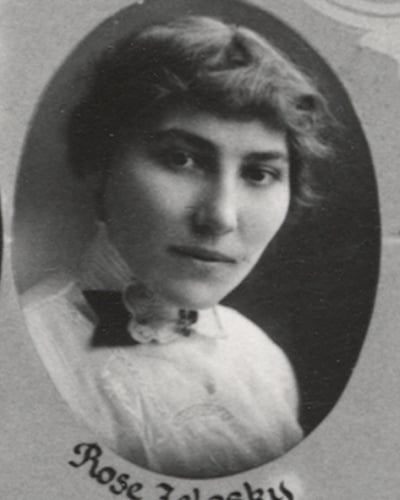
In June 1914, Rose Zeloski of Fort Worth became one of the first women to graduate from the University of Texas School of Law. This achievement earned her a license to practice law in Texas. It was forty-five years after Arabella Babb Mansfield of Iowa became the first woman in the United States to pass the bar examination, yet still four years before women in Texas gained the right to vote. Nevertheless, the Texas court system proved less than welcoming to women in the legal profession. Rose Zeloski was combative by nature, so she became involved in the women’s suffrage movement and moved to Philadelphia to campaign for women’s voting rights in Pennsylvania. She also began working with girls from reform institutions, a cause to which she remained devoted throughout her life. When the campaign for women’s suffrage in Pennsylvania failed at the ballot box, she returned to her parents in Fort Worth and then joined the new State Industrial School for Girls in Gainesville. Ultimately, her career path returned to the law. She moved to New York, where she became the first woman in the legal department of the American Telephone and Telegraph Company.
Once the doors had opened, others followed the pioneers. The first woman to represent a party in a Fort Worth court proceeding was Mrs. Hortense Ward of Houston. She appeared before Judge James Swayne’s Seventeenth District Court as the representative of James W. Lawson’s two children in a dispute over insurance proceeds from the estate of his former wife. Mrs. Ward succeeded in persuading the court that the disputed sum rightfully belonged to her clients, not to the former husband. Newspapers of the time repeatedly emphasized that Mrs. Ward was “best known” for securing passage of the “Married Women’s Act” in the Texas Legislature. She was fortunate that the case was heard by Judge Swayne, who had long championed minority rights, dating back to his days as a defense attorney.
In 1917, Texas Christian University, which had moved back to Fort Worth from Waco in 1911, admitted its first female law student, Geneva Bradley, the daughter of a judge. According to contemporary reports, her classmates were “glad to have a lady among them.” The student magazine expressed the view that she would compel them to work harder for fear of falling behind her. That concern, however, proved unnecessary. There is no record that Bradley completed her studies before the law school closed in 1920.
In 1930, there were seventy-five female lawyers practicing in Texas, compared with six thousand five hundred seventy-one men. Nearly all the women practiced civil law rather than criminal or corporate law because the courtroom was still considered too harsh an environment for women, especially in murder and rape cases. Some were forced to work as stenographers or legal assistants in male-run law firms.
Many years later, Hollywood character actress Florence Bates claimed the title of “Texas’s first woman lawyer” for the period before she left for Hollywood. According to her own account, the Texas native decided to become a lawyer at the age of twenty-six. She rejected the law school route and instead studied independently for “eighteen hours a day for eight months” before passing the bar examination. She then opened an office in her native San Antonio, where she practiced for four years until a court attempted to force her to breach attorney-client confidentiality. She “voluntarily” abandoned her practice and joined the office of her father, who was a lawyer. She then married a Texas oilman, and together they moved to California, where she began her acting career in 1938 at the age of fifty. She found success in Hollywood as a character actress and never forgot her Texas roots. Whenever she returned home, she was always welcomed as a local celebrity. It appears that no one ever investigated her story about her early legal career in any detail.