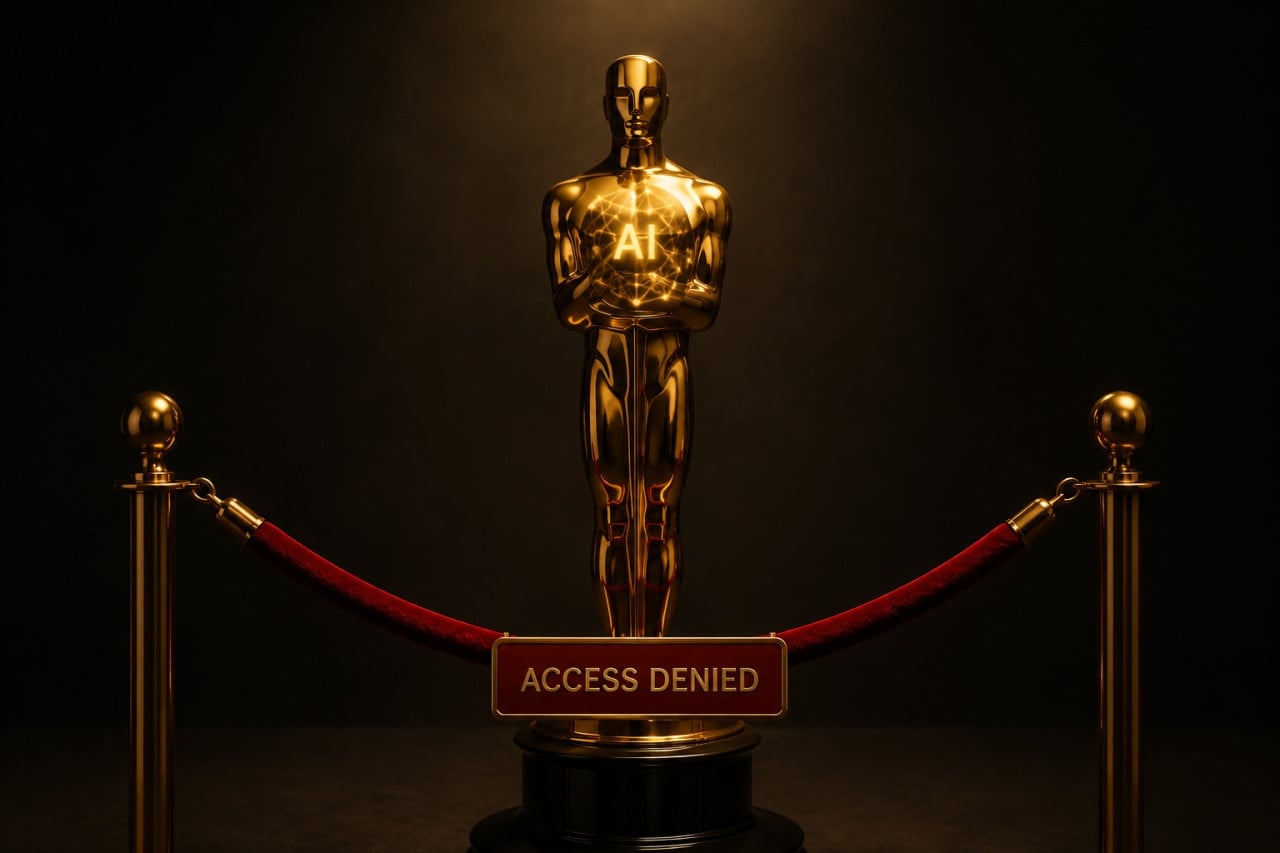
The Academy of Motion Picture Arts and Sciences has made a radical change to its awards process. The new rules for the 99th Academy Awards include a major change: if you are an AI actor or had a chatbot generate your film’s screenplay, you are not eligible for the golden statuette. Why exactly were these changes made, and why now?
What do the new rules say?
The Academy of Motion Picture Arts and Sciences decided to take this radical step on May 2, 2026, when it issued updated rules for its awards. They affected two key categories: actors and screenplays. As of this May, an acting performance must therefore be demonstrably performed by a human being with their consent. The same applies to screenplays, which must be demonstrably written by a human, not artificial intelligence.
In addition, producers will have to sign an Affidavit of Human Origin, a sworn declaration confirming the work’s human origin, under penalty of disqualification. The Academy may also request more detailed information about other uses of AI. In short, this is not just “some new rule,” but a genuine contractual obligation with real consequences.
Why did this happen?
It is no coincidence that the rule changes have come now. Hollywood has recently faced an increasing number of cases in which AI no longer serves merely as an assistive tool. Instead, it is taking on a more specific creative role and raising entirely new ethical questions.
A good example is the new film As Deep as the Grave, whose trailer featured an AI version of the late actor Val Kilmer in the lead role. Although the character appears in the film with the consent of the actor’s daughter, it is nevertheless a digital actor. Similar debate was sparked by the AI-generated actress Tilly Norwood, who cheerfully wrote on Instagram that she could not wait to attend the Oscars. Under the new rules, however, that is out of the question.
The changes to the awards rules also build on the results of the 2023 screenwriters’ and actors’ strikes, during which the unions opposed the use of AI. The new regulations thus reaffirm what the unions achieved and extend that level of protection to the awards themselves.

AI is allowed, but only in certain areas
It is important to note that the Academy has not banned artificial intelligence altogether. If AI is used in visual effects, editing, or sound, such works can still be nominated for an Oscar without issue. The crucial point, however, is that AI must remain merely a tool in human hands, not the creator. Simply put, a work will be judged according to the extent to which a human was at the core of its creative authorship.
A fine line
Thanks to specific cases, the rules for the 2027 awards have been defined relatively clearly. The question, however, is how they will work in practice. Verifying and assessing the boundary between AI as a tool and AI as an author is not always easy. Nevertheless, this is undoubtedly a milestone in the world of generative AI and in how it will continue to permeate various areas of life.
Source: BBC, Hypebeast, NPR, The Next Web