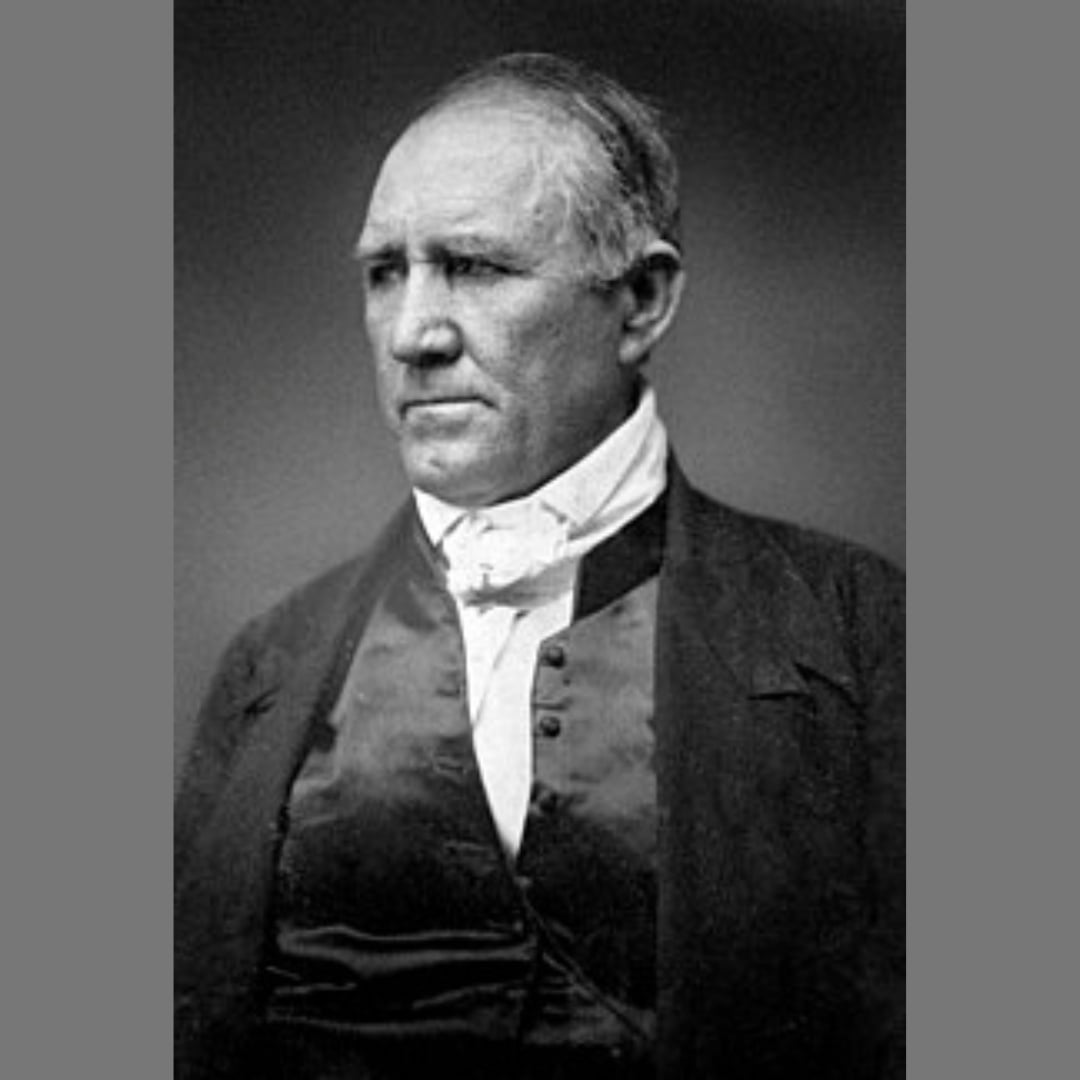
“We have been harried like outlawed wolves,” declared Sam Houston in his inaugural address as the first elected president of the Republic of Texas. “Our little band was driven from one hiding place to another and pushed to the very brink of despair; while the blood of our kindred and friends cried out for the vengeance of an offended God and rose to heaven, we met the enemy and defeated him.”
It was October 1836, six months after Houston’s rebel army defeated Santa Anna’s forces at the Battle of San Jacinto and tore Texas away from the rest of Mexico. The bones in Houston’s ankle, shattered by a musket ball during the fighting, had not yet healed. The surge of excitement that followed his unexpected victory had not yet subsided, and the blood of fallen comrades at the Alamo and on other battlefields seemed still to smolder. At least that is the impression one gets from reading Houston’s words, filled with righteous awe, and there is no doubt that he delivered the speech in person with all the theatrical force of his personality.
Texas, “a tract of land almost unknown to the geography of its day,” was no longer a restive frontier province of the Mexican federation. All at once, it had become an independent country of its own. And as anyone who has ever encountered a flamboyant Texan will attest, the state has never been able to stop thinking of itself that way. All the familiar hallmarks of the Texan character—courage, defiance, self-reliance, and self-admiration—resound in Houston’s speech, born of Texas’s hard-won national self-confidence.
The Republic of Texas claimed the mighty Rio Grande as its southern and western boundary, making it at the time far larger than it would become when the borders of Texas as a state of the Union were finally settled in 1850. With an area of 389,166 square miles, the country was nearly twice the size of France. Yet no European palace housed its president or served as the seat of government. The national parliament was an ordinary wooden shack. The new senators and representatives often slept directly on the ground beneath a spreading oak tree. The secretary of state, the man charged with representing Texas before the world, was Stephen F. Austin, who had first brought English-speaking settlers to Mexican Texas. His government accommodations were no grander. He lived in a shed and soon died of pneumonia after a cold north wind whistled through its cracks. From the very beginning, Texas was a republic of vastness, ruggedness, and belligerence.
Other states, too, had been or would become independent countries before joining the Union. Vermont declared itself a republic in 1777 before joining the United States in 1791. The California Bear Flag Republic existed for just twenty-five days in 1846. And after the overthrow of Queen Liliuokalani, sovereign of the Kingdom of Hawaii, the newly established Republic of Hawaii spent four years in uncertain anticipation before the United States annexed it.
Most Texans expected to be annexed as well, but the Republic of Texas turned out to be not merely a transitional entity but something resembling a genuine country. It endured for nearly ten years, from 1836 to 1845. Eventually it was recognized by other nations, specifically the United States, France, England, and the Netherlands. It had its own flag, official state seal, navy, supreme court, and postal service, although the country was so vast and so deeply in debt that it paid its mail carriers in land rather than money.
What prevented Texas from immediately becoming part of the United States was its status as a haven for slavery and its unwillingness to give that up. Its economic prosperity rested on plantation cotton cultivation, which in turn depended on enslaved laborers. Cotton accounted for ninety percent of its exports. Without slavery, Austin had written ten years before the Texas Revolution broke out, “nothing but poverty awaits us for a long time, perhaps for the rest of our lives.”
Texas’s insistence on remaining a slaveholding republic, however, collided with the passionate and unresolved dispute raging in the United States over the expansion of slavery. In the words of Quaker activist Benjamin Lundy, who had been watching Texas warily for years, the true purpose of the entire revolution had always been merely to bring into the Union “a vast and profitable market for slaves.”
Rejection by the country they longed to join only deepened the sense of grievance and isolation that English-speaking Texas had already experienced when it was a neglected part of Mexico. Texas was accustomed to being regarded as a persistent problem by unknown officials in distant capitals. And it had plenty of problems of its own to address. One way to understand why Texans developed such a proud and combative sense of identity is to recognize that throughout all ten years of its existence, the Republic of Texas found itself—and kept itself—at war.
Santa Anna’s army may have been defeated at San Jacinto, but the Mexican government never fully reconciled itself to the idea that Texas now belonged to American interlopers, whom Santa Anna regarded as land thieves. Mexico, as one Veracruz newspaper affirmed, “knew of no country called the Republic of Texas, but only of a band of adventurers rebelling against the laws of the government of the republic.”
There was a general atmosphere of contentiousness that scarcely abated after the Battle of San Jacinto. New arrivals continued to stream in from the United States, eager to revive the fight they had missed. Mirabeau Lamar, an ambitious politician and ardent poet, arrived in Texas just in time to fight Santa Anna as a rank-and-file soldier, and six months later he was vice president of the new republic. He became president after Houston’s first two-year term ended, called annexation to the Union “the grave of all the hopes and happiness” of Texas, and decided that Texas could perfectly well become a mighty nation in its own right. His policies were brutal and drove the country toward bankruptcy. He waged war against the Cherokee and rekindled the longstanding hostility with the Comanche. He dispatched a disastrous expedition to Santa Fe in an attempt to force its recalcitrant inhabitants to believe that they were now Texans rather than Mexicans, as they considered themselves. “Wherever the Texan sets his foot,” Lamar told them in one of the earliest and grandest empty boasts in Texas history, “he transforms the wilderness into a fertile land.”
When Lamar’s ill-fated term ended and Houston returned to office, Mexico invaded Texas not once but twice. The armies were repulsed, and then Texas itself was repulsed when it attempted to invade Mexico. By the time Texas was finally annexed by the United States in 1845, it was exhausted and penniless. Yet the story of its birth that it had fashioned for itself during those ten years as a republic—the tale of its struggle for freedom from Mexico, the sacred sacrifice at the Alamo, and the glorious victory at San Jacinto—had been cultivated so carefully that in the end it was not merely preserved in memory but enshrined.
The annexation of Texas led to war between the United States and Mexico, which in turn led the United States to acquire vast new territories, further inflaming the bitter dispute over the expansion of slavery. The result was the Civil War, in which Texas seceded from the Union that had once reluctantly accepted it, just as it had previously broken away from the Mexican nation. In a sense, it also separated itself from the defeated South. Texas assiduously cultivated the idea that it was something unto itself. It had no need to indulge in dreams of the Lost Cause so long as it had a frontier to exploit in the West and Native resistance to suppress.
The Texas state song was adopted in 1929, sixty-four years after the end of the Civil War. Unlike the wistful and nostalgic official songs of other states of the defeated South, with their references to sweetly warbling birds and “proud heraldic trees,” “Texas, Our Texas” is a vibrant anthem of dominion. The phrase “largest and grandest” had to be changed to “boldest and grandest” after Alaska joined the Union in 1959, but “boldest” probably captures the essence better anyway. Otherwise, the song remains unchanged, as does the national pride it celebrates. Texas once was, and still not entirely secretly wishes to remain, “an empire wide and glorious.”