

Every month, Wikipedia and other Wikimedia projects receive billions of page views from around the world. When this traffic arrives, Wikimedia Foundation algorithms classify whether it comes from humans or bots. This helps maintain an accurate overview of human activity and enforce restrictions on third-party bots that collect data for commercial search engines and AI systems. Many bots are becoming more sophisticated and trying to appear human. To keep the metrics accurate, the classification methods are continuously updated.
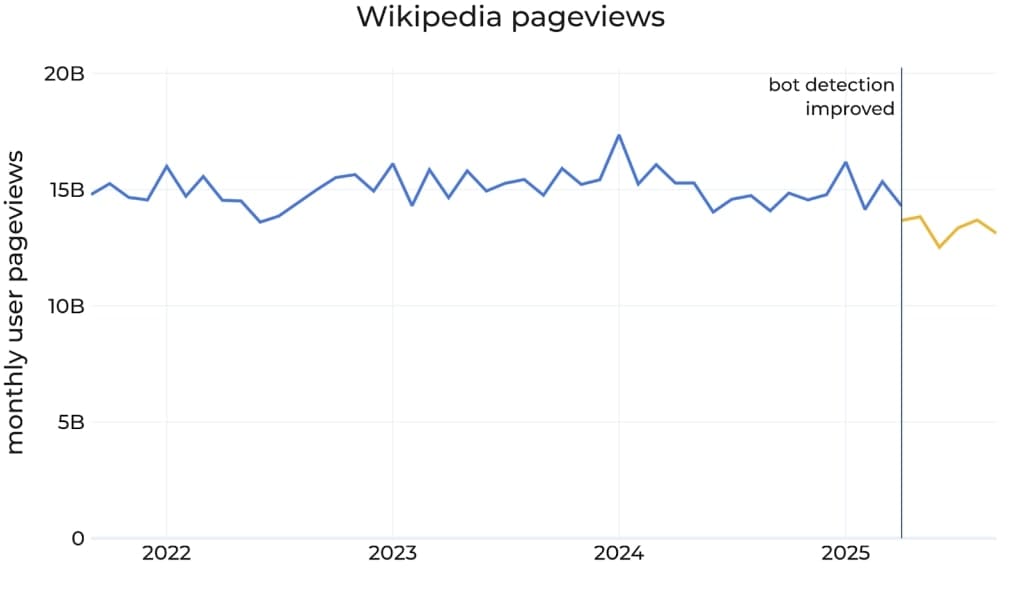
Around May 2025, they recorded an unusually high amount of seemingly human traffic, mainly from Brazil. This led them to investigate and adjust their bot detection systems. They applied the new logic to data from March through August 2025 and found that a large portion of the high traffic in May and June came from bots designed to evade detection.
This data revision means that the data must be interpreted carefully because the bot detection systems used different rules during different periods. After the adjustment, we see a decline in human page views on Wikipedia in recent months, amounting to a decrease of roughly 8% compared with the same months in 2024. This decline is a result of the impact of generative AI and social media on how people search for information, especially as search engines provide answers directly, often based on Wikipedia content.
The internet is evolving
These declines are not surprising. Search engines are increasingly using generative AI to provide answers directly instead of linking to websites such as Wikipedia. Younger generations search for information on social video platforms rather than on the open web. This shift is not limited to Wikipedia. Many other publishers and platforms are reporting similar changes as users spend more time on search engines, AI chats, and social networks. These companies also place a burden on the infrastructure of these platforms.
Although some users do not come directly to Wikipedia, its content remains one of the most valuable datasets for these new forms of knowledge distribution. Almost all large language models (LLMs) are trained on data from Wikipedia. Search engines and social platforms alike prioritize its information when answering users' questions. People therefore read knowledge created by Wikimedia volunteers across the internet, even if they do not visit Wikipedia directly. This human-created knowledge has become even more important for disseminating reliable information online. In addition, Wikipedia remains highly trusted and valued globally as a neutral, accurate source of information, as measured by extensive surveys regularly conducted by the Wikimedia Foundation.
We welcome new ways for people to access knowledge. However, LLMs, AI chats, search engines, and social platforms that use Wikipedia content should encourage more visits to Wikipedia so that the flow of free knowledge on which so many people and platforms depend can continue sustainably. Fewer visits could mean fewer volunteers expanding the content and fewer individual donors supporting this work. Wikipedia is the only website of its scale with standards of verifiability, neutrality, and transparency that powers information across the internet, and it remains essential to people's daily needs in unseen ways. For people to trust information on the internet, platforms should clearly cite their sources and encourage visits to and participation in those sources.
Responding to the current situation
Regular reviews of global trends have prompted Wikipedia to respond proactively to these changes on the internet. Extensive work is currently underway to help fulfill its mission as the world around it changes:
-
To ensure that third parties responsibly access and reuse Wikipedia content at scale, they are enforcing policies, developing an attribution framework and new technical capabilities, including through Wikimedia Enterprise.
-
Two new reader teams (Reader Growth and Reader Experience) are bringing fresh ideas and an experimental approach to how people find and read Wikipedia.
-
Based on direct feedback from volunteers, they have strengthened their focus on editing from mobile devices, on enjoyable and productive first experiences for new volunteers, and on developing a new generation of advanced volunteers who do the hard work of building Wikipedia.
-
The Future Audiences project is experimenting with new ways to bring free knowledge from Wikipedia to younger audiences on platforms such as YouTube, TikTok, Roblox, and Instagram, including through videos, games, and chatbots.
How you can help
Now more than ever, the Wikimedia movement must work together to respond and adapt to the changes around us and across its projects. While these traffic trends and other data reveal a shift in users and content usage, there are many things we can do to support the long-term sustainability of Wikimedia content.
Everyone can choose online behaviors that support the integrity of content and its creation. When searching for information online, look for citations and click through to the original source material. Talk to people you know about the importance of trustworthy, human-curated knowledge and help them understand that the content underlying generative AI was created by real people who deserve support.
Active volunteers can also help by testing new experiences and tools on Wikipedia with Wikimedia Foundation teams. At a time of rapid change on the internet, it is time to consider which parts of Wikipedia should change (and which should not) while preserving the promise of human-centered, free knowledge for the world.
Source: diff.wikimedia.org


