

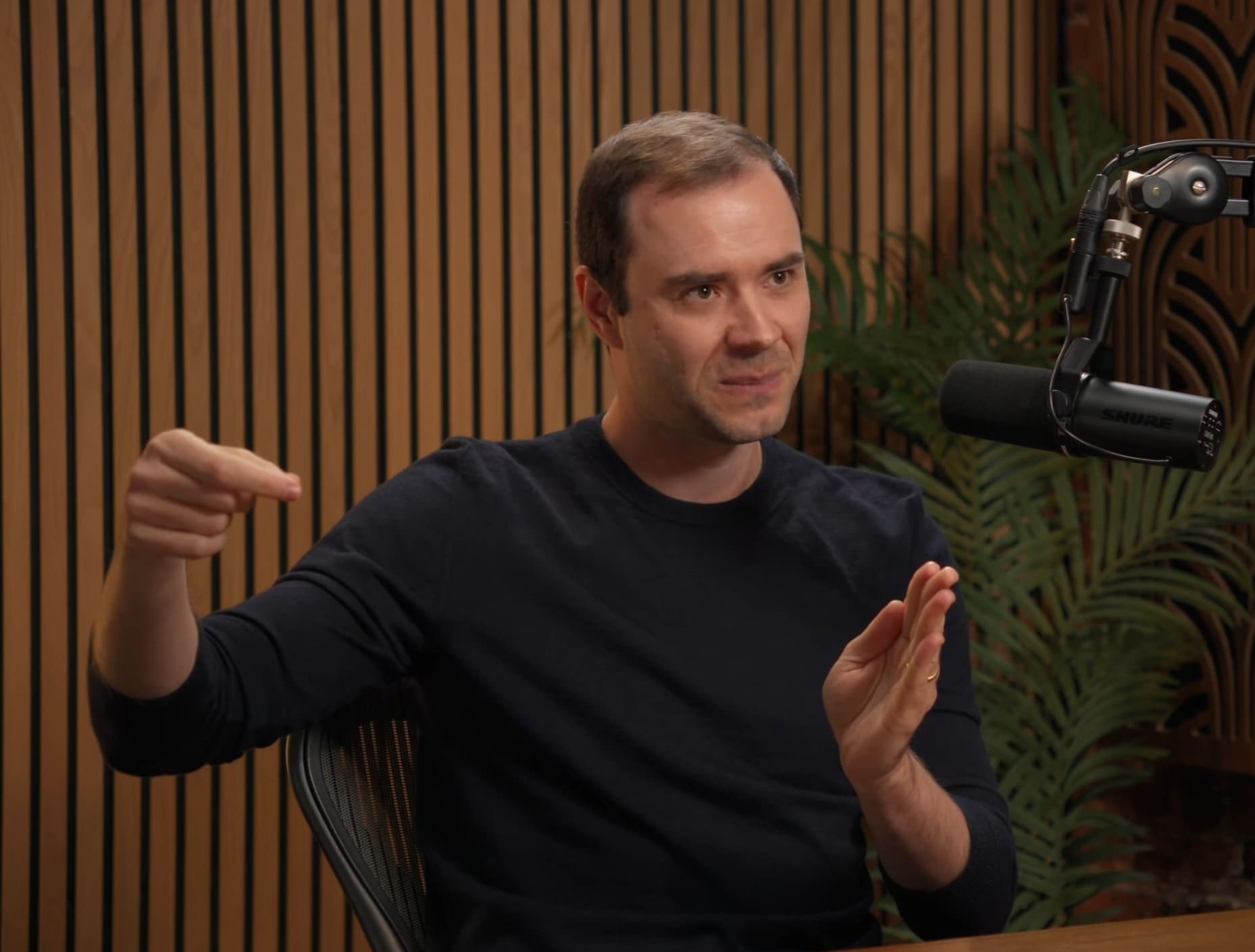
Andrej Karpathy, who previously led AI at Tesla and was a founding member of OpenAI, recently appeared on Dwarkesh Patel's podcast. In the lengthy interview, he offered a realistic view of the current state of artificial intelligence. Instead of expressing excitement about rapid progress, he said that true AI agents capable of functioning as reliable assistants or interns are still a decade away. According to him, today's large language models (LLMs) suffer from serious shortcomings and are more like advanced autocorrect than genuine thinking.
Karpathy emphasized that the industry is overestimating the pace of development. Instead of the "year of agents," we should be talking about the "decade of agents." He explained this based on his own experience, including his work on the nanochat project, where he attempted to build a ChatGPT clone from scratch. He found that coding agents are not at all useful for new code—instead, they unnecessarily bloat it with defensive elements and get lost in unfamiliar structures.
Problems with Model Training
One of the main topics was a critique of reinforcement learning (RL). Karpathy called it "terrible" and "stupid" because it works by rewarding an entire sequence of actions based on a single final outcome. He compared it to "sucking supervision through a straw." If a model happens to reach the correct answer, the system reinforces every step along the way, including mistakes and unnecessary detours. This leads to noisy learning that a human would never engage in.
Another approach, process supervision, where each step is rewarded separately, has its own pitfalls. Karpathy noted that LLMs used as "judges" to evaluate steps are easy to circumvent. The model learns to produce nonsensical outputs such as "thththth," which the judge mistakenly rates as perfect because they fall outside its data distribution.
Karpathy also described pre-training as "lousy evolution." Models learn from the internet, which is full of "garbage and waste," forcing them to devote most of their capacity to memorization rather than genuine cognitive work. He suggested that future research should separate the "cognitive core"—pure problem-solving algorithms—from memorized knowledge. According to him, such a core might require only one billion parameters, rather than the hundreds of billions used today.
Practical Shortcomings: Examples from Coding
In the context of coding, Karpathy described the models' "cognitive deficits." While building nanochat, he found that agents get stuck on standard patterns from the internet, add unnecessary try-catch blocks, and use outdated APIs. They are "asymmetrically worse" at writing code that no one has written before, which is the essence of research. Instead, he recommends using them only for autocorrect, where they are effective.
He compared this to human learning: a person reads a book not merely to memorize it, but to actively generate new ideas—through reflection, discussion, and connecting it with existing knowledge. Models do not do this; their "reading" is merely next-token prediction. Moreover, their outputs are "quietly collapsed"—they occupy only a small space of possible ideas. Karpathy said that ChatGPT knows only three jokes, illustrating its lack of diversity.
Another problem is the absence of an equivalent to human sleep or reflection. Models have no mechanism through which daily experiences (the context window) could be distilled into long-term memory (model weights). Humans have high thought entropy, which prevents overfitting to narrow patterns, while models collapse quickly.
Analogies from Autonomous Driving
Karpathy drew on his work on autonomous driving at Tesla, where he described the "march of nines." A demo that works 90% of the time is easy, but each additional nine of reliability—99%, 99.9%—requires the same amount of work. That is why he is "extremely unimpressed by demos" and believes that the path to useful AI will be long and slow, taking at least ten years.
He warned that today's "driverless" cars are misleading—they are often supported by hidden centers staffed by teleoperators. "We haven't removed the human; we've just moved them somewhere you can't see them," he said. This principle also applies to software: a bug in code can cause millions of Social Security numbers to be leaked, just as an error in driving can cause harm.
Predictions and Risks
Karpathy predicted that superintelligence would not be a "god in a box," but rather a gradual loss of control through many autonomous entities. AI will not cause a sudden jump in the 2% GDP growth rate; it will be a slow diffusion, similar to computers or mobile phones, which are not visible in the GDP curve.
In education, he envisions a future where learning becomes an enjoyable form of self-improvement rather than preparation for work—much like we go to the gym for our health today, not to perform manual labor. His new project, Eureka Labs, aims to help humanity keep pace with AI, for example through LLM101n, a course on building your own models.
Karpathy emphasized that models lack "culture"—they do not create content for one another as humans do. He proposed self-play, in which one model creates problems for another, similar to AlphaGo.
Economic Context
The interview included market estimates: the global economy is worth around USD 117 trillion, of which digital tasks account for 10–20%, or USD 11–23 trillion. Karpathy believes that the current expansion of data centers is justified because demand for tools such as autocorrect is enormous, even if agents arrive later.
Dwarkesh Patel countered that AGI could add billions of "digital workers," transforming the economy in a way similar to the Industrial Revolution. Karpathy rejected this, viewing AI as a continuation of the long-term trend of automation.
You can watch the full interview with Karpathy on YouTube or read a detailed analysis of the questions on theneuron.ai.


