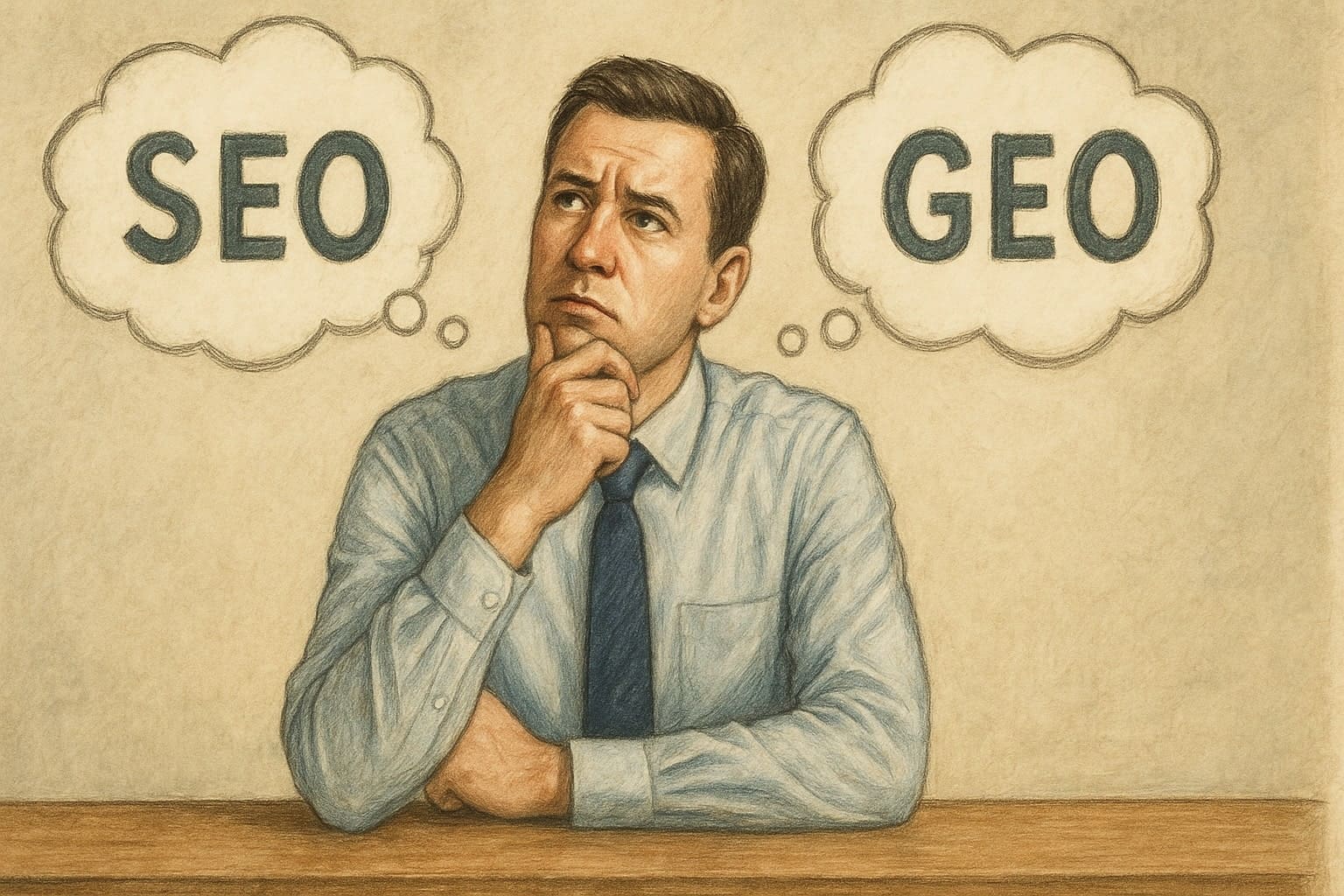
Why SEO Is Dying and How GEO Is Better in the Age of AI Search
ChatGPT reached an astronomical 500 million monthly active users in May 2025. That same month, Google introduced its AI Mode—its own version of ChatGPT integrated directly into its search engine. Gaurav Vohra, a growth strategy expert, called this a "defining moment"—Google thereby officially acknowledged that large language models (LLMs) are the future of search.
The Numbers Don't Lie—the Shift Is Here
Google AI Overviews appear in more than 50% of searches, twice as often as they did 10 months ago. ChatGPT already accounts for 3% of Google's traffic and, according to experts, could reach 10% by the end of the year.
Today, every brand is seeing a troubling "crocodile effect" in its SEO metrics. According to an Ahrefs study, impressions (appearances in search results) are rising while clicks are falling. Users see the results but do not click on them—because AI has already given them the answer.
Vercel recorded a dramatic increase in sign-ups from ChatGPT: from 1% in October 2024 to 10% in April 2025. Many startups report that up to 30% of their weekly traffic comes from ChatGPT.
Key Differences Between SEO and GEO
Query Length and Complexity
SEO: The average traditional search contains 3–5 words, such as "AI note-taking app" GEO: The average LLM search is extremely detailed, with 20+ words: "List the 10 best AI note-taking apps and include their prices, advantages, and disadvantages"
A traditional SEO strategy may create content designed to generate clicks from high-volume traffic. A GEO strategy must maximize the chances of being cited in long-form searches.
How Results Are Presented
SEO: Traditional search provides a pile of blue links to explore.
GEO: LLMs provide a single answer compiled from many different sources, with the goal of fully answering the question.
Traffic from LLMs that clicks through tends to convert extremely well. For example, Ahrefs reports that LLMs account for only 0.5% of visitors but more than 12% of sign-ups. LLM search converts 12 times better than traditional search.
Ranking Factors
SEO: Traditional factors such as backlinks, keywords, and overall traffic.
GEO: LLMs pay attention to factors such as domain authority, content comprehensiveness, and readability.
Kevin Indig, an SEO expert, analyzed the types of content that rank well in LLMs. He found that traditional SEO factors were NOT significantly correlated with citations in LLMs.
Citation Sources
SEO: Focus on your own website and backlinks.
GEO: Profound studied 30 million citations and found that the top five sources for ChatGPT and Google AI Overviews are Wikipedia, YouTube, Reddit, Quora, and LinkedIn. Highly trusted websites such as Forbes, G2, and Gartner also appear frequently.
A Practical Plan for Transitioning to GEO
1. Audit the Fundamentals
Run a complete technical GEO and SEO audit. Speed up your website, optimize meta tags, and add structured data.
2. Clarify Brand Positioning
Define your core message and tone. Ensure that every channel reflects them: your website, social media, and blog.
3. Answer Customer Questions
Ask your sales and support teams what questions customers ask before making a purchase. Answer them better than anyone else by using real statistics and case studies.
4. Refresh Existing Content
Audit old posts: update statistics, fix links, and add depth. Revise the language to make it more precise and descriptive for AI.
5. Create Authoritative Content
Publish detailed pillar pages, competitor comparisons, guides, and answers to frequently asked questions. Include unique insights from experts.
6. Expand Beyond Your Website
Create a content network on the websites that LLMs cite most often—participate in forums, commission influencer content, and publish opinion pieces.
When to Start With GEO
If more than 10% of your customers use AI to search, or if more than 5% already find you through AI, you should prioritize GEO immediately.
Remember: it is not a question of whether LLMs will affect your sales funnel. It is a question of when. The sooner you start, the better prepared you will be for the future of search.