

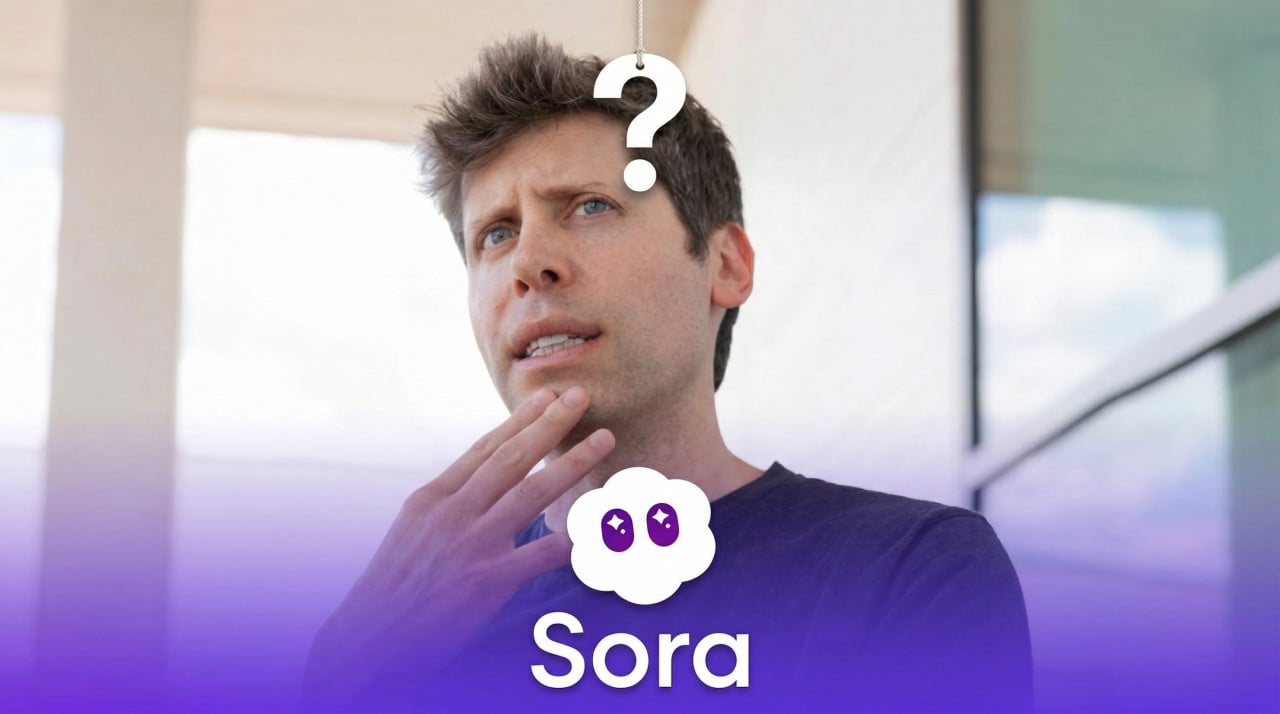
Sam Altman arrived in Los Angeles in early March for Vanity Fair's Oscar party. The mood was great, and business was booming. OpenAI was close to securing licensing deals with Hollywood studios, and its Sora video generator looked like the next big leap after ChatGPT. Users could use it to create videos of themselves dribbling like the Harlem Globetrotters or fighting with lightsabers alongside Darth Vader.
And now, less than a month later, Sora has been shut down. OpenAI announced the app's closure just six months after its public launch. And the way it happened shocked even the company's closest partners.
Disney learned about the shutdown less than an hour in advance
There was big money riding on Sora. Bob Iger, Disney's CEO, agreed to invest one billion dollars in OpenAI. The deal included bringing characters from Marvel, Pixar, and Star Wars to Sora. Selected user creations were even supposed to be streamed on Disney+. Disney also planned to deploy OpenAI products across the entire company.
But Disney executives learned about Sora's shutdown less than an hour before the public announcement. The shock was enormous. A three-year licensing agreement ended after just three months. The entire billion-dollar deal collapsed overnight.
According to The Wall Street Journal, both teams were still working on Sora shortly before news of the shutdown arrived.
A million dollars a day gone and empty servers
But why did OpenAI sacrifice such an attractive partnership? The answer is prosaically simple: Sora devoured money and computing power like nothing else at the company. According to TechCrunch, Sora cost roughly one million dollars a day in operating expenses. Video generation is extremely demanding on specialized chips, the most valuable resource that artificial intelligence labs have. And Sora consumed them at an unsustainable rate.
Meanwhile, OpenAI desperately needed computing capacity for other things. The company was working on a new model code-named Spud, focused on coding and enterprise tools. That was where it saw real revenue, but Sora stood in the way.
User exodus
The download figures confirm it. According to analytics firm Sensor Tower, after its launch in October, Sora had 4.8 million downloads worldwide. In November, the figure even reached 6.1 million. Then came the turning point. In December, it fell to 3.2 million, in January to 2.1 million, in February to 1.4 million, and in March it barely exceeded one million.
Seema Shah of Sensor Tower pointed out a peculiar paradox: Sora was losing users even while expanding into new markets. Logically, it should have been growing there, not declining. The analyst called it a warning sign. According to TechCrunch, the number of active users fell below 500,000. The app that was supposed to be the next sensation after ChatGPT simply did not engage people enough to keep them coming back.
Meanwhile, the competition pulled ahead
And who benefited? Companies such as Google, Kling, Runway, Luma, and Seedance. Sora simply was not the best at anything. The impressive early demo videos looked great, but after launch, the gulf between the marketing samples and the actual output became apparent. If your model is not number one at at least one thing, it is difficult to attract masses of users.
And there was another threat on the other side. Anthropic, with its Claude Code tool, was luring away developers and companies that generate real revenue. OpenAI suddenly found itself under pressure in its own domain.
Altman changed course
Sam Altman made the decision. He shut down Sora, freed up computing capacity, and redirected it to where he sees the real future: enterprise tools, coding, and agentic technologies. “We cannot squander this moment by allowing ourselves to be distracted by side projects.” That was how Fidji Simo, OpenAI's head of product deployment, put it.
OpenAI also announced that it was increasing its current funding round by another 10 billion dollars, bringing the total to more than 120 billion. The company is clearly aiming for an IPO soon, and investors want to see money flowing to where it will generate returns. According to available reports, OpenAI is also postponing planned erotic features in ChatGPT and reassessing several other side projects, including social networks and its own browser.
What Sora left behind
Sam Gregory of Witness, a nonprofit organization that fights deceptive deepfake videos, is concerned about Sora's demise, but for a different reason. “Sora normalized a world in which people are unsure what they are actually seeing on their timelines,” he told The Verge. Whether it was funny videos or footage from armed conflicts.
And who took the biggest hit? Disney apparently is not giving up. The company remains open to similar licensing agreements with other companies working on video generation. The billion-dollar investment in OpenAI is gone, but the appetite for experimentation clearly is not.
Just one day before announcing Sora's shutdown, OpenAI published a post on its blog about how to use Sora safely and how it was strengthening its safeguards. There is talk that the company plans to use the technology behind Sora for research into world simulation and robotics. But whether anything will ever come of it, no one knows today, probably not even Altman himself.


