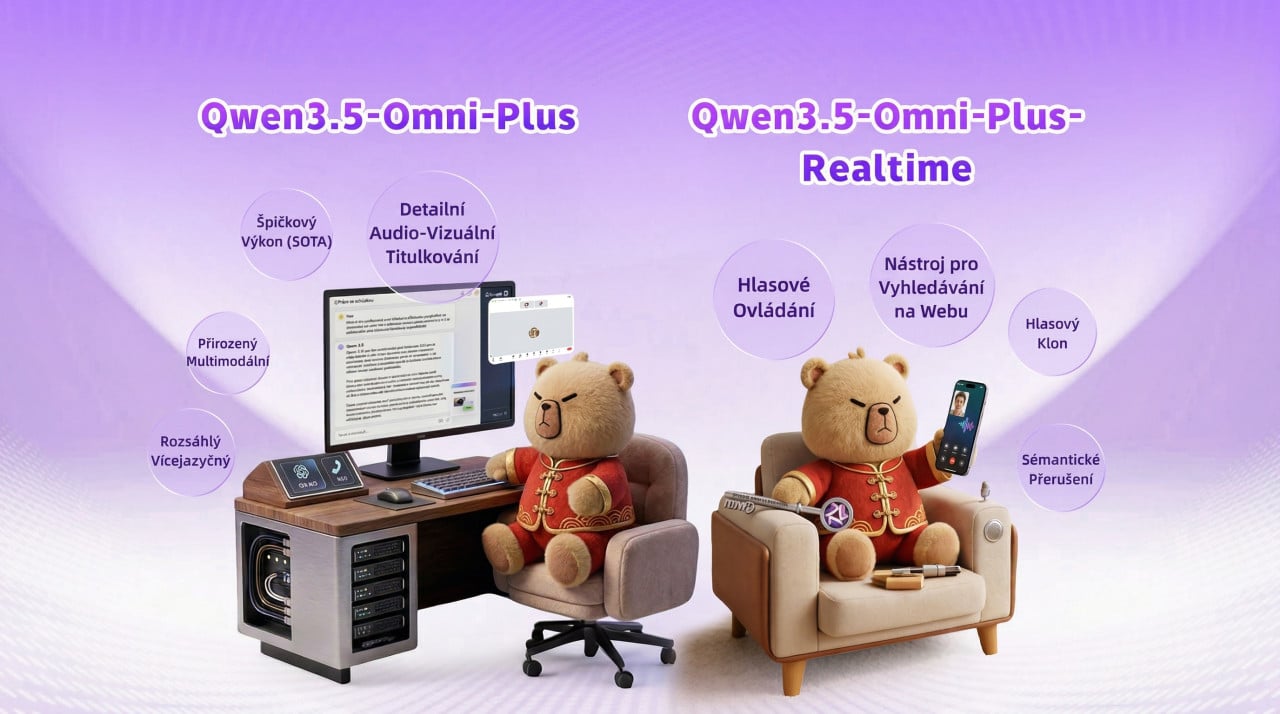
Alibaba Cloud has unveiled something that deserves attention. Qwen3.5-Omni is its latest language model, and this time it is not limited to text. This system processes images, audio, video, and text simultaneously in a single computational stream. No cobbling together of external modules, no separate audio transcription. Everything runs under one roof.
And as if that were not enough, Alibaba has released the entire model under the open-source Apache 2.0 license. This means anyone can download it, modify it, and run it on their own hardware. That is exactly what makes Qwen3.5-Omni so compelling.
Thinker-Talker Architecture
At the heart of the model is a two-part architecture the team calls Thinker-Talker. The Thinker module perceives its surroundings. It receives images through a visual encoder, tokenizes audio using a specialized audio transformer, and keeps everything aligned through time-oriented positional encoding (TMRoPE), which synchronizes different types of input.
The Talker module then generates responses from these representations, including real-time voice responses. The entire system operates as a stream, so the model does not have to wait until it has processed the complete input. It responds continuously.
Under the hood is a hybrid Mixture-of-Experts (MoE) mechanism. Of the total 397 billion parameters, only about 17 billion are activated for a single query. Think of it as an enormous team of specialists, with only those needed for the task at hand working at any given time. The result? Performance comparable to monolithic giants, but at a fraction of the computational cost.
Better Results Than the Competition
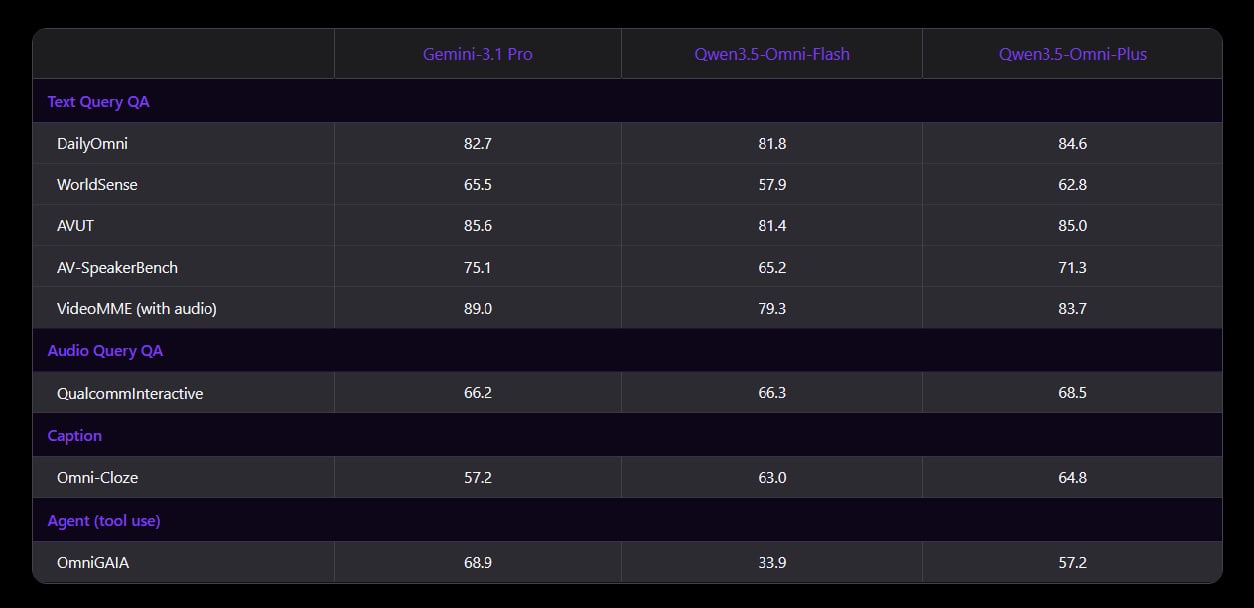
Qwen3.5-Omni-Plus achieved the best results across 215 audio and audiovisual benchmarks. In the DailyOmni test, it scored 84.6 points compared with Gemini 3.1 Pro's 82.7. In speech recognition on the Librispeech dataset, it achieved an error rate of just 1.11%, while Gemini posted 3.36%.
In IFBench, which measures the ability to follow complex instructions precisely, the Qwen3.5-397B version achieved 76.5%, outperforming GPT-5 High at 73.1%. In the MMLU-Pro benchmark, focused on in-depth expertise, GPT-5 still leads with 87.1%, but Qwen is close behind at 86.3%.
But what interests managers more than benchmarks? Price. API calls cost less than $0.11 per million tokens. That is roughly one-tenth of what the competition charges. With first-packet latency of around 234 milliseconds, the model also responds so quickly that conversing with it feels like a normal conversation.
Czech That Finally Does Not Sound Robotic
One of the biggest leaps is language support. The model recognizes speech in 113 languages and dialects and can generate speech in 36 languages. Czech is among the supported languages, including speech synthesis.
The natural-sounding voice is powered by ARIA (Adaptive Rate Interleave Alignment) technology, which dynamically aligns text and speech units. It addresses problems that plagued older models: swallowing word endings, incorrect inflection of numerals, and unnatural pauses. Its voice naturalness score (UTMOS) reaches 4.16 out of 5, approaching human speech.
The semantic interruption feature is also interesting. If you interrupt the model while it is speaking, it immediately falls silent and responds to your new input. At the same time, it ignores background noise and filler words. Anyone who has ever tried talking to a voice assistant on a busy street will appreciate this.
Vibe Coding: Show It, Say It, and Get Code
One of the most impressive demonstrations? So-called Audio-Visual Vibe Coding. You point a camera at a paper sketch of an interface, describe by voice what the application should do, and the model generates functional components in React or HTML. You simply show it and tell it what you want. It writes it for you.
The model can process more than 10 hours of audio or 400 seconds of high-resolution video within a single context window of 256,000 tokens. This opens up possibilities for analyzing entire meetings, lectures, or industrial video recordings without losing context.
Open Model
For companies working with sensitive data (healthcare, finance, government), its release under the Apache 2.0 license provides the option to run the model on their own servers without sending information anywhere else. This directly addresses the requirements of European data protection regulations.
Smaller variants of the model (such as the 35B-parameter version) require only a graphics card with 24 GB of memory. With FOMOE (Fast Opportunistic MoE) technology and intelligent loading of experts from NVMe drives, it is even possible to run the full 397-billion-parameter version on a standard workstation. You can achieve a speed of around 9 tokens per second, which is more than enough for an enterprise chatbot.
Three Model Versions
The model is available in three sizes: Plus, Flash, and Light. Plus is the flagship for maximum accuracy, Flash offers the best balance of performance and speed, and Light is suitable for deployments with limited resources. All of them support a context window of 256,000 tokens.
You can access it through the Offline API (batch processing, long documents, detailed video descriptions) or the Realtime API (live interaction, voice assistant, function calling, and web search). It is also available through Qwen Chat and Alibaba Cloud Model Studio.
Those interested in cybersecurity will be pleased to know that the community has already created modified variants without safety filters, suitable, for example, for forensic malware analysis in an isolated environment. The model has simply taken on a life of its own, with developers around the world adapting it to their needs.