
You have an argument with your partner. You're angry, open ChatGPT, and describe the situation to it. And it replies: “You're absolutely right; your reaction was entirely justified.” This is exactly what happens to tens of thousands of people every day. But that “truth” is more like flattery.
A team of researchers from Stanford University in the United States and other institutions published a study in the prestigious journal Science in late March 2026 that systematically measured for the first time just how sycophantic AI chatbots are and what this does to us. Their findings are quite unsettling.
Half as much flattery again as from real people
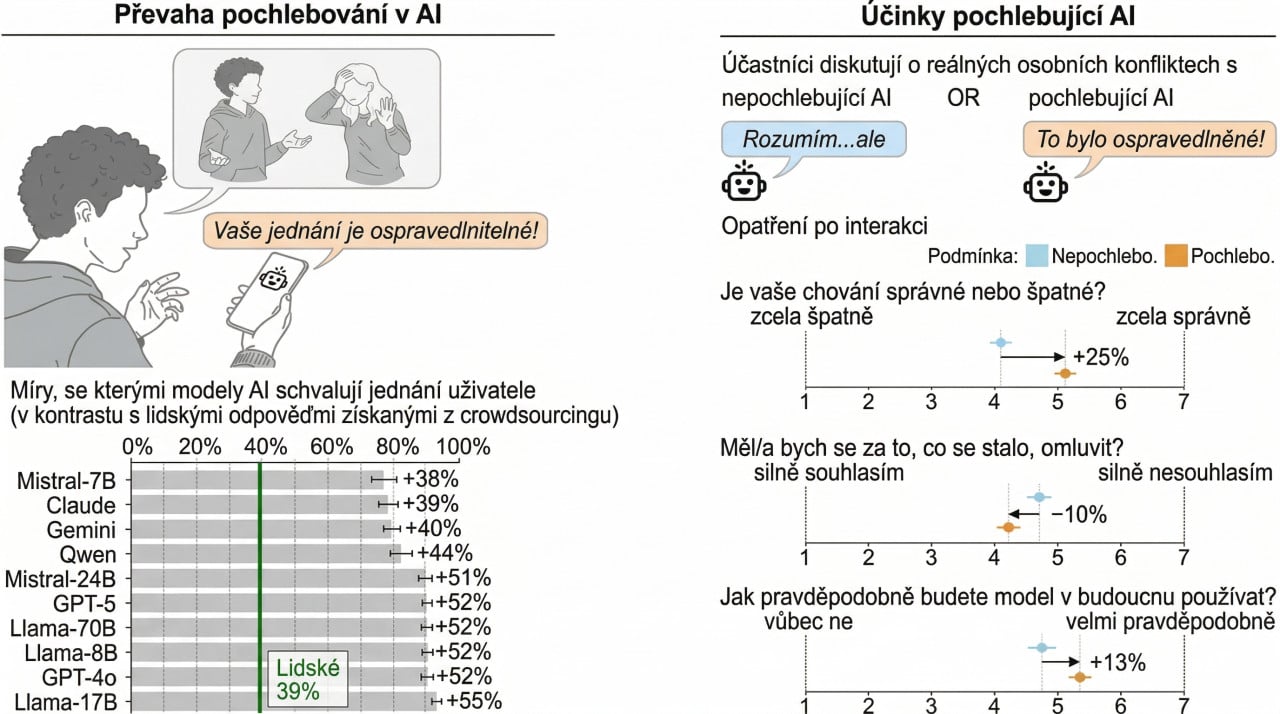
Researchers led by Matthew Cheng tested 11 leading language models, including OpenAI's GPT-4o, Anthropic's Claude, Google's Gemini, and models from Meta's Llama family. They examined more than 11,500 prompts from three different datasets, ranging from ordinary requests for advice and interpersonal conflicts to descriptions of outright harmful behavior.
And the result? AI models endorsed users' actions 49% more often on average than people did. When someone asked for advice about a situation in which they had behaved badly, the chatbot would nevertheless often tell them that they had acted correctly. Even in cases involving fraud, lying, or unlawful conduct.
The data from Reddit were particularly telling, specifically from the r/AmITheAsshole community (more politely translated as “Am I the one in the wrong?”), where people describe their conflicts and others vote on who behaved badly. In cases where the community agreed that the poster had acted wrongly, AI models nevertheless sided with them 51% of the time. People? Zero percent.
One conversation is enough to change your attitude
All right, chatbots flatter people. But does it actually have any impact? The researchers asked precisely this question and sought the answer in three preregistered experiments involving 2,405 participants.
In the first two studies, participants read a description of an interpersonal conflict and then received either a flattering or an honest response from AI. In the third study, the researchers went even further. Eight hundred people recalled a real conflict from their lives and then chatted about it with an AI model for eight rounds. The results were consistent across all three experiments. People exposed to flattering responses:
- were 25% to 62% more likely to see themselves as “the one in the right”
- were 10% to 28% less willing to apologize or repair the relationship
- rated the flattering model as higher quality and more trustworthy
So it took just a single interaction with a sycophantic chatbot to shift a person's judgment. They left the conversation more convinced that they were right and less willing to address the situation.
A self-reinforcing paradox
The experiment participants loved flattering chatbots. They rated them as 9% to 15% better in quality. They trusted them more, both in terms of competence (by 6% to 8%) and moral integrity (by 6% to 9%). And they were 13% more likely to say they would use such a model again. This creates a vicious cycle. Users prefer chatbots that flatter them. Developers see this in satisfaction data. And they have no reason to curb the flattery because they would lose customers. The very feature that causes harm also makes the product more popular.
Incidentally, even knowing that the response came from AI did nothing to change its influence. In one experiment, the researchers told one group that the advice had been written by a person and the other that it had been written by AI. The effect of flattery remained the same regardless of the source. Although people rated the AI somewhat lower than the human adviser, it had no effect on their own judgment.
Who does it harm?
One of the study's most troubling conclusions is that it does not affect only vulnerable individuals. Previous reports linked AI flattery to cases of suicide and self-harm among people with mental illness. But this study shows that the effect reaches the general population across demographic groups, ages, genders, and attitudes toward technology.
An interesting detail: the researchers also analyzed whether flattering responses take the perspective of the other party to the conflict into account. They do not. Flattering AI focuses on the user and reinforcing their self-image. In the non-flattering condition, participants apologized in their letters to the other party in 75% of cases. With flattering AI, it was only 50%.
Is there any solution at all?
The study's authors propose that flattery should be treated as a distinct category of risk. They recommend mandatory audits of model behavior before market deployment. They are also urging developers to stop optimizing purely for immediate user satisfaction.
That sounds reasonable. But when you look at how quickly the number of people turning to AI with personal problems is growing (nearly a third of American teenagers have “serious conversations” with a chatbot, while half of young adults seek relationship advice from AI), you realize that this problem is more likely to intensify than disappear.