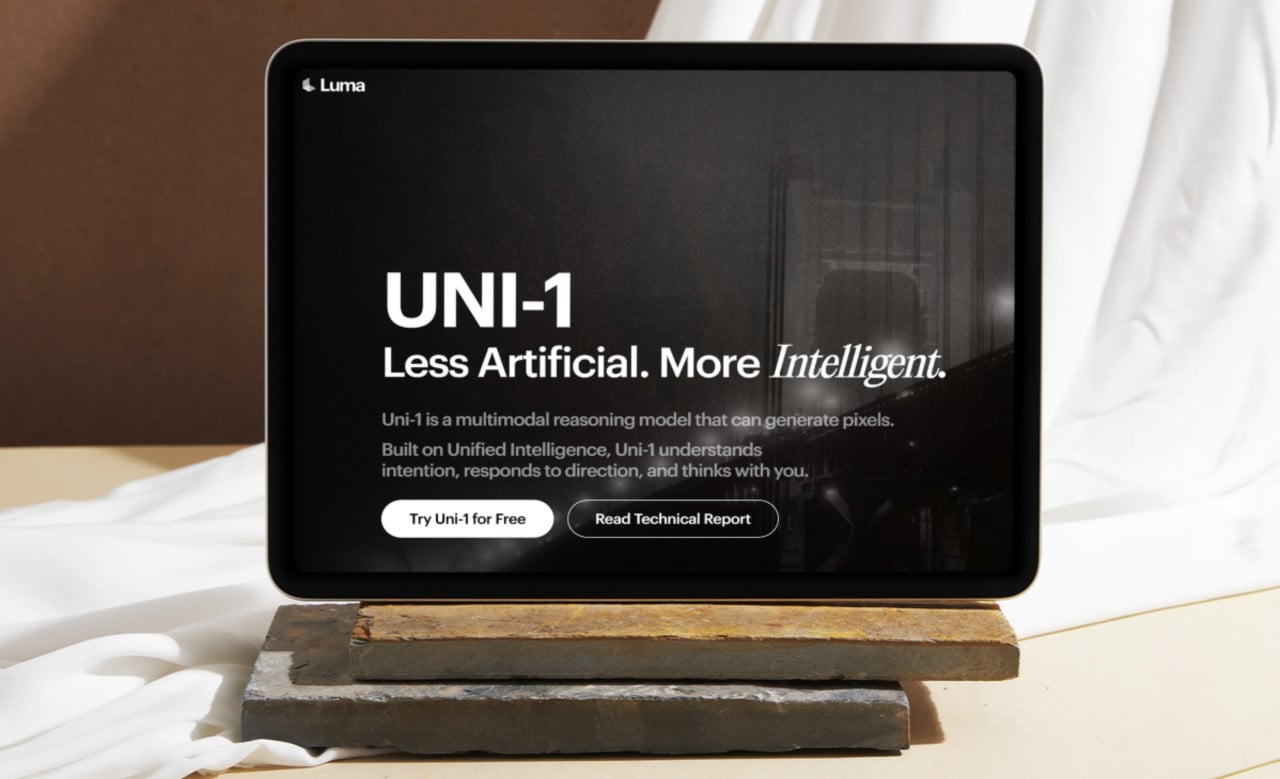
Image generation has long been the playground of truly major players such as Google, OpenAI, and Midjourney. Google's Nano Banana models even set new standards in image creation. At least until recently. At the end of March, however, the startup Luma AI shook things up by launching its first image model, Uni-1. And the results are more than interesting.
What Exactly Is Luma AI?
Luma AI is a San Francisco-based startup with just 150 employees. Until now, it was known primarily for its video generator Dream Machine, but Uni-1 has changed that.
Uni-1 marks the company's entry into the world of image models. And make no mistake, this is not just another text-to-image generator. Major companies immediately took notice, and Uni-1 is already being used by brands such as Adidas and Mazda.
What Makes the Uni-1 Image Generator Different?
The difference between Uni-1 and other image generators is not merely cosmetic. Uni-1 stands out not only for its results, but above all for the process used to create them.
Most current AI image generators operate on the principle of diffusion models. In practice, this means that an image starts as noise, from which individual shapes and objects are gradually rendered.
Uni-1 instead uses a decoder-only autoregressive transformer. Put simply, this means that the model first thinks about what it should generate and only then starts drawing. If this process sounds familiar, you are not mistaken. This is exactly how modern language models work when writing text.
Most major image systems still rely on a separate workflow: one model for understanding the instruction and another for the generation itself. Uni-1 eliminates this transition and handles everything at once. According to Luma, the result is better adherence to complex instructions, spatial reasoning, and consistency across edits. The benchmarks also demonstrate its greater persuasiveness and stronger capabilities.
Uni-1 vs. Nano Banana, GPT Image 1.5, or Midjourney
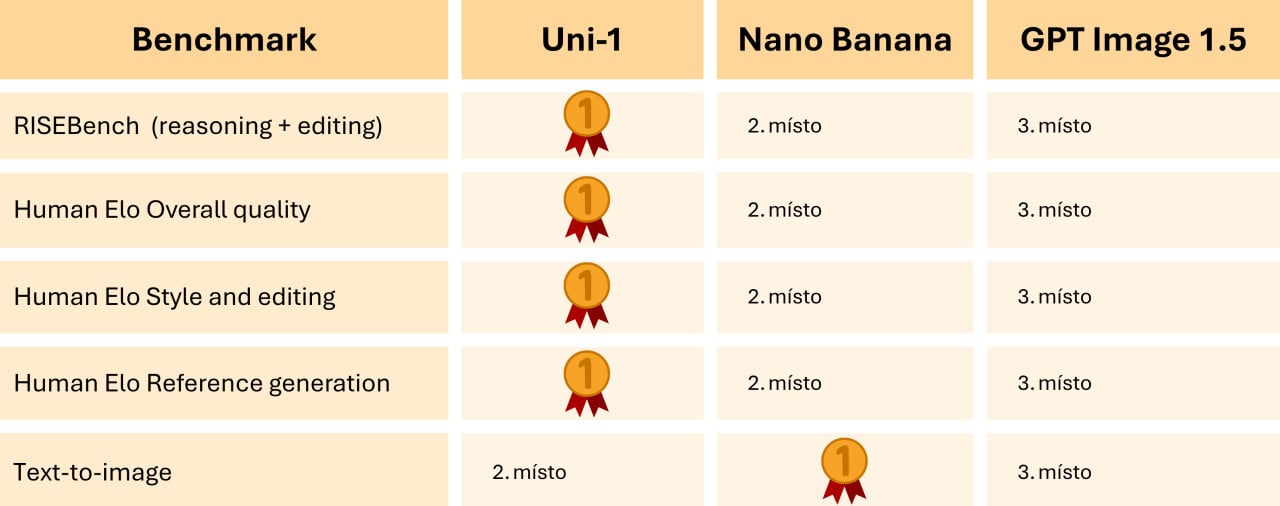
Until March 23, 2026, Google's Nano Banana had emerged from comparison tests as the clear winner, while OpenAI's GPT Image 1.5 shared second place with Midjourney. But the arrival of Uni-1 changed everything.
In the specialized RISEBench test, which measures visual reasoning capabilities, Uni-1 took first place with an overall score of 0.51. It narrowly outperformed Google's Nano Banana 2 model (0.50) and OpenAI's GPT Image 1.5 (0.46). While the differences at the top are minimal, the gap widens significantly in some categories. In spatial reasoning, Uni-1 leads with 0.58 compared to Nano Banana 2's 0.47, and in logical reasoning (which is the most difficult task of all for image models), it achieves a score of 0.32, more than double GPT Image's result (0.15).
In human preferences measured by the Elo rating, Uni-1 took first place. This included overall quality, style, editing, and generation based on reference images. However, Google Nano Banana still maintains its lead in pure text-to-image generation.
And how does it compare with Midjourney? Reviewers from The Decoder described Uni-1 as a noticeable step forward compared to Midjourney v8, which struggles with complex prompts.
Price as Another Advantage
Performance is one thing, price is another. However, Luma AI's Uni-1 excels in both areas. A Uni-1 image costs approximately USD 0.091, while Nano Banana 2 costs USD 0.101 and Nano Banana Pro as much as USD 0.134. This represents savings of up to 30% at high resolutions. And that can make a very noticeable difference for large projects.
Why Luma AI's Uni-1 Deserves Attention
Uni-1 is not revolutionary in the sense that everything else is now obsolete. The ecosystem surrounding the model and its evaluation are still in their early stages. Nevertheless, the model's architecture, greater control over generation, outputs, benchmark results, and adoption by major brands show that Luma AI is serious about its ambitions. For anyone who works professionally with AI image generation, Uni-1 is definitely a model worth trying.
Source: Luma Labs AI, Venture Beat, Revolution In AI, The Decoder