New York robotics lab and design studio Tuesday Labs has opened reservations for its home robot. Called the Voxel Series-1, it walks on two legs, and its main task will be to keep the home tidy. It will put away scattered items, bring you a book or keys, water plants, and when you cannot find your phone, tell you where it last saw it. Interested buyers can reserve one for $200, but the finished robot will cost around $20,000, and the first units will not reach customers until 2028 at the earliest.
The company describes Voxel as a robotic butler and even introduces it on its website as a gentleman in training. According to the manufacturer, the robot is meant to gradually learn the household's daily routine and ensure that everything stays in its proper place.
The manufacturer promises four basic skills. The first is a home reset, during which the robot collects items scattered around the home and returns them to where they belong. It tidies up according to the owner's preferences. The second skill is searching. Simply ask Voxel about the TV remote, a wallet, or a phone, and it will tell you where it last saw the item. The third is delivery, so it will bring you a book, a drink, or keys on request. The fourth is caring for houseplants, which it will water regularly.
To help the robot know where everything belongs, the company plans to use continuous environmental sensing and machine learning. Voxel is thus expected to gradually memorize the layout and appearance of the home and learn where individual items belong. It will then recognize an item lying in the wrong room and return it to its proper place.
However, no one should expect it to cook dinner or change a baby's diaper. The company mentions doing laundry and washing dishes only as possible future tasks. The Verge noted that if the robot can reliably remember where keys were left, people with weaker short-term memory might find a reason to pay so much for it.
Two arms, hidden eyes, and backward-bending knees
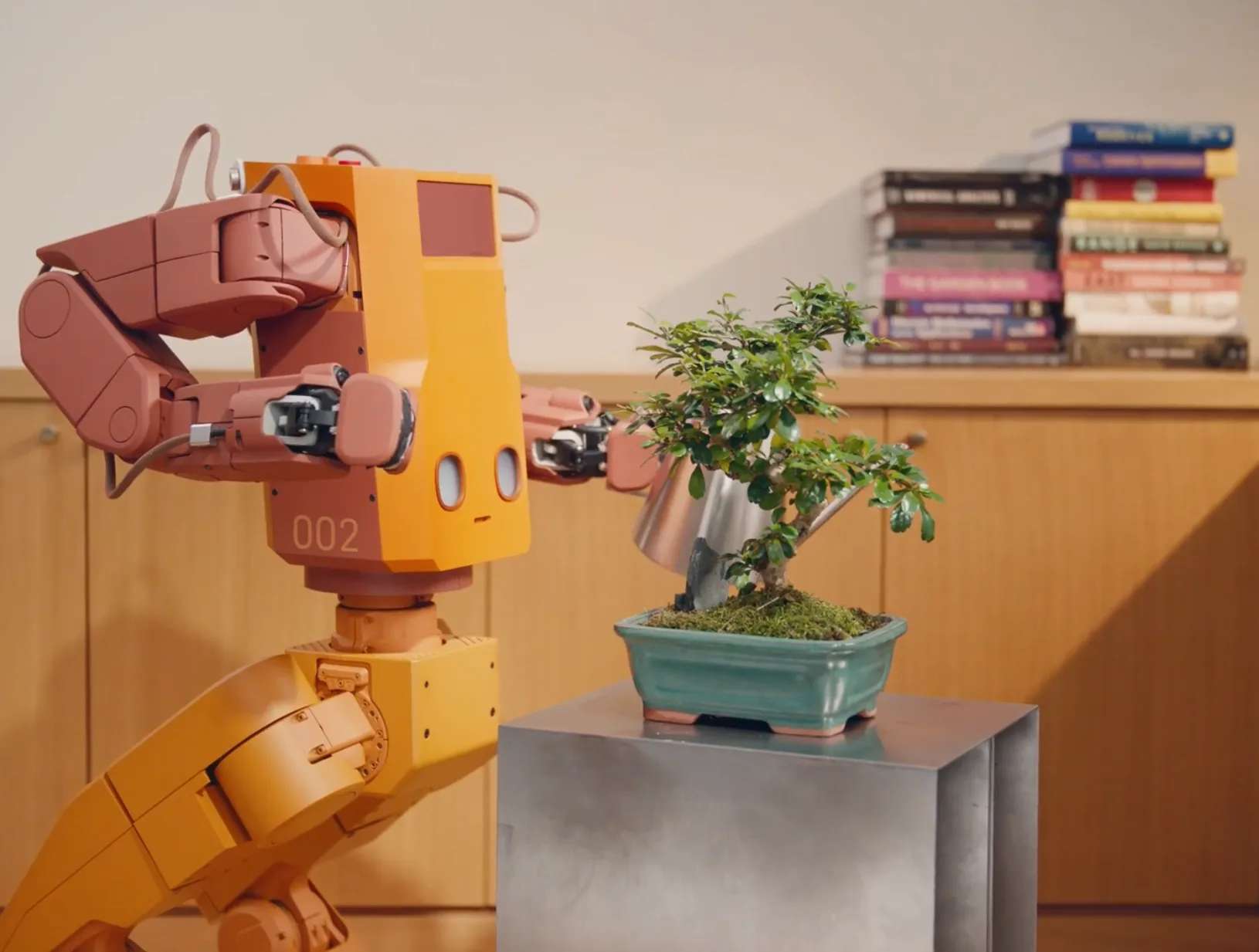
At first glance, Voxel resembles a human, although its designers have allowed themselves a few deviations. Its main tools are two arms. Each has seven degrees of freedom, meaning it can bend and rotate through seven different joints and directions, much like a human arm. This allows the robot to reach around doors, shelves, and kitchen counters and handle household items that frequently change location, such as towels, dishes, or everyday clutter.
The arms do not end in fingers, but in simple grippers that move in only one way. They open and close, which is enough to grasp, hold, pull, and release an object. While Boston Dynamics' Atlas robot has a dexterous hand with fingers, Voxel opts for a simpler solution.
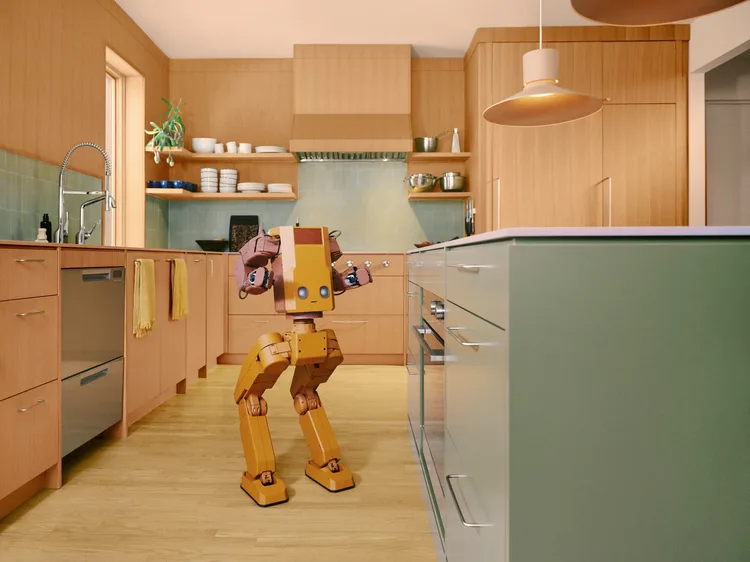
Its face also looks unusual. The robot's torso doubles as its head and has a small mouth. Its animated pixel eyes are located down by its waist, far below a pair of concealed color cameras that give the robot stereoscopic vision similar to human eyesight. Another wide-angle camera helps it monitor the entire room, recognize individual objects, and determine their exact position.
The robot walks on Z-shaped legs with knees that bend in the opposite direction from human knees. This is not a mistake, but an intentional design choice. It allows Voxel to crouch or stretch, maintain its balance, and stand close to cabinets, tables, or shelves. This makes it easy for the robot to reach items at different heights. Its feet are designed to absorb the impact of each step, and according to the manufacturer, the robot's footsteps should be as quiet as those of an adult wearing loafers on a wooden floor.
The company's design team is responsible for the way Voxel moves. Tuesday Labs works with illustrators, character designers, and animators, aiming to bring their experience with beloved on-screen characters to robots that live under the same roof as humans. The robot's movements are therefore first created using a three-dimensional model in animation software. Computer models are then trained on these movements to reproduce them faithfully in the real world. In doing so, the robot must account for gravity, sloping floors, unexpected shoves, or stumbling. The goal is not merely to prevent it from falling, but to ensure that it moves exactly as the animators intended while also adapting to what is currently happening around it.
The company devotes the same care to its appearance. According to the manufacturer, Voxel will take up a considerable amount of space in the home, so every surface, material, and point of contact is designed with the homes where the machine will operate in mind. The company claims that the best technology should require as little attention as possible.
For now, just a lot of promises
However, many questions about the robot remain unanswered. The company's website describes its components in detail but says much less about its actual capabilities and real-world benefits for the home. Voxel is still under development, and it remains to be seen whether it can reliably handle the full range of household chores. Before production can begin, the company must fine-tune its vision, walking, and object-handling capabilities to ensure safe operation around people.
A home is an exceptionally demanding environment for a robot. It is full of objects of various shapes and sizes, clutter, and items that are constantly being moved. Voxel must correctly recognize them, navigate around obstacles, and manipulate them under conditions that change every day.
Anyone wishing to reserve a Voxel will pay a $200 reservation fee, which is separate from the full price of around $20,000. Production is scheduled to begin in 2028, and the robot should reach customers during the same year. Interested buyers will therefore have to wait at least a year for their butler, and likely even longer.