

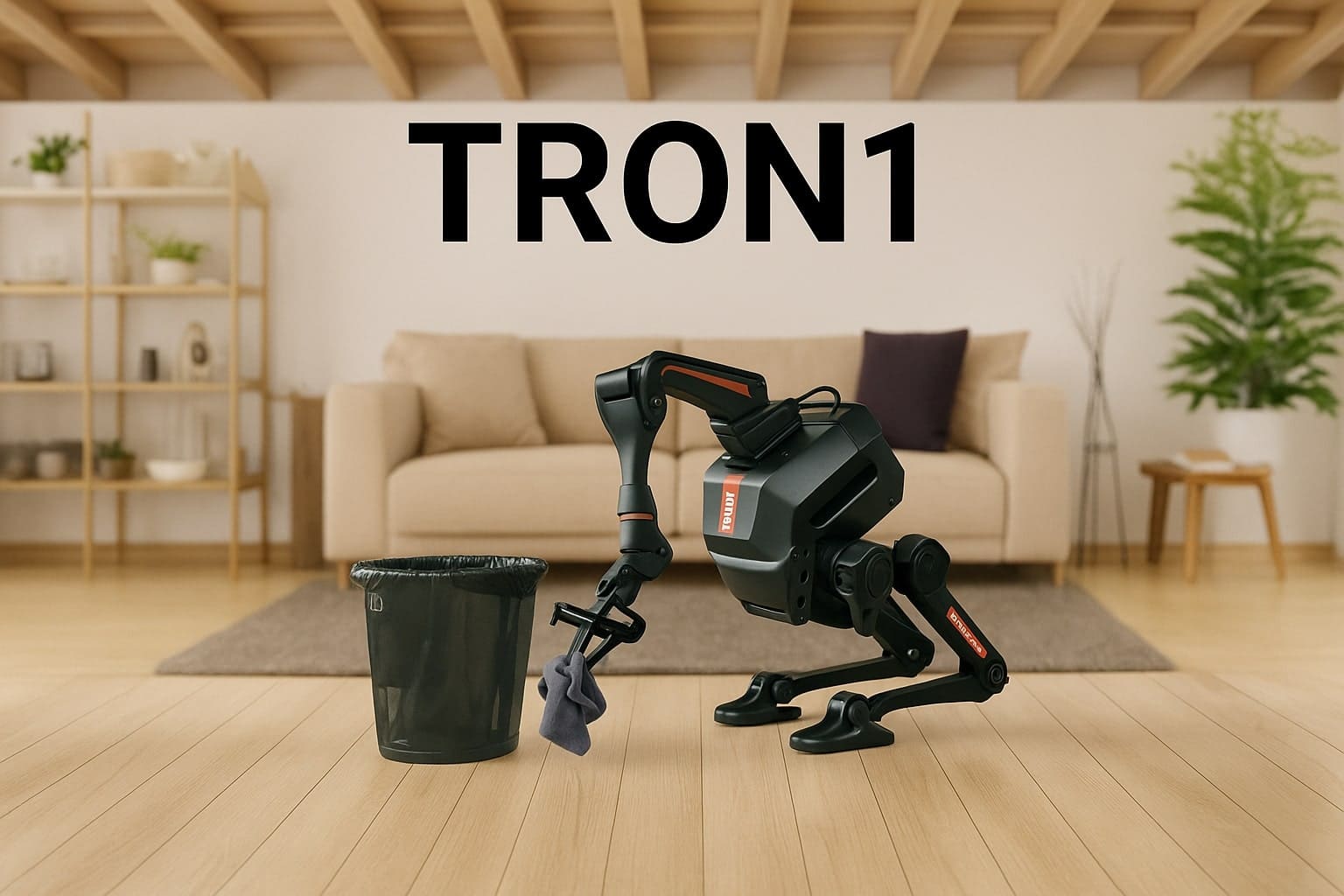
TRON1: LimX Dynamics’ multi-modal bipedal robot ushers in a new era of robotics research
TRON1 represents a significant advancement in the field of accessible bipedal robotic platforms. This innovative robot, developed by LimX Dynamics, is primarily intended for research and development in the fields of humanoid robotics, reinforcement learning, and embodied intelligence. TRON1 boasts the title of the world’s first commercially available bipedal robot with a modular foot system, allowing it to smoothly switch between three different modes of movement. This flexibility makes TRON1 an invaluable tool for researchers and developers in the field of robotics.
Technology for humanoid robotics research and development
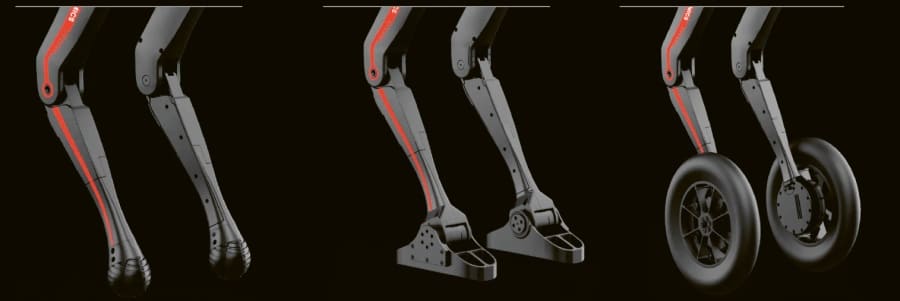
A key feature of TRON1 is its unique three-in-one modular design, which includes three distinct modes of movement. The first mode, called Point-Foot, is optimized for simple leg control and basic motion studies. The second mode, Sole, enables human-like humanoid walking, which is essential for research into anthropomorphic mobility. The third mode, Wheeled, provides high-speed movement across all terrains, with the ability to reach speeds of up to 5 meters per second or more. This versatility in a single device significantly expands the possibilities for research and applications. TRON1 is designed with user-friendliness in mind. It comes fully assembled and ready for immediate use straight out of the box. This “plug-and-play” approach eliminates traditional barriers to entry in the field of robotics research, making it an ideal platform for both beginners and professionals. Minimal setup requirements allow researchers to focus on their experiments and algorithm development instead of dealing with hardware-related technical issues.
The open development environment is another major advantage of TRON1, particularly in its educational (EDU) version. The robot offers a complete SDK with an open hardware interface, allowing developers to fully customize and extend its functions. TRON1 supports Python-based development, eliminating the need for complex programming in C++. This accessibility considerably lowers the entry barrier for new developers. In addition, it is compatible with major simulation platforms such as NVIDIA Isaac, Mujoco, and Gazebo, helping to bridge the gap between simulation and the real world (Sim2Real), which is a critical aspect of modern robotics research.
Specifications
From a technical perspective, TRON1 impresses with its specifications. The robot measures 392 x 420 x 845 mm and weighs approximately 20 kg. Despite its relatively compact size, it can carry a payload of up to 10 kg, with a maximum capacity of 15 kg. In Point-Foot and Sole modes, it moves at speeds of up to 1 m/s, while in Wheeled mode it reaches an impressive speed of 5 m/s or more. TRON1 can handle inclines of up to 15° and overcome obstacles up to 15 cm high. It is equipped with a replaceable hot-swappable battery that provides approximately 2 hours of operation on a single charge. Computing power is provided by a computer with an Intel i3 Gen12 processor, 16 GB of RAM, and a 512GB SSD. The robot is designed to operate in a temperature range from -5°C to +40°C, enabling its use in various environments.
Tron’s applications
TRON1 is used in a wide range of research fields. It is ideal for humanoid reinforcement learning research, validation of robotics algorithms, and mobility studies in various terrains. Thanks to optional robotic arm modules, the robot also expands its applications to manipulation tasks, further increasing its versatility beyond locomotion alone. Two main editions of TRON1 are available on the market. The Standard Edition is ready for immediate use but does not support secondary development or an open SDK. The Educational Edition (EDU) is a fully open platform supporting advanced customization and algorithmic research, making it an ideal choice for academic institutions and research laboratories. The base price of TRON1 starts at approximately USD 15,000 (excluding tax and shipping), representing a relatively accessible investment given its advanced capabilities and research potential.
With its robust multi-modal movement capabilities, potential for rapid prototyping thanks to its modular design, comprehensive software support including a Python API, and strong suitability for both educational settings and cutting-edge research laboratories, TRON1 represents a significant step forward in humanoid robotics. Its ability to smoothly transition between different modes of movement opens up new possibilities for research and development, making it a valuable tool for the future of robotic engineering and artificial intelligence.


