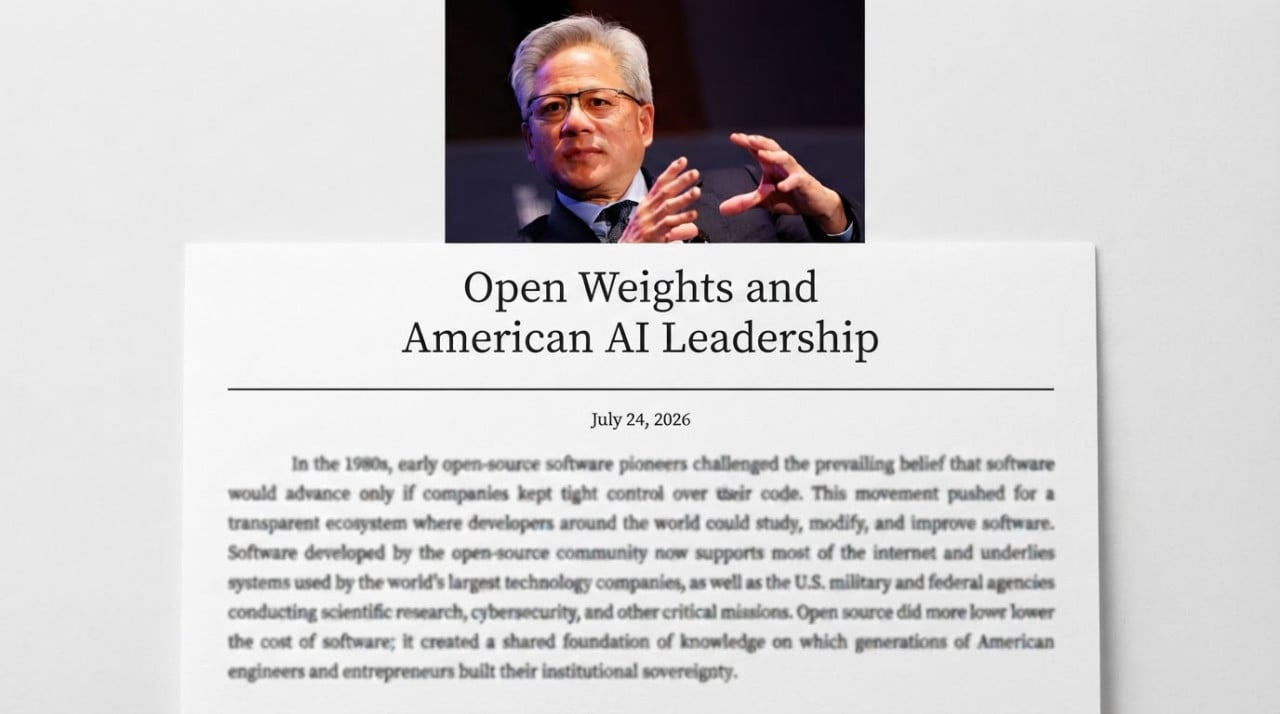
More than twenty American technology companies sent Washington one clear message: hands off open AI models. The letter, titled Open Weights and American AI Leadership, was signed by Nvidia, Microsoft, Meta, Palantir, IBM, Dell, Mistral, Mozilla, Hugging Face, and the Linux Foundation. In the letter, the companies warn against premature bans that they say would stifle competition and drive development outside the United States. They also spell out what the U.S. government should do instead.
What preceded the letter
Had the same text appeared in May, hardly anyone would have noticed it. What gave it relevance was July 16, when Beijing-based Moonshot AI released the Kimi K3 model. It outperformed its American competitors in several tests and, more importantly, it is a model with freely available weights, meaning anyone can download it and run it on their own servers. This sparked a debate in Washington over whether access to Chinese models should be restricted in America.
The following week, Treasury Secretary Scott Bessent announced that the administration would investigate whether Chinese companies were stealing American intellectual property. A day later, White House adviser Michael Kratsios made a specific accusation: according to him, Moonshot built Kimi K3 by distilling Anthropic’s technology. Distillation means that a smaller, weaker model is trained on the outputs of a larger, more capable one, transferring its skills to the smaller model. Kratsios acknowledged that this method has a legitimate place in open development, but described large-scale, covert industrial copying of American technology as unacceptable.
So the companies drafted this letter at a time when three possible measures had emerged in Washington: restricting access to Chinese models, targeting the distillation technique itself, and imposing export controls on model weights.
What the companies fear
The signatories identified two related concerns.
The first is a blanket ban or severe restriction on open models. According to the letter, such a move would fragment competition, concentrate the most powerful AI in the hands of a small number of providers, and simply push development elsewhere, outside America. The authors draw an analogy with the 1980s, when the prevailing belief was that software would advance only if companies kept tight control over their own code. The open-source movement turned that idea on its head, and today most of the internet, the systems of the largest technology corporations, the U.S. military, and federal agencies dealing with scientific research and cybersecurity are built on its achievements.
The second concern is more specific and relates directly to distillation. The companies fear that, in its eagerness to protect American know-how, Washington will overreach and ban a practice that underpins ordinary development. Training one model on the outputs of another is used for improvement, testing, and validation, and according to the letter, it continues the tradition of building technology on what others have already invented. The signatories say that unlawfully extracting value from closed models is a legitimate concern, but one that belongs in court and commercial contracts, not in a broad ban on the entire method.
How the government should respond
The companies are asking the government to expand access to computing power for startups and academic researchers. They want public investment in shared training resources—that is, datasets, tools, and model evaluation methodologies that anyone could build on. And they want America to maintain multiple cutting-edge models from multiple companies, meaning no restrictions on open models unless and until there is documented justification for them. They also mention that the application layer above the models deserves equal attention, because that is where AI reaches businesses, schools, and hospitals.
The final request directly addresses the distillation dispute: authorities should not conflate legitimate development practices with theft. Where there is genuine unauthorized extraction from closed models, targeted legal and commercial tools should be used.
The signatories acknowledge the risks of open weights. They explicitly write that once weights are released, their creator loses control over them, and modified versions can be difficult to trace or recall.
But they argue that a ban is not the answer. When attackers use advanced AI, defenders need models with comparable capabilities so they can detect, simulate, and respond to threats. Relying exclusively on closed models is not inherently safe, because they too can be breached, abused, or fail in ways that no one on the outside can see. According to the letter, concentrating the most powerful capabilities behind a handful of closed interfaces creates a few points of failure whose disruption could cripple the rest. Open models, by contrast, allow a large community of researchers to examine system behavior, identify vulnerabilities, and build protections against them. The authors argue that safeguards should therefore be tied to demonstrated harm, not to the assumption that a closed system is inherently safer.
Who signed and who did not
Nvidia CEO Jensen Huang published the text as his very first post on X. He wrote that AI will transform every industry, power every company, and be built by every country, and that open models strengthen safety, accelerate the spread of technology, and enable sovereignty. According to him, the world needs both cutting-edge closed and cutting-edge open models. Microsoft CEO Satya Nadella struck the same note in his own message later that day.
The original list beneath the letter contained twenty-five names and did not include anyone selling access to a cutting-edge closed model. OpenAI, Anthropic, and Google were absent. OpenAI President Greg Brockman said on Thursday that he had not participated in any White House discussions about restricting access to Chinese open models, adding that he believes the use of AI needs to be democratized.
For my first post, I’m sharing a letter @NVIDIA signed on why open models matter.
— Jensen Huang (@JensenHuang) July 24, 2026
AI will transform every industry, power every company, and be built by every country.
Open models strengthen safety and cybersecurity, accelerate innovation and diffusion, and enable sovereignty.… pic.twitter.com/t02bi51N4C
In the version Nvidia has since posted on its website, the list of signatories has grown to several dozen names, with OpenAI, Google, AMD, Cisco, Cloudflare, GitHub, Scale, Vercel, and SpaceX among the additions. Anthropic, whose models are at the center of the distillation accusation, is still not among them.
Money is represented on the list as well. Andreessen Horowitz and Y Combinator, two of the most influential names in Silicon Valley, signed in the first wave, alongside the funds Emergence Capital, Unusual Ventures, and Atreides Management. Their portfolios are full of companies building products on downloadable models, so any potential ban would affect their balance sheets faster than anyone else’s.
Sources: cnbc.com, businessinsider.com and theinformation.com