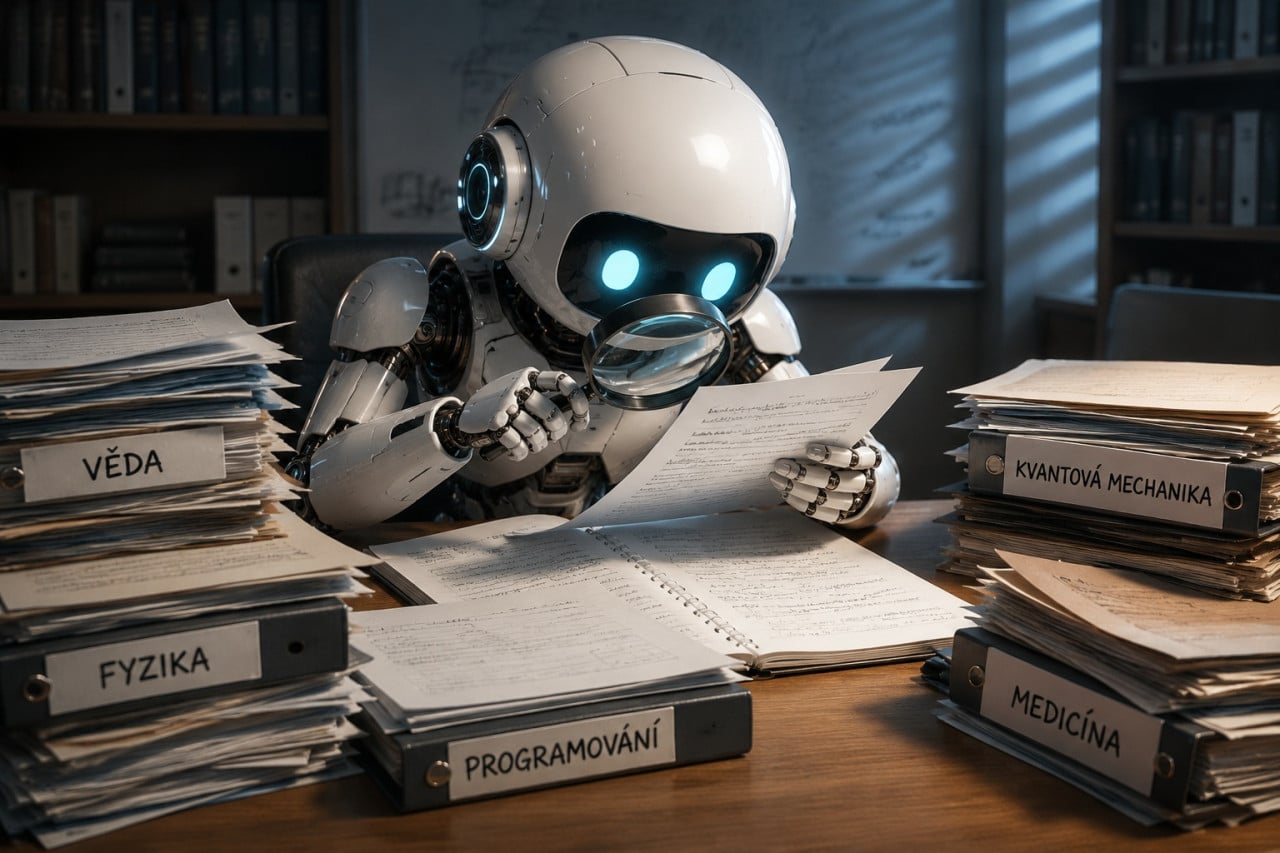
Few expected artificial intelligence to reach mathematicians before truck drivers. But it happened. One of the models recently disproved the Jacobi conjecture, an open problem that mathematicians had struggled with in vain for eighty-seven years. Terence Tao, whom most of his colleagues consider the greatest living mathematician, then asked AI to explain how it had arrived at the solution. Similarly, an important open question in quantum cryptography was resolved, and solving Erdős problems has essentially become routine for the best models. Meanwhile, employment in long-haul trucking is slightly higher today than it was ten years ago.
Machines are already smarter than us in many respects, yet the world around us looks almost the same. People still commute to work, sit at computers, scroll through their phones, and collect paychecks. Productivity is growing at a decent pace, but not miraculously so. Where, then, are the real benefits becoming apparent? We have selected ten things that artificial intelligence can do for us.
1. It will crack problems that have defeated humans
Mathematics and cryptography are the most visible examples so far. We hold only a sparse handful of facts about the world, and reason is what fills the space between them. Where that space behaves nicely—that is, where a problem has a continuous solution space and the result can be verified—AI is almost godlike. This is exactly what programming, mathematics, and most administrative work look like. And because both model performance and available computing power continue to grow, what we see today is also the worst AI will ever be at mathematics.
2. It will help doctors find treatments and free them from paperwork
In medicine, we will see benefits in two areas. The first is research. Models can help search for drugs and treatments for diseases that have plagued humanity for decades. The second is administration. Evaluating tests, transcribing data, and handling paperwork. There is also talk of robots that will assist during surgeries and reduce the risk of human error.
3. It will accelerate science, including science we do not yet know how to do
For a long time, scientists could only talk about something like this. A program capable of processing an enormous volume of data, finding patterns in it, and drawing conclusions changes the pace of research more than its fundamental nature. For decades, linguists and computer scientists tried to find the rules governing human communication, without much success. Then language models arrived, and suddenly the problem was solved in practice, without us really knowing how.
Patterns that are too diffuse and complex for a single person to imagine or pass on to someone else, yet regular enough to be useful. If other things work this way too—such as plasma, air turbulence, topological materials, or even social sciences like economics and sociology—then an entire field of knowledge opens up that not even the smartest group of humans has been able to access. And it would not matter whether the model was smarter than any particular scientist. What matters is its computational ability to keep an enormous amount of data together.
4. It will uncover hidden know-how
The best optical glass in the world is made by Germany’s Zeiss. If one of the mirrors it supplies for ASML lithography machines were the size of Germany, the largest irregularity on its surface would measure one millimeter. No one knows exactly how Zeiss does it, not even the people at Zeiss. If the process could be written down in documentation, China would have stolen it long ago, just as Huawei once hacked Cisco and Nortel. If several former employees could explain it, they would receive millions of dollars for doing so.
That knowledge is distributed among hundreds of people who do not themselves know which of their minor habits make the result so good. China’s dominance in rare-earth refining, which local companies have spent four decades building, works in a similar way. AI could disrupt this. Give workers on the factory floor glasses with cameras, sensors on their gloves, and detectors throughout the facility, let a model connect all the data, and it will begin suggesting minor improvements. Most attempts will fail, some will succeed, and the next round will begin immediately. This is not about intelligence; it is about rapidly processing enormous amounts of data. Companies that currently lag behind the best could catch up much faster.
5. AI will be unlimited
The number of human minds is determined by fertility, which we have no way to increase. On the contrary, it is declining, and humanity will begin to shrink. This limitation does not apply to AI. Build another data center, run more agents in parallel, and you get more intellectual work done. It is not free, but neither is it finite. It is ordinary physical capital that you can expand whenever you decide to invest part of your earnings. As a result, the ratio of capital to labor in society will shift, and every person will have an army of machines at their disposal.
6. Robots will perform physical work
A great deal of work is physical, and that requires a machine. That is why so many people in the field have recently turned to robotics and models of the physical world. They are being helped by the rapid development of batteries, which makes energy easy to store and transport. In short, digital tools and physical tools arrived at the same time. Interestingly, intelligence in robots is divisible. An ant-sized robot can be remotely controlled by a data center the size of a football field. Humans cannot do that.
7. It will get you from point A to point B faster and more safely
Self-driving cars were long just a dream, but computer vision has brought them into reality. Estimates suggest that more than thirty million such vehicles will be on the roads by 2040. Even before AI becomes widespread in autonomous cars, however, it will make its mark in navigation systems capable of calculating the truly best route and in traffic analysis, including finding a better route during congestion. A side benefit is lower fuel consumption.
8. It will advise farmers and help with the climate
Agriculture and artificial intelligence may not seem like a natural fit at first glance, but the benefits are quite practical. Programs help farmers decide how to manage soil and water, provide weather forecasts, recommend when to irrigate, and advise which sprays to use and whether they are needed at all. Machine learning is also being used in the fight against climate change, from developing renewable energy sources to finding ways to reduce emissions so that governments can make decisions based on better information.
9. It will watch over your money
Banks and insurance companies can now examine an individual client’s financial history in great depth and offer tailored recommendations. The second application is even more useful: fraud detection. A model monitors account activity and transfers, and when it detects typical signs of fraudulent behavior, it raises an alert. For both the institution and the individual, this can mean the difference between a normal day and financial collapse.
10. It will have your back online
Network defenders long felt that they were constantly falling behind attackers. Data breaches are increasing, and so is malicious code. AI can deploy defenses across devices, servers, and entire networks, detect an attack before it fully unfolds, and immediately limit its impact. This applies to intrusion attempts, ransomware, and conventional viruses.