

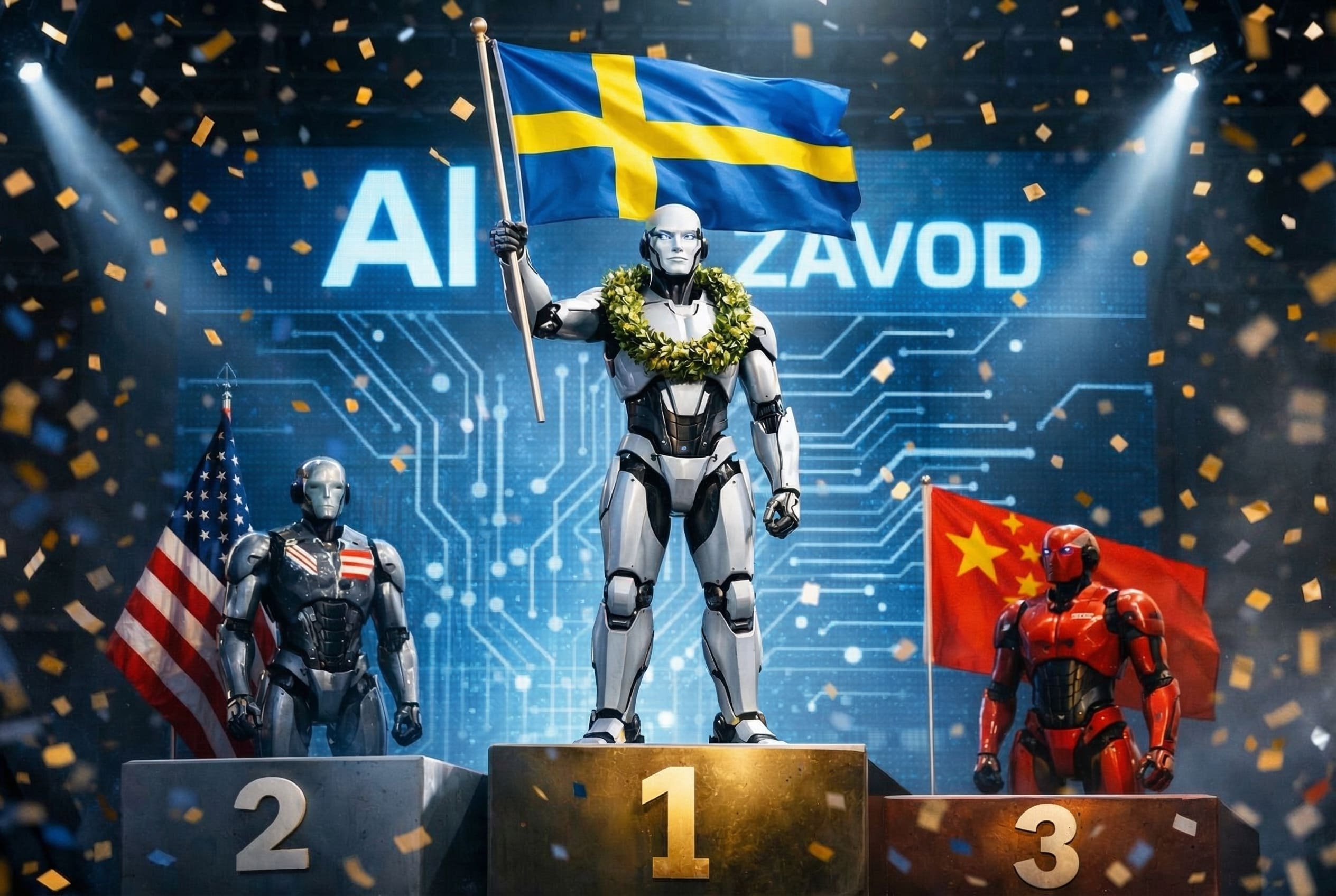
Sweden is becoming a true powerhouse in artificial intelligence (AI). The country, with a population only half that of New York State, produces more unicorns—startups valued at over one billion dollars—per capita than anywhere else outside Silicon Valley. In 2024, Swedish startups raised €2.4 billion (approximately CZK 60 billion) in venture capital, the highest per-capita figure in Europe since 2020. Overall, AI in the Nordic countries, led by Sweden, attracted a total of $35.1 billion (approximately CZK 807 billion) in investments from public and private sources between 2023 and 2025. All of this is helping to create an independent ecosystem where startups focus on ethical and sustainable solutions.
A History That Laid the Foundations
It all began in the 1990s, when the Swedish government launched the Hem-PC-reformen program, which aimed to put a computer in every household. This move helped create a generation of digitally literate people who went on to establish global success stories such as Skype in 2003, King (the creator of Candy Crush), also in 2003, Klarna in 2005, Spotify in 2006, and Mojang with its game Minecraft in 2009. These companies—such as Skype and Mojang, which were sold to Microsoft for billions of dollars, or Spotify and Klarna, which went public—created wealth that is now being reinvested. Many of these millionaires are now investing in new AI projects.
Examples of Successful AI Startups
Swedish AI companies specialize in specific fields, such as climate technology and healthcare, while emphasizing ethics. For example, Grasp raised $7 million (approximately CZK 161 million) in a Series A round for market analysis tools used in global trade. Cytely received $3 million (approximately CZK 69 million) for an AI microscopy platform that accelerates drug discovery. Meva Energy secured $46 million (approximately CZK 1.058 billion) in debt financing for renewable biogas technology. ZeroNorth, which uses AI to reduce emissions in shipping, has raised $53.3 million (approximately CZK 1.226 billion) to date. ClimateView helps cities achieve climate neutrality with AI and has raised $15.1 million (approximately CZK 347 million). Altris AB develops sodium-ion batteries for energy decarbonization. Lovable, an AI-powered app development platform, is growing rapidly and personalizing customer interactions in retail.
Other notable examples include Legora, which automates tasks for lawyers and is raising capital at a valuation of $1.8 billion (approximately CZK 41.4 billion). Einride, an electric vehicle unicorn, recently announced $100 million (approximately CZK 2.3 billion) to expand autonomous freight transport. Sana, focused on educational AI, was acquired by Workday for $1.1 billion (approximately CZK 25.3 billion). Norway’s Riff raised $16 million (approximately CZK 368 million) for an enterprise AI platform emphasizing ethics and regulatory compliance.
Why Does Sweden Excel in AI?
Sweden spends 3.57% of its GDP on research and development, the highest share in Europe. By 2025, AI accounted for 0.63% of the Swedish economy, with usage increasing by 140% between 2023 and 2025. The government supports entrepreneurship—every employee can take six months off to start a business under the tjänstledighet scheme. This year, the prime minister backed an AI reform that provides agentic AI free of charge to government employees, students, teachers, research institutions, and nonprofits. A strong social safety net reduces risks for entrepreneurs, and the country has a high level of English proficiency. Investors such as EQT, Northzone, and Creandum provide capital, while universities such as KTH and Handelshögskolan cultivate talent.
Swedish culture also helps—from the design of Volvo and IKEA, where function meets form, to the emphasis on trust and information sharing between companies. The long winter nights of the 1990s led people to experiment with computers and the early internet. The aforementioned Nordic companies integrate ethics through the Nordic Ethical AI Expert Group, setting them apart from American giants that, together with China, control 87% of the global AI market. In 2024, Nordic startups raised $8 billion (approximately CZK 184 billion) in investments, often from funds such as Mubadala or Temasek.
Challenges and Opportunities
Although Sweden is growing, returns on investment are slower than in other European countries, and many companies view AI more as an IT tool than as a business transformation. This creates opportunities for investors who can help scale these models. The Nordic approach, focused on sustainability and values, offers an alternative to the profit-driven American model and addresses global issues such as climate change and data governance. In the third quarter of 2025, American AI startups received 62.7% of all venture capital investments, but Sweden is building long-term value through partnerships with governments, academia, and investors focused on ESG (environmental, social, and governance factors).
Sources: ainvest.com and fortune.com


