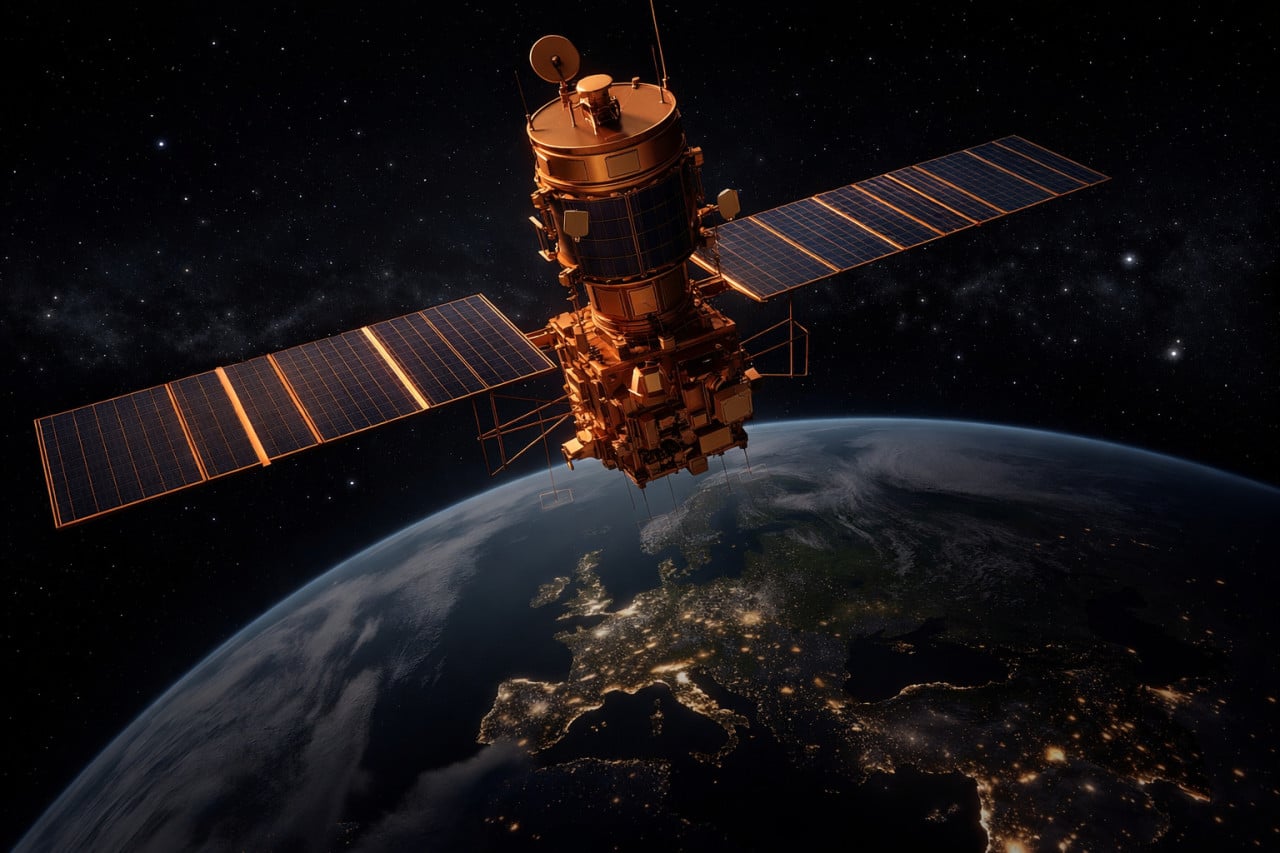
Data centers powering artificial intelligence require large amounts of electricity and water, and local communities are increasingly rejecting them. The solution? Move them into Earth orbit! And make no mistake, this is no story from the future. The startup Starcloud already has a functioning satellite in orbit equipped with a powerful GPU chip and has become the first company in history to train an AI model there.
Starcloud: A Billion-Dollar Startup in Orbit
If you have never heard of this startup, we can begin with some surprising figures. Starcloud raised $170 million from investors in its Series A round, bringing its total valuation to $1.1 billion. All this came just 17 months after the company first unveiled its concept for space-based data centers to the public. This made it the fastest startup in Y Combinator's history (a program for developing early-stage companies) to achieve unicorn status.
So what exactly does Starcloud do? In November 2025, the startup partnered with SpaceX and launched its first satellite, Starcloud-1, equipped with an NVIDIA H100 chip. It thus became the first company in history to train an AI model in space while also running a version of Google Gemini there. The mission confirmed that the hardware could reliably process AI workloads.
The next major milestone is expected to be the launch of the Starcloud-2 satellite later this year. It is set to deliver up to 100 times the performance of its predecessor and will carry the NVIDIA Blackwell B200 chip, considered the most powerful AI chip currently available.
Why Space?
Terrestrial data centers currently face a dual crisis. One issue is their enormous energy consumption, while the other is opposition from local communities unhappy about the construction of gigantic data centers. Space is therefore emerging as an elegant solution to these problems.
In space, solar panels can collect energy for up to 99% of the year and generate 5–13 times more electricity annually than terrestrial solutions. And cooling? In space, it does not require a single drop of water. Satellites dissipate waste heat through thermal radiation directly into the vacuum.
Other Major Players Are Joining the Race
Is Starcloud the only space pioneer? Definitely not. Elon Musk's xAI was recently merged with SpaceX through an acquisition, and one of the goals is to build space-based data centers.
Google, meanwhile, is working on its Suncatcher project, while Jeff Bezos has placed his bet on Blue Origin, which is developing technology for space-based data centers. NVIDIA has also taken a major step. At GTC 2026, it unveiled the Space-1 Vera Rubin Module and IGX Thor platforms, designed specifically for orbital data centers.
The largest orbital computing cluster currently in operation is run by the Canadian company Kepler Communications across 10 satellites.
A Deceptively Simple Solution
Although orbit may appear to solve the problems facing terrestrial data centers, the reality is unfortunately somewhat more complicated. The cost of launching technology into space remains a key obstacle.
Orbital data centers could become competitive with terrestrial data centers once launch costs fall to approximately $500 per kilogram of payload. For now, however, this price remains out of reach.
The Future of AI
Space-based data centers are more than just a technological curiosity. Their implementation could significantly shape the future of AI infrastructure. They are one of the few ways to increase computing power without further straining power grids and the environment. It appears that the race for space-based data centers has most likely already begun.
Source: TechCrunch, GeekWire, Introl, CNBC, NVIDIA Newsroom