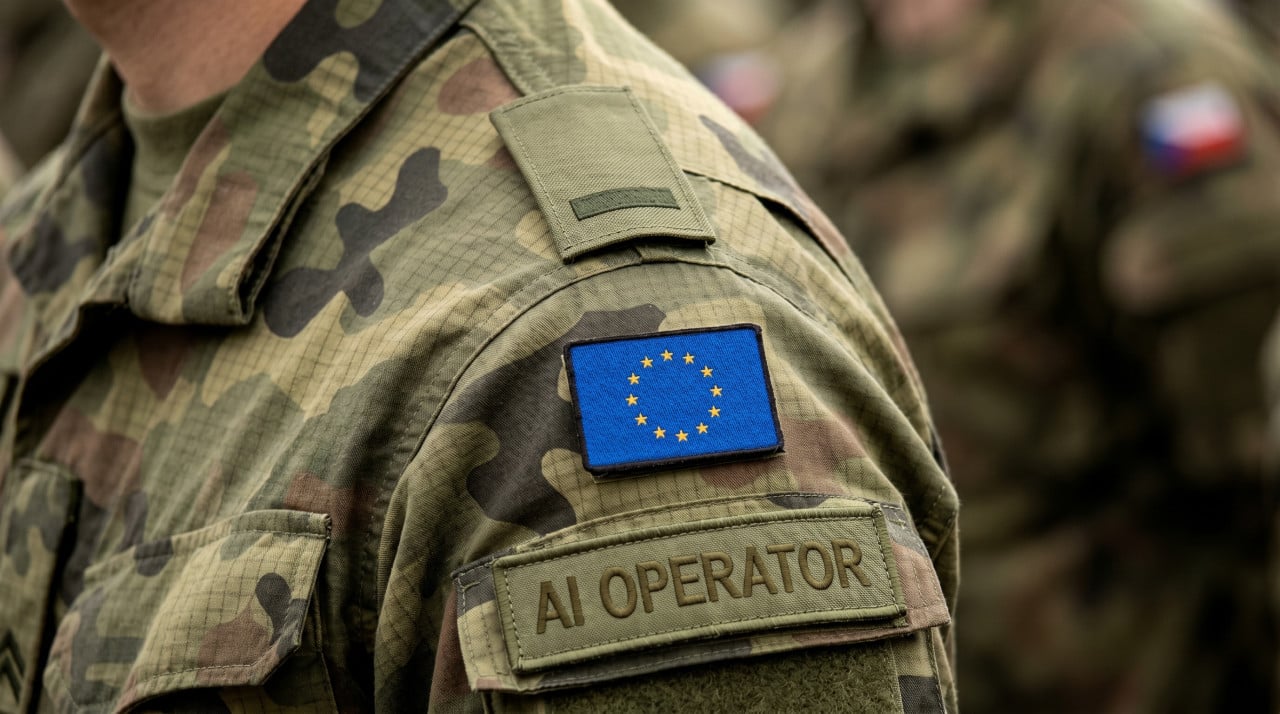
The European Commission has announced an investment of more than one billion euros in 57 new defence projects under the European Defence Fund. Drones, satellites, cyber technology. These are the recurring themes. But behind them lies one more specific common denominator that holds this entire investment together: artificial intelligence. AI permeates most of the selected projects, whether in real-time threat detection, autonomous decision-making on the battlefield, or the protection of communication networks.
Project STRATUS: AI and drone swarms
One project is attracting more attention than the others. STRATUS aims to develop an AI-powered cyber defence system whose main task will be to neutralise drone swarms. Not a single drone, but dozens or hundreds of unmanned aircraft attacking in coordination. Why is this difficult? Because traditional defence systems simply cannot cope with such speed and density of targets. A human cannot react quickly enough. An algorithm must react instead.
What sets the project apart from the others is the involvement of a Ukrainian subcontractor. Kyiv brings something that no laboratory in Brussels or Berlin possesses: direct experience from combat where drones serve as cheap, fast, and lethal weapons used every day. This combination of Europe’s technological base and Ukrainian frontline know-how is precisely what the Defence Readiness Roadmap 2030 identifies as a strategic opportunity.
DIALOG-AI, AI-SHIELD, and secret language models
If STRATUS has convinced you, wait until you see the rest. EDF 2025 is funding a range of projects that deploy AI directly in command and intelligence processes.
Project DIALOG-AI (Defence Innovative Assessments and Live-tests of Operational Generative AI) focuses on deploying generative artificial intelligence for operational planning and intelligence assessment. In other words, it is a system that helps commanders process information more quickly and make decisions under pressure.
AI-SHIELD is developing a system that enables meaningful cooperation between humans and artificial intelligence in life-or-death situations where every second counts. The name is no coincidence: the goal is to guard against errors that occur when people are under extreme stress and must make decisions quickly.
And then there is LLM Secret: a project involving large language models intended exclusively for European defence and security. Sovereign, trustworthy, and independent of commercial platforms. The military cannot afford to send operational plans through the servers of American technology giants. That is why the EU is building its own.
MIDAS (Middleware for Intelligent Defense AI Dialogue Systems) then connects these systems into a functional architecture capable of communicating across command levels.
AI in radars, robots, and at sea
Artificial intelligence in EDF 2025 is not confined to command tents. It is going directly into weapons and sensors. Under the 2026 calls that build on this year’s results, the EDF is allocating funding for an AI-optimised radar system capable of tracking hypersonic glide vehicles and unmanned aircraft in a dynamic environment. Conventional radar cannot do this quickly enough. An algorithm can.
Thirty million euros is being directed to AI-based tactical situational awareness projects for small robots and drones. A machine that independently assesses the terrain, identifies a threat, and recommends an action. Without having to wait for a human command. At sea, a multi-domain naval combat cloud is also being built, with AI processing data from various platforms and sharing it in real time. What used to take hours should take seconds.
The Spin Defender project uses spin-based neural networks to process radio-frequency signals directly at the network edge, meaning where they are needed most—right at the sensor—without the latency caused by sending data to a remote data centre.
Why the EU is finally betting on AI
In 2025, Russia spent more than 7 percent of its GDP on defence. Chinese investment in defence technologies is growing every year. And the United States, until now the guarantor of European security, is shifting its attention elsewhere.
Europe must respond. The Defence Readiness Roadmap 2030 openly states that technological superiority is the backbone of deterrence. And AI is mentioned in the document as a factor that will determine the ability to produce critical systems for modern warfare: drones, satellites, command and control systems, and secure cloud environments.
The Commission therefore intends to accelerate access to datasets for training AI models and reduce the administrative burden on companies developing these systems. Training a high-quality military AI model without access to relevant data is like building a car without steel.
Of the 634 participating entities from 26 Member States and Norway, startups and small businesses account for more than 38 percent of participants. They receive more than 21 percent of the total funding. And under sub-calls focused on the mass production of drone munitions, smaller companies with no previous defence experience can receive up to 60,000 euros to integrate new innovations.
Behind all these projects lies one deeper question. Can Europe afford to rely on American or Chinese AI platforms for its most sensitive military operations? The answer is obvious, and the EDF is taking it seriously.
Project LLM Secret best symbolises this approach. Europe wants its own large language models, trained on its own data, operated on its own infrastructure, without dependence on foreign servers and without the risk of information leaks. It is a more expensive and complicated path, but apparently a necessary one for the defence of the continent.
Grant agreements with the consortia should be signed by the end of 2026. Then the real work will begin: testing, fine-tuning, and deployment. And the AI that today exists only in project documents will begin appearing on radar screens, in the ears of military commanders, and in defence systems protecting European airspace.
Additional sources: eunews.it and kurzy.cz