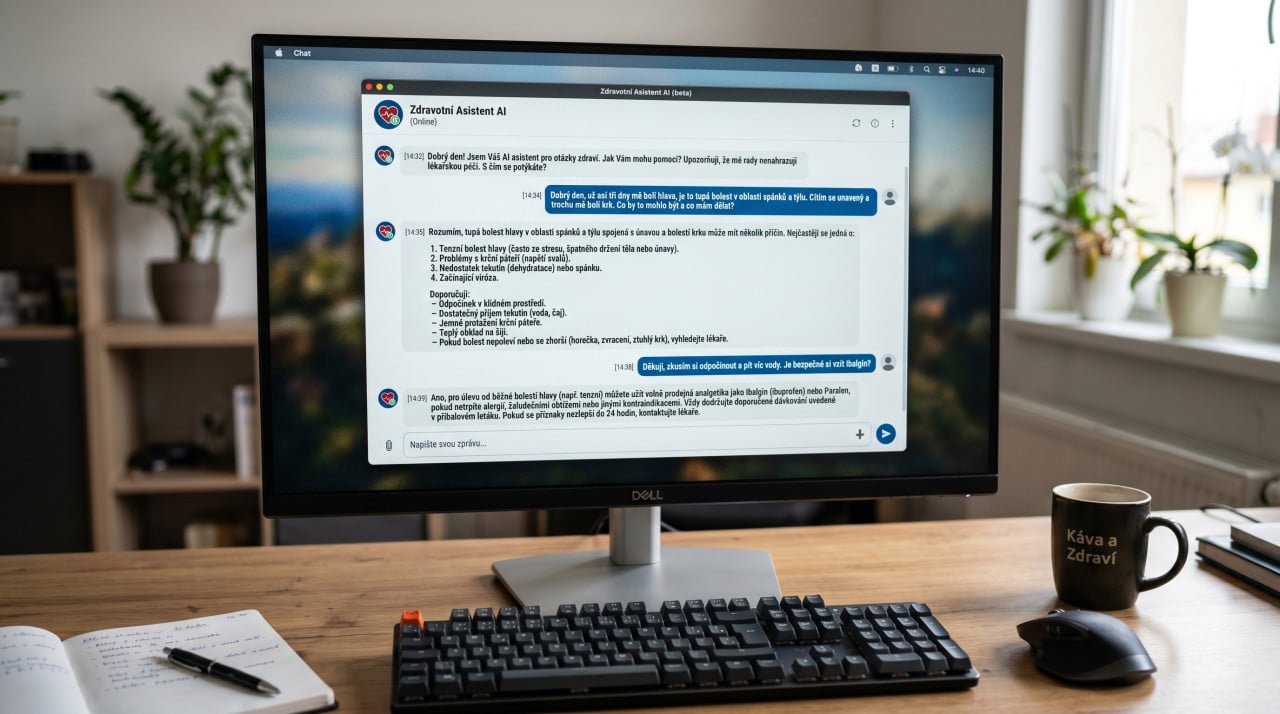
Tiffany Davis is 42 years old, lives in Mesquite, Texas, and takes weight-loss injections. When she develops a symptom or simply does not feel well, she does not reach for the phone to call a doctor. She opens ChatGPT. “I simply describe how I feel and what my condition is," she says. “I use it for everything I experience."
Her approach does not seem particularly unusual, because a quarter of American adults, or more than 66 million people, have used an artificial intelligence tool or chatbot for health information or advice in the past thirty days. This is according to a large-scale survey conducted jointly by West Health and Gallup. The research took place from October to December 2025 and involved more than 5,500 respondents. Put simply, people are no longer going straight to a doctor and are instead exploring the situation with artificial intelligence first.
Why do people choose AI instead of a doctor?
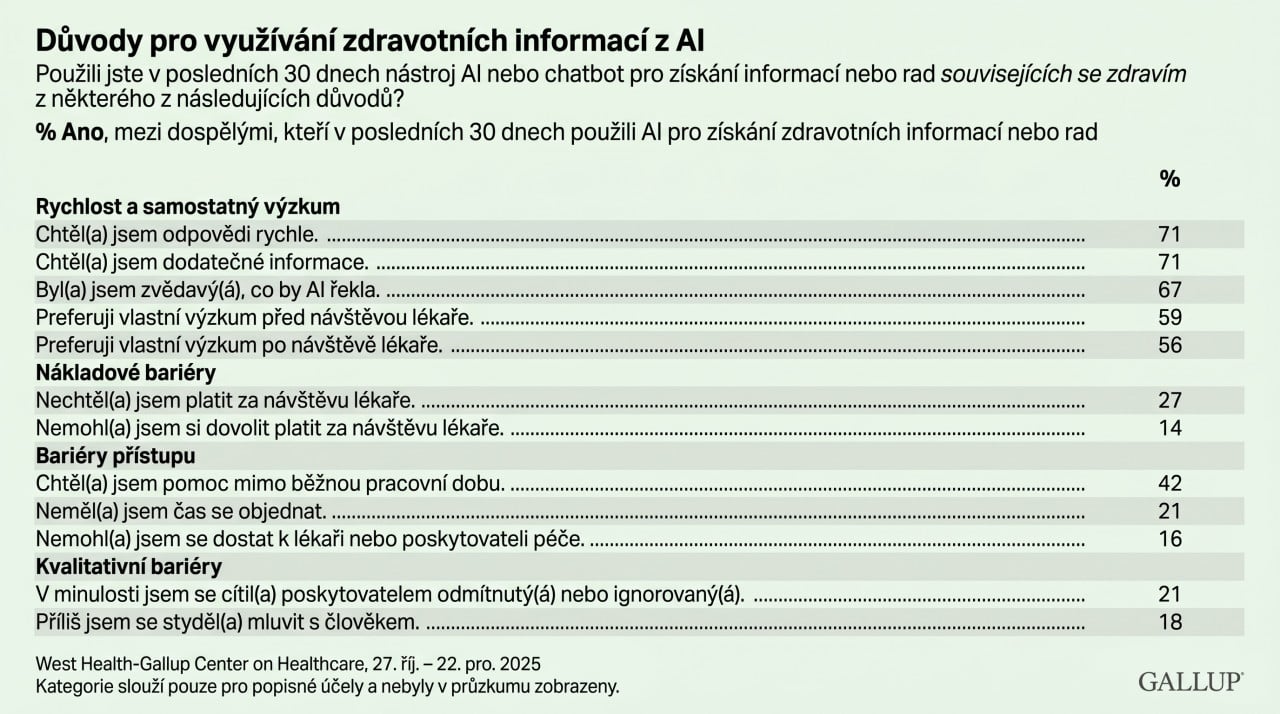
The answer is simple. Most people do it because they want quick answers. 71% of recent users said they wanted information immediately. The same percentage were looking for additional information, and 67% were simply curious about what AI would tell them.
More than 59% of users use AI to do research before seeing a doctor, and 56% use it after an appointment to better understand what the doctor actually told them. Rakesia Wilson, a 39-year-old assistant school principal in Alabama, knows this well. She regularly uses ChatGPT and Microsoft Copilot to find out whether she even needs to see a doctor. “I simply don't have time when it's something I consider minor," says the woman, who sometimes works up to 70 hours a week.
But some people turn to AI for a different reason. 27% of recent users admitted that they did not see a doctor because they did not want to pay for the visit. 14% simply could not afford it. 16% could not even get access to a doctor because they were unable to contact one. And 21% had previously felt dismissed or ignored by a doctor.
AI as a substitute for care?
Dr. Karandeep Singh, chief health AI officer at University of California San Diego Health, sees it simply. “I see it as a better gateway to searching the web," he says. Instead of browsing through twenty links, you get a summary. And let's admit it, who among us has not done that? Entering symptoms into Google and then spending an hour reading various websites is a classic.
The most widely used tools remain general-purpose conversational systems such as ChatGPT or Copilot (61%), closely followed by AI summaries in search engines such as Google (55%).
What do people ask about most often? 59% ask about nutrition and exercise, and the same percentage ask about physical symptoms. 46% want to understand medication side effects, 44% need medical information explained, and 38% investigate a diagnosis or medical condition. A quarter of users (24%) even use AI to address mental health or emotional issues.
Interestingly, 46% of users say AI helped them feel more confident when talking to a doctor. That sounds like good news. But then there are the less reassuring figures.
14 million Americans skipped seeing a doctor because of AI
14% of recent users of AI for health information said that, based on this information, they skipped a doctor's appointment that would otherwise have taken place. Extrapolated to the entire adult population of the United States, this represents approximately 14 million people.
Although these people are making decisions about their health based on AI advice, they do not fully trust this information. Only 4% of users strongly believe in the accuracy of AI-generated health information. One-third trust it, one-third do not, and one-third are unsure. 11% even admit that AI recommended information or advice they considered dangerous. That is a significant cause for reflection, as millions of people are skipping a visit to the doctor based on advice they themselves do not fully trust.
Doctors are not panicking, but they have reservations
Dr. Bobby Mukkamala, president of the American Medical Association and an ENT specialist, is among those who are not sounding the alarm. On the contrary, he says he is pleased when patients arrive with better questions than they used to have. “It is an assistant, not an expert. That is why doctors must be involved in care," he adds.
But AI users themselves also have concerns. Three-quarters of American adults are very or somewhat concerned about the privacy of the health data they share with chatbots. At the same time, most people do not even realize that settings exist to prevent their conversations from being used to train future models.
Last summer, it also emerged that private ChatGPT conversations had been indexed on the public web without users knowing. Tamara Ruppart, a 47-year-old executive from Los Angeles, has a clear approach to AI because of her family's history of breast cancer: “Health is a serious matter. And when it goes wrong, you can really hurt yourself." She is right. And yet those 66 million Americans consult AI about their health every day.
Additional sources: westhealth.org abcnews.com