In the days before Enlightenment ideas had permeated the legal system, the law regarded women as wards of men, who held complete authority over them. This principle was firmly embedded both in statute and in court proceedings. In Texas, for example, all of a woman’s property passed into her husband’s hands upon marriage, and he disposed of it as he saw fit. Women could not serve on juries, there were no female judges or prosecutors, and no woman was admitted to the Tarrant County bar until 1932.
At the turn of the twentieth century, divorce was becoming an increasingly urgent social problem. The family was seen as an institution under threat, Christian values were in decline, and civil courts were struggling with a flood of divorce petitions. Men were particularly concerned. Some states considered laws that would protect a wife if her husband defamed her. An even more radical proposal stipulated that the party filing for divorce would never be permitted to marry again. This debate was not confined to decadent eastern metropolises. In 1900, Tarrant County Assistant County Attorney Jefferson McLean proposed federalizing divorce law so that a uniform law would apply throughout the country. Such radical solutions coming from a member of the upper classes must have horrified husbands across the nation. If women received equal treatment in divorce proceedings or, God forbid, federal civil rights protections, it would mean the end of civilization as men had always known it.
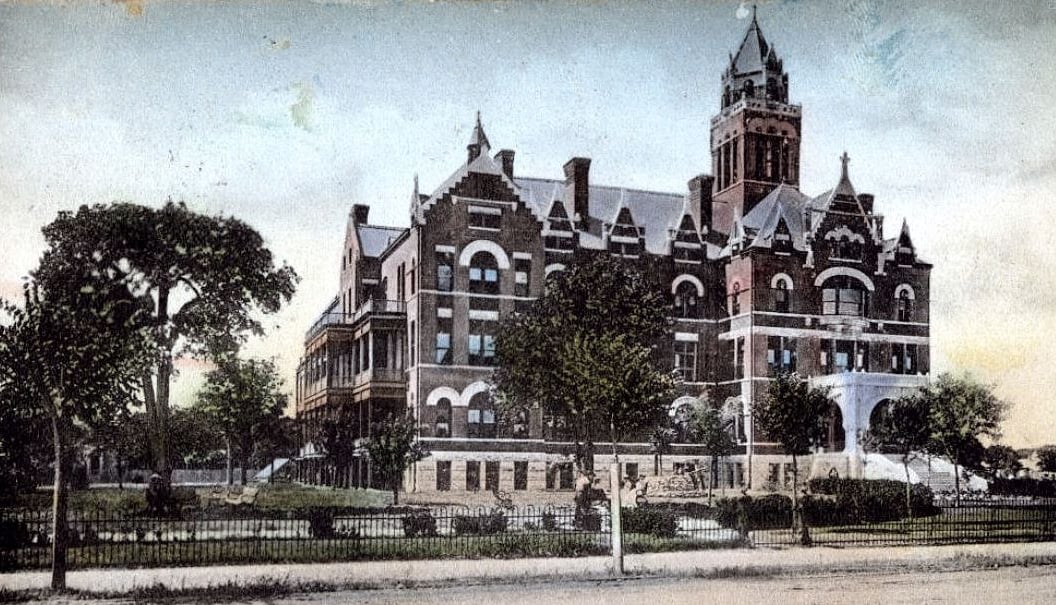
Fortunately for husbands, there was another, entirely legal solution. If a wife became a burden or a source of trouble, he could get rid of her without a lengthy and expensive divorce. All he had to do was persuade the county court to declare her insane and have her committed to an institution. Sanity hearings were conducted before a judge and jury much like criminal trials. The crucial difference was that the accused woman did not have to be present or legally represented. In 1904, the Texas Sheriffs’ Association recommended that such proceedings be conducted by the county physician together with the county attorney instead of a jury, but the proposal went nowhere. A well-connected man could even dispense with that formality: at his request, a judge would sign a commitment order and the wife would be hurried away. The husband could choose between a state institution, such as Terrell State Hospital, where the state would care for the woman, or a private facility. Private institutions for the mentally ill were euphemistically called “sanitariums” and could appear very welcoming from the outside. One such facility also existed in Fort Worth: Arlington Heights Sanitarium (AHS), standing on the windswept prairie five miles west of the city.
AHS opened in 1906 and was operated by Doctors Wilmer and Bruce Allison together with John S. Turner. They described their facility as “a quiet retreat... with a strictly ethical approach,” specializing in “nervous conditions, selected cases of mental illness, and drug and alcohol addiction.” But that was only half the truth. In reality, they served an exclusive clientele seeking discreet care for their loved ones. The institution had rooms for forty patients of both sexes and, for those who could afford it, offered a markedly better alternative to the state hospital in Terrell.
Although those confined in private facilities enjoyed the best care money could buy, they nevertheless remained victims of a judicial system that treated women and children as the property of the head of the family, entirely without rights of their own. Three cases from Fort Worth’s history clearly illustrate how this system worked and how ugly things could become: the commitments of Mary Couts Burnett, Lena Sneed, and Irene George made front-page news because the women refused to be locked away and forgotten without a fight.
Mary Couts Burnett was the second wife of Samuel Burk Burnett, a wealthy cattleman and patriarch of one of Texas’s most powerful families. She came from a family in Parker County and had previously been the widow of Claude Barradell. Burk Burnett married her in 1892 after divorcing Ruth Loyd Burnett, the daughter of his banking partner, Martin B. Loyd. In most cases, divorce would have ended the business partnership, but not here. During the happy years of their life together, Mary and Burk had a son, Burk Jr., and Mary became a prominent figure in Fort Worth society. Around 1911, however, the marriage began to falter. Mary resented Burk moving their son’s wife and granddaughter into their home, and she liked the fervent attention he lavished on them even less. Burk, perhaps fearing an expensive divorce, filed a petition with the court accusing Mary of “hallucinations” and “hopeless insanity.” According to reports, she accused him of attempted murder. His friends testified against her, as did Dr. H. L. Warwick. A six-man jury concluded that Mary suffered from a “mental disorder,” and on May 24, 1911, ordered her commitment. As the ultimate insult, the court appointed Burk her legal guardian, giving him full control over both her person and her property. After a brief stay in Terrell, he had her moved to a private home in Weatherford, where she received kind care but remained cut off from the world. She spent the next eleven years there and was not even allowed to attend Burk Jr.’s funeral in 1916.
On June 27, 1922, Burnett died. He left a detailed will that excluded Mary entirely and bequeathed nearly everything to his granddaughter Anne. That same day, Mary left Weatherford, returned to Fort Worth, and turned to her longtime physician Charles Harris, one of the area’s most respected doctors and a self-proclaimed expert on mental illness, to help her overturn the insanity judgment. Together they retained William J. Slay, one of the most successful local attorneys, who filed suit in county court. After Judge Hugh Small declared her “of sound mind,” she contested the will and had it invalidated, thereby becoming entitled to the “widow’s half” of the largest estate ever probated in Tarrant County up to that time. She prevailed and walked away with approximately three million dollars. For his efforts, Harris received a handsome fee of $25,000, and Slay was also duly rewarded by the newly wealthy widow. Mary did not enjoy her wealth for long, however; she died on December 16, 1924, at the age of sixty-eight. She left most of her estate to TCU. After her death, she was effectively erased from the history of the Burnett family for good.
The case of Lena Sneed was even more tangled because it involved murder and the entire story unfolded in the pages of the local newspapers. Like Burk Burnett, John Beal Sneed was a man from a privileged background, the cunning son of a wealthy cattle-ranching family, accustomed to getting his way. The object of his desire was Lena Snyder, a spirited and headstrong young woman. They married in 1900, when he was twenty-two and she was twenty. Ten years later, Lena fell in love with Al Boyce Jr., told Beal that she was crazy about him, and asked for a divorce. Instead, in the fall of that year, Beal obtained a medical opinion and, without any proceedings whatsoever, secured a court declaration that she was “morally insane.” In accordance with her husband’s wishes, she was placed in the private Arlington Heights Sanitarium indefinitely. Beal had not reckoned with the power of love, however: less than a month later, Al rescued Lena from the institution, and the two fled to Canada. Sneed accused him of “abduction” and hired a private detective to track down the lovers. They were found in Winnipeg, and Sneed managed to persuade his wayward wife to return. Boyce remained in Canada and fought extradition, while Lena returned to the sanitarium, this time under stricter supervision. An attorney hired by the Boyce family secured a hearing before Judge W. T. Simmons of the Sixty-Seventh District Court. Given the absence of formal commitment papers and any evidence of Lena’s insanity other than her husband’s word, the judge ordered her release.
The enraged Beal Sneed could not get at young Al, so he turned his attention to Al’s father. On January 13, 1912, he ambushed him at the Metropolitan Hotel and shot him dead. He was tried for murder in the Seventeenth District Court and invoked the “unwritten law” in his defense, arguing that he had merely defended the sanctity of his home. In court, the defense thoroughly called Lena’s sanity and moral character into question. The all-male jury sided with Beal and acquitted him. Beal and Lena reconciled, and it might have seemed that the matter was over. But it was not.
Nine months later, on September 14, 1912, Sneed finally caught up with Al Jr. in Amarillo and shot him dead in the street. Once again, an all-male jury, this time in Vernon, acquitted him under the Texas “unwritten law.”
The third case is the story of Irene George, whose husband, W. R. George, had her placed in Arlington Heights Sanitarium on January 30, 1911, after what everyone described as a “nervous breakdown.” Like Lena Sneed, she was literally maneuvered into the sanitarium: her clothes were taken away and she was kept in isolation without contact with the outside world. A sanity hearing was held on March 22, 1912, and Irene was not permitted to attend. She was accused of “moral insanity,” a controversial medical term for a person considered morally unfit to live in respectable society. The doctors at Arlington Heights soon rid themselves of Irene and transferred her to the state hospital in Terrell, apparently because she was a difficult patient or because her family was unable to pay for her stay. The doctors in Terrell found her sane and released her into her family’s care. Unlike Mary Couts Burnett and Lena Sneed, Irene had the support of her husband. Together they sued the sanitarium and its doctors for “false imprisonment.” In county court, the entire case then depended on whether a twelve-man jury found her sane.
In the end, the judicial system had it both ways: the jury affirmed Irene George’s sanity, allowing her to proceed with her lawsuit against the doctors in district court, but there the judge cleared the defendants of the charge of false imprisonment. Everyone seemed to have won: Irene was declared sane, and the authority of the medical establishment remained intact.
At least the women in these cases were spared the humiliation of having their photographs published in the newspapers, which was especially surprising for such well-known figures as Mary Couts Burnett and Lena Sneed. In Burnett’s case, neither she nor her ruthless husband wanted their faces filling the newspaper pages while he was trying to have her locked away. In Lena Sneed’s case, her husband’s legal battles lasted nearly two years and cast a spotlight on their marriage the entire time, yet her photograph appeared in the newspapers only twice, and each time it was the same nondescript file photo. Perhaps the Star-Telegram followed the old rule that the name (or photograph?) of a respectable woman should appear in the newspaper only three times: at her birth, at her marriage, and at her death.
Legally, none of these cases changed anything fundamental. None became a landmark decision establishing new law. Male doctors continued to believe that women who behaved “strangely” suffered from a mental disorder, and their medical credentials allowed them to make such accusations without any factual evidence. The accused woman was generally neither present in the courtroom where her fate was decided nor legally represented. Irene George’s doctor testified that he “did not consider her mind sound” and ordered her commitment because “isolation would be beneficial to her.” Such testimony was entirely commonplace in courtrooms of the era. None of these three women had the slightest chance once a credible (male) person accused her of insanity. The real struggle for freedom could begin only after they had been locked away, and without legal representation and habeas corpus proceedings, they had little hope of prevailing over their (male) accusers.