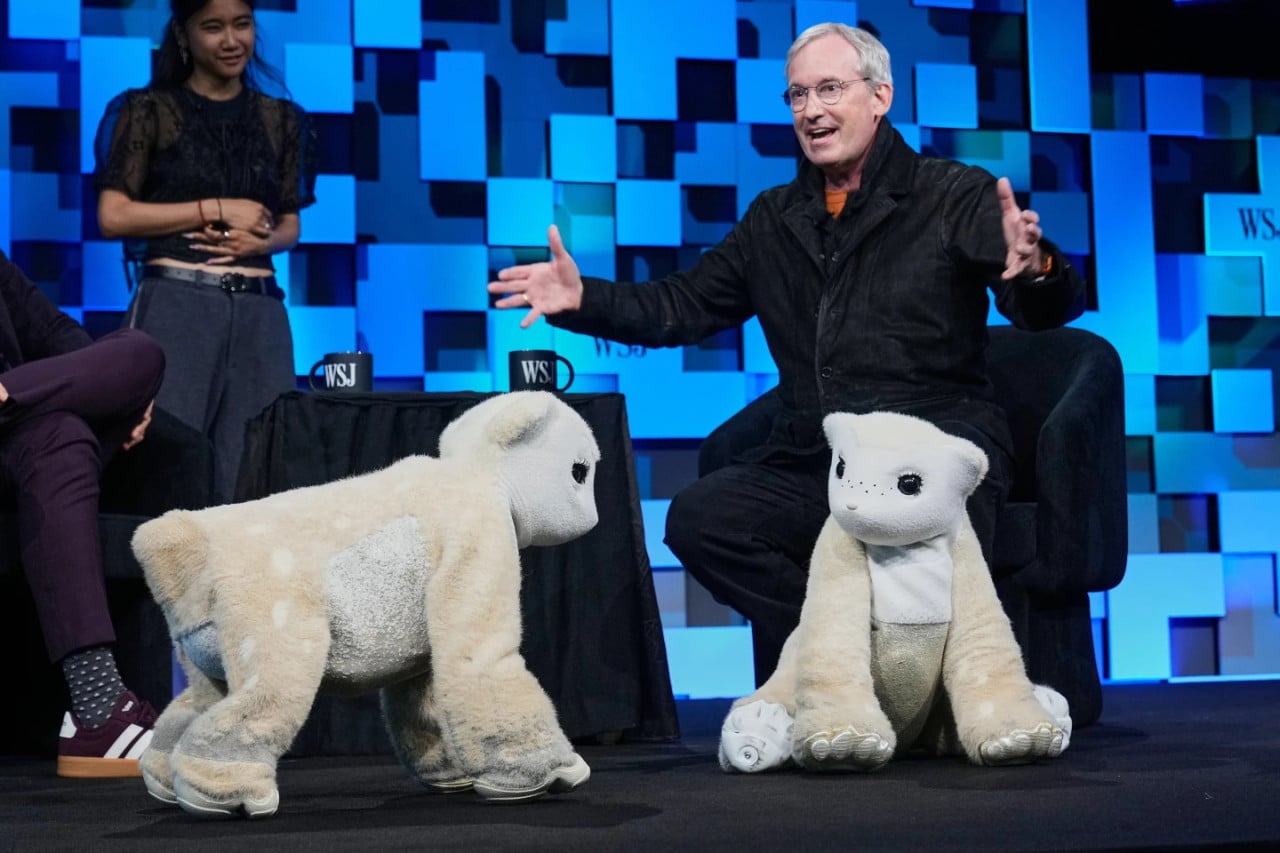
The man who gave the world the Roomba robotic vacuum cleaner has a new idea. Colin Angle has unveiled a four-legged robotic pet named Familiar and wants you to one day enjoy petting it, hugging it, and taking it for walks. Just like a real animal. The bulldog-sized machine, with gentle eyes and paws like a bear cub’s, stretches into a welcoming pose when it meets you and invites you to pet it. Its fur is artificial, but it can sense touch.
Angle is behind the startup Familiar Machines & Magic, based in Woburn, Massachusetts. Before that, he spent a quarter of a century leading iRobot, the company that made the Roomba. And he admits: “I couldn’t have done this six months ago.”
That is because Familiar works thanks to the latest generative artificial intelligence. The same technology that powers chatbots such as ChatGPT. The robot has “ears” for audio input and an artificial intelligence system that understands what you say to it. It gradually adapts to the people around it, learns their habits, and changes its behavior. It does not speak; it makes animal-like sounds. But it understands.
Angle deliberately avoided imitating existing animals. “We chose a form that isn’t human, dog, or cat because we wanted to sidestep all those preconceptions,” he explained in an interview with the AP news agency. The word “familiar” comes from folklore. It refers to the animal companions of witches and wizards, such as cats or owls, or to creatures from Philip Pullman’s fantasy novels, His Dark Materials. “It’s an archaic, ancient word,” Angle says. And to his surprise, it was even available to register as a trademark.
This is not the first attempt at creating a robotic pet. The Japanese company Sony introduced the plastic robotic dog Aibo in the 1990s and revived it in 2018. But Angle believes Familiar achieves something “that simply hasn’t existed before.”
For people who fear commitment
When will Familiar be available? We will have to wait for a direct answer. Angle has not launched sales yet. One of the target groups is retirees who are past the age when they usually get pets. “Not because they’ve stopped enjoying them, but because the fear and commitment involved in caring for them are so great that few people are eager to get a new pet later in life,” Angle says.
The robot could also be used in retirement homes or as a source of emotional support in mental health care. This is highlighted by Maja Matarić, a professor of computer science at the University of Southern California. Twenty-five years ago, she co-founded the field of socially assistive robotics with the aim of creating machines capable of providing people with emotional support. When she first saw Angle’s prototype, she immediately lay down on the floor and began petting and examining it. “Decades of research into human-robot interaction show that a robot that is cute, personalized, and vulnerable is much more appealing and endearing to people than the alternative,” Matarić says.
MIT team pushes back against the humanoid trend
Angle works with renowned pioneers in robotics. Marc Raibert, founder of Boston Dynamics and a pioneer of robotic locomotion, is among his advisers. So is Cynthia Breazeal, who created the robotic head Kismet and later the desktop talking robot Jibo. These were early attempts to give robots social expressiveness.
Many of them worked together at the Massachusetts Institute of Technology. And they share skepticism about the current trend toward sleek humanoid robots that may walk like humans but are practically incapable of doing anything physically useful. Matarić adds: “Before generative artificial intelligence, robots couldn’t easily understand what people were saying to them.” That has now changed, opening the door to robots like Familiar.
From the Roomba to a downfall and a fresh start
Angle’s journey to Familiar has not been without difficulties. iRobot turned the Roomba into the first mass-market household robot. Then fierce competition arrived, particularly from China, and the company began to struggle. Amazon planned to acquire iRobot but ultimately withdrew from the deal. Angle stepped down as CEO and chairman of the board in 2024.
Familiar Machines was founded shortly afterward and operated in secrecy until Angle brought the prototype to New York in May 2026 for The Wall Street Journal’s Future of Everything conference. Winston and Daphne, as the two demonstration models are called, stretched, wagged their tails, and showed the audience what generative artificial intelligence can do when given a body made of faux fur and four paws.
Source: abcnews.com