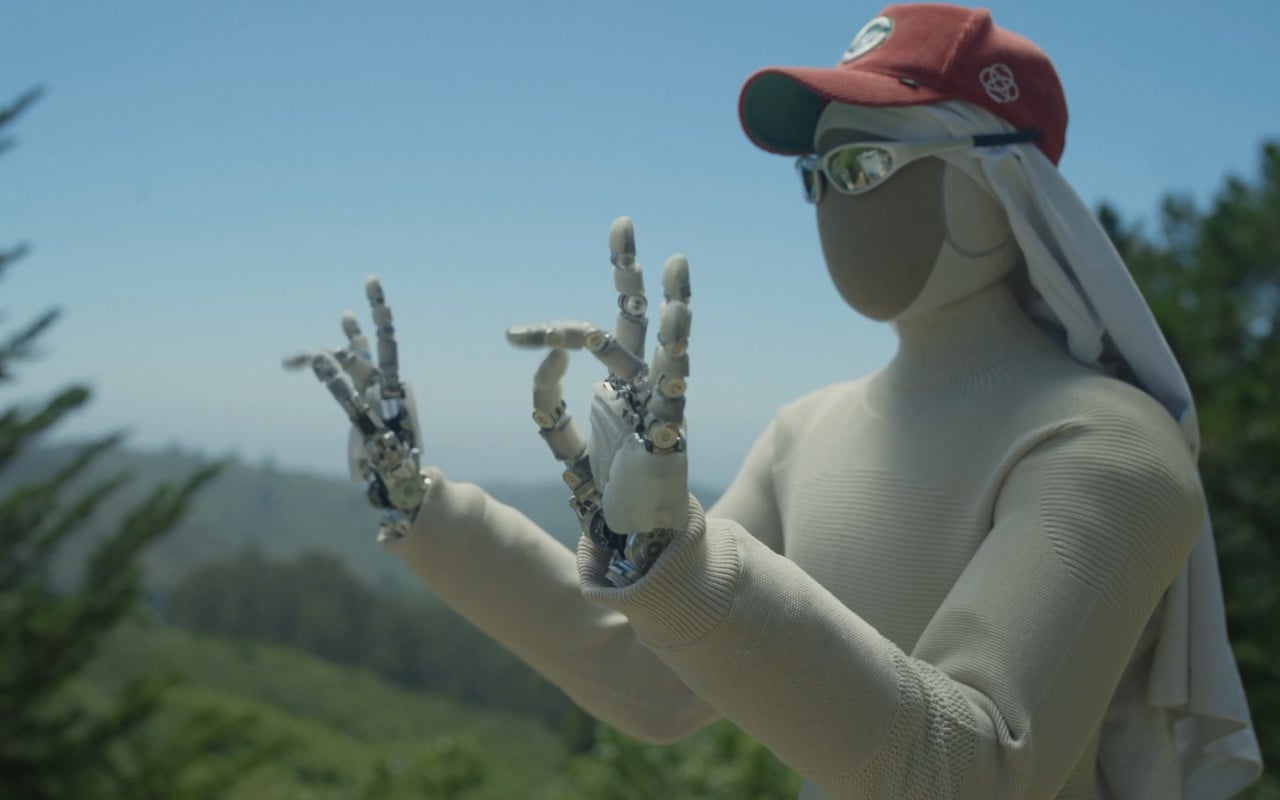
California-based company 1X from Palo Alto has unveiled new hands for its NEO robot. They have 25 degrees of freedom, are tendon-driven much like human hands, and according to the manufacturer, approach human dexterity, strength, and reliability. The goal was to give the robot a limb that not only grasps an object but also gathers information about it. NEO can now handle almost anything humans do with their hands.
Until now, humanoid machines had run up against one harsh reality. It was not the software or the cameras. The problem was at the end of the arm. A standard two-finger gripper can do three things: lift, put down, and push. And everything anyone programs it to do is merely a repetition of these three movements. 1X claims it has now removed this limitation.
Fingers that ask questions and get immediate answers
Pick up an unfamiliar object. You squeeze it to find out how hard it is. You run a finger over its surface, weigh it in your hand, and trace its shape. You rarely look at the object while doing so. This is exactly the principle that 1X engineers wanted to transfer to a machine. According to them, touch is not a passive channel like a camera feed. It is an experiment. The hand asks a question by applying force and reads the answer through the same joints.
Most robotic hands cannot do this. They operate in only one direction. You specify a position, the hand moves there, and no useful information comes back. The gearbox is usually to blame. With common gear ratios of 100:1 or 200:1, friction absorbs touch forces before they can even reach the motor. The robot is therefore insensitive through its own joints, so companies cover it with external sensors.
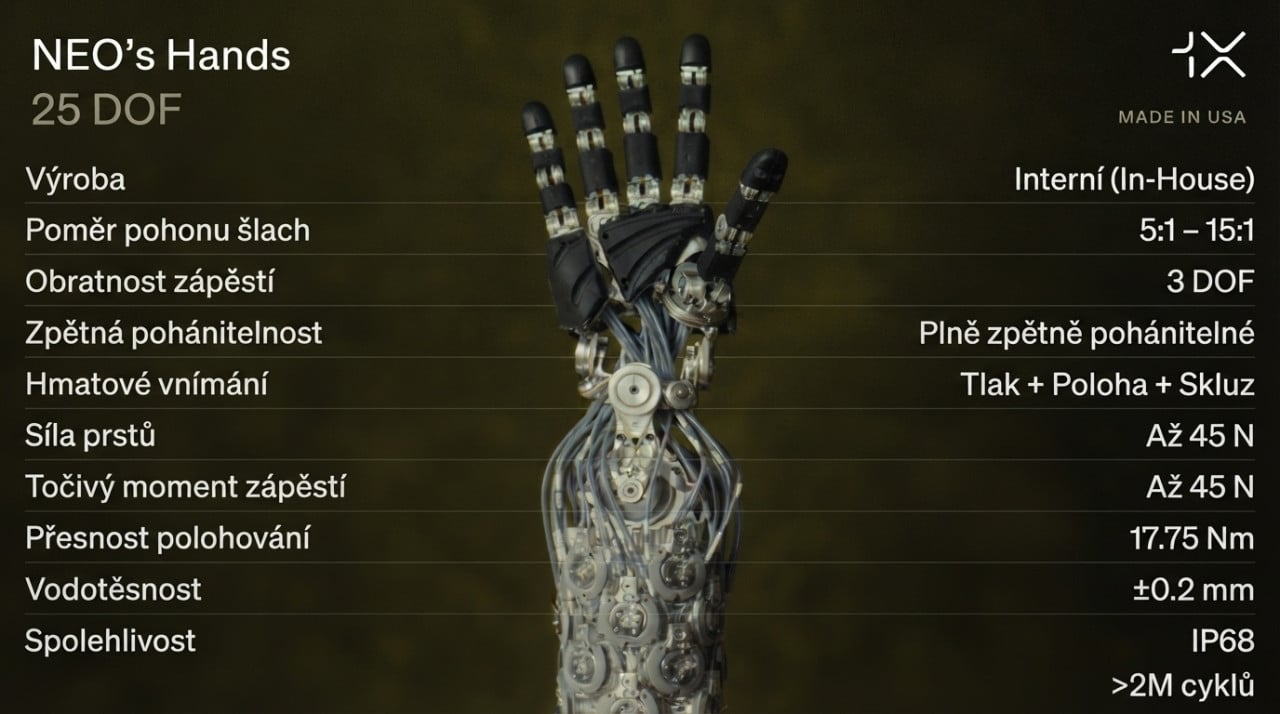
NEO’s hand solves this differently. It uses a tendon drive with very low gear ratios of roughly 5:1 to 15:1. All 25 degrees of freedom (22 in the fingers and palm, plus three in the wrist) are force-controlled, and the joints can also be moved by external force. When you push on a finger, it yields while simultaneously reporting how hard you pushed. Force travels outward, while information returns along the same path. The company calls this force transparency, and it is what turns an ordinary push into a measurement.
Another quiet sense operates alongside it. The hand always knows what position it is in without having to look. Much like you can touch your fingertips together with your eyes closed.
NEO’s Hands
— 1X (@1x_tech) July 9, 2026
An API to the Physical World pic.twitter.com/zds5rlxfzT
Capabilities of NEO’s hands
The list of skills is long and quite specific. NEO can build a LEGO structure, pick individual screws and coins out of a wallet, screw in and replace a light bulb, use a screwdriver, and rotate an object directly in its palm. It can zip up a jacket, sort grapes by color, pour tea from a kettle, catch a soft ball, plug in a USB-C charger, grasp a wine glass, and wipe a surface with a paper towel and cleaning spray. It can also communicate using sign language.
Dexterity is one thing; strength is another. Peak torque reaches 3.5 Nm in the thumb and 2.6 Nm in the finger joints, while flexion force at the fingertips reaches up to 45 N. The wrist can exert 17.75 Nm of torque. The hand can therefore produce a firm whole-palm grip, handle tools, lift and carry objects, open doors, and push a loaded cart. At the same time, it maintains positioning accuracy of two-tenths of a millimeter, which is precisely the realm of small objects where most human work takes place.
Artificial skin is like human skin
The final half-millimeter is handled by artificial skin. It covers the fingertips and other surfaces, sensing normal force, contact location, and shear. This allows NEO to detect when an object begins to slip and react in real time. The company shows footage of the hand gently holding fragile origami without damaging it, as well as pressure maps recorded during a handshake.
The skin is designed together with the sensors inside and the tendons behind it. For many tasks, vision alone is not enough, especially with small, transparent, soft, or obscured objects. This is precisely where tactile feedback is crucial.
Built to last
A hand that learns by touching everything must also be highly durable. That is why 1X designed for reliability from the outset, from tendon routing and bearings to electronics. Entire fingers and drive units underwent millions of test cycles, the motors were tested at extreme temperatures, and the wrist joints withstood more than two million cycles under heavy loads.
The entire hand is sealed to the IP68 standard and made from food-contact-safe materials. NEO can therefore wash its hands under running water just like a person. The low gear ratios, together with the tendon drive, also allow an external impact to safely push the fingers out of the way. Slow-motion footage shows the hand yielding when someone strikes it with a hammer, when it is caught in a closing drawer, or when it collides with polystyrene. A machine that explores the world through touch must be inherently gentle. After all, that world is full of people.
Power from the forearm
The motors are not located in the palm but in the forearm, which is also where humans generate most of their grip strength. Tendons then run through the wrist into the fingers. This keeps the hand itself lightweight while still allowing it to exert considerable force and remain cool enough for continuous operation.
1X designs and manufactures practically everything in-house: motors, electronics, sensors, tendons, gearboxes, and firmware. This deep integration enables rapid modifications and gradual improvements that cannot be achieved by assembling off-the-shelf parts from different suppliers.
The company identifies one figure as strategically most important. Hundreds of these hands have already rolled off the production line, and 1X has the capacity to produce ten thousand of them this year. The company builds every unit itself from start to finish, from tendon material and proprietary motors to soft polymers, skin, and the layer of tactile sensors.
1X experts designed the hand to match humans in every way that matters and to perform ordinary everyday tasks. According to them, the robot has now crossed a threshold that the entire industry has long been waiting for.