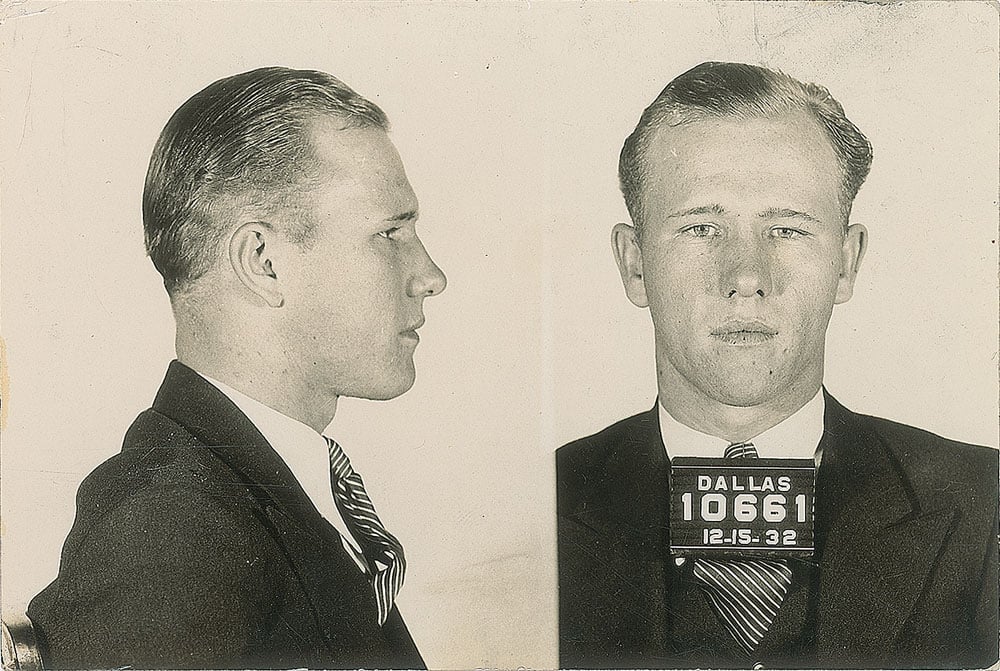
Today, no one remembers Raymond Hamilton, while almost everyone knows his associates, Bonnie Parker and Clyde Barrow. A two-year crime spree from 1932 to 1934 that stretched across several states landed them on the U.S. Federal Bureau of Investigation's (FBI) most-wanted list. Bonnie and Clyde were star-crossed lovers who saw themselves as modern-day outlaws in the spirit of Robin Hood. But there was nothing romantic or appealing about their accomplice Ray Hamilton. He was thin as a rail, with sharp features and sparse blond hair. He was hot-tempered, acted rashly, and was a bundle of nerves.
Hamilton's criminal career began rather modestly. As a teenager, he bootlegged liquor in Wichita Falls, Texas, and by July 1931 had worked his way up to stealing cars in Dallas. Dallas police caught him, and he received a three-year suspended sentence. When he was arrested again for the same offense in the town of McKinney and faced a lengthy prison term, he sawed through the bars of his cell in January 1932 and escaped under cover of darkness.
Shortly afterward, he joined up with Bonnie and Clyde. He was only nineteen when they embarked together on a series of robberies and car thefts. Raymond's role in the Barrow gang was precisely that—stealing cars. He was excellent at it. He could select a suitable getaway car and start it without the keys in a matter of seconds. Clyde would then take the wheel. What Ray was not good at, however, was handling weapons and keeping a cool head in tense moments. His first major crime came in April, when Clyde and Ray robbed a small family-owned store near Hillsboro, Texas, and Raymond shot its owner. It was not a cold-blooded murder; his nervousness merely caused his trigger finger to twitch, but John Bucher was dead all the same. For a time, the trio was practically inseparable, but according to one source, tensions in their romantic relationships drove them apart. Ray was sleeping with both Bonnie and Clyde, and such a triangle could not last long.
In August, Clyde and Ray became involved in a shootout with Oklahoma lawmen in which the sheriff was seriously wounded and his deputy was killed. The two then vowed never to be taken alive. That winter, Ray went to Michigan to visit his father, but he was arrested there and transported back to Texas, where he was to stand trial for Bucher's murder. In May, he was transferred to LaGrange, Texas, to stand trial for a November 1932 bank robbery. He was found guilty and sentenced to life imprisonment. His trial for Bucher's murder followed in June, adding another life sentence. Texas authorities sent him to serve his sentence at Eastham Prison Farm. On January 15, 1934, Clyde and an accomplice freed Hamilton and four other inmates from prison, including Joe Palmer, who was serving time for bank robbery. Palmer and Hamilton then became ill-matched members of the Barrow gang because they could not stand each other. The only things they ever had in common were their time at Eastham and the fact that Clyde Barrow freed them during the bloody escape of 1934, which was rather ironic in view of their ultimate fate.
The reunited gang robbed a bank in Lancaster in late February 1934, but soon afterward broke up over an argument about dividing the loot. Raymond and his girlfriend, Mary O'Dare, went their own way and headed to New Orleans to lie low and spend the proceeds. When Clyde and another accomplice shot two Oklahoma lawmen, Ray sent a letter to his Dallas attorney denying any involvement in the Barrow gang's latest killings. Ray and Mary returned to Texas, and in late March he robbed a bank in West, Texas. Ray then found a new accomplice, and in April they robbed a bank in Lewisville in Denton County, about forty kilometers north of Dallas. Their flight did not last long, however, as police caught up with them near Sherman. They surrendered without a fight, and Ray told the officers: “Don't shoot, boys. I'm out of guns, ammunition, liquor, and women.” And once again, he found himself behind bars.
Clyde sent him a mocking note at the Dallas jail, saying that he and Bonnie were sorry to hear of his capture but had no sympathy for him because he had “put up no resistance.” He concluded the letter by calling him a “boastful brat.” Hamilton was transferred from Dallas to the Denton jail to answer for the Lewisville robbery.
While Hamilton was in prison, Bonnie and Clyde's reign of terror came to an end. On May 23, 1934, they were ambushed near Arcadia, Louisiana. Reporters interviewed Ray in his cell in Denton and asked what he thought of the news. He mourned the death of his “good friend” and denied that there had ever been any disagreement between them.
Ray was returned to the Texas prison system, where his combined sentences amounted to 462 years. While he was in Huntsville, another jury sentenced him to death for killing an Eastham guard during the prison escape. In addition, he faced federal charges for breaking into National Guard armories and stealing heavy weapons. But if Hamilton had learned anything from his former friend, it was that a determined man could escape from Texas prisons with relative ease. On July 22, 1934, he and five fellow inmates shot their way out of death row using weapons smuggled in to them by friends on the outside. It was his fourth prison escape and the “most sensational escape” in the history of the Huntsville prison. He returned to Dallas for a time, hiding in the home of his brother Floyd until police discovered it and set up another ambush modeled on the one that had ended Bonnie and Clyde's lives eight months earlier. Both brothers escaped the trap amid furious gunfire and fled Dallas. Raymond headed to Mississippi, where he resumed his crime spree in March 1935. He robbed a bank, took hostages, and disarmed an armed posse pursuing him. He managed to evade police roadblocks, picked up two accomplices, and slipped back into Texas in hopes of disappearing from view. The FBI and authorities in several states were now hunting the man nicknamed the “fair-haired bandit of West Dallas.”
Newspapers that followed such matters described him as a master escape artist and “probably the boldest bank robber the state has ever produced,” as though competitions were held for such things. The Star-Telegram cast him as Clyde Barrow's successor as “Texas's most wanted criminal,” while other journalists crowned him “Public Enemy Number One.” J. Edgar Hoover, who had originally created the list to attract public attention to the FBI, neither confirmed nor denied the title bestowed on the twenty-three-year-old career criminal.
He could not return to Dallas because everyone there who carried a badge and a gun was hunting him. He was now a fugitive on the run and had few friends apart from his immediate family. The days when he roamed the country with Bonnie and Clyde in stolen Fords, robbing banks and gas stations in small towns, were gone. He arrived in Fort Worth on April 4 aboard a freight train from Oklahoma City and jumped off at the rail yard. He was accompanied by two associates, an illiterate young man from Mississippi named Nolan Allred and an older man, Glen Allen, whom they had picked up in Illinois. The once-dapper criminal now wore greasy overalls and scuffed shoes. He did not want to remain in Fort Worth, but he needed money for the journey and new clothes. He had to send word to his family in Dallas to obtain them.
The manhunt for Raymond Hamilton ended at that same rail yard the very next day. Through Allred, he sent several messages to his sister in Dallas asking for help. On his second trip, Allred was caught by Dallas Deputy Sheriff Bill Decker, who was watching the sister's house. During questioning, Allred gave Hamilton away. Hamilton and Allen were hiding in the Rock Island rail yard just east of downtown. Deputy Sheriff Decker and Sheriff R. A. “Smoot” Schmid gathered three more deputies and called the authorities in Fort Worth to ask for assistance. They then drove to Fort Worth, where they were joined by Fort Worth detective Chester Reagan and Tarrant County Deputy Sheriff Carl Harmon. They entered the rail yard near the bridge on Belknap Street, while other officers set up roadblocks at both ends of the bridge. Then, with weapons drawn, they began searching the tracks south of the bridge, checking empty railcars and hobo camps. They found Hamilton and Allen about fifteen meters north of the East First Street overpass, “sprawled on the tracks” and indistinguishable from the “six or seven other vagrants” nearby, except for the two .45-caliber pistols Hamilton carried and a suitcase full of brand-new clothes. Bill Decker approached him, pointed his pistol at him, and said: “Hands up, Ray, before I cut you in half.” At least, that was how he later told the story. Hamilton's decision was made easier by the fact that he was surrounded by police officers with drawn weapons. He surrendered meekly. When later asked why he had not gone out in a blaze of glory like Bonnie and Clyde, he replied that he knew Decker would deal with him “fair and square.” The other officers quickly closed in around him with guns in hand. They handcuffed him, loaded him into a car, and sped off to Dallas. The next morning, a Dallas Morning News headline credited Hamilton's capture to the “Dallas party.” Photographs in the Star-Telegram, however, told a different story. They showed the dejected fugitive standing meekly between Fort Worth detective Reagan and Dallas sheriff Schmid immediately after his arrest, suggesting that the credit should have been shared.
A subsequent investigation showed that Hamilton had been hiding at the rail yard for about twenty-four hours. When detectives canvassed the area with his photograph, they learned that he had eaten at the Round House Café at 507 Diamond Street and had a few beers at Choate's Famous BBQ stand at 1415 Peach Street. Neither the owners nor the regular customers paid much attention to the slight newcomer, since workers and hobos were common in the neighborhood. He apparently slept in a tool shed beneath the East First Street overpass. The rail yard foreman noticed him loitering in the area but did not bother him. “He was very polite,” Tom Stanfield recalled. Other employees thought Hamilton was “just another hobo” among the many who passed through the rail yard on freight trains or came looking for work. (The police apparently made no effort at all to find Hamilton's two traveling companions.) One of the men involved in Hamilton's downfall was Dallas Deputy Sheriff Ted Hinton, who had also taken part in the ambush that ended Bonnie and Clyde's lives.
Although he could not compare with other notorious criminals of his era, such as John Dillinger or Pretty Boy Floyd, Ray Hamilton was the greatest “public enemy” ever captured in the Fort Worth–Dallas area. He was a celebrity in an age that liked its criminals larger than life. When he was taken back to Dallas, his presence drew more than five hundred curious onlookers to the courthouse, hoping to catch a glimpse of him. It was reported that “parents even carried babies in their arms, and youths crowded alongside women in their Sunday best and men in overalls.” Meanwhile, the sheriff's office received calls from as far away as New York from people seeking confirmation of the news of his capture, which had spread over the telegraph wires.
In truth, Raymond Hamilton was no hardened, Dillinger-style criminal who laughed in the face of death. This unremarkable architect of his own crime wave had always played second fiddle to Clyde Barrow. The press's attempts to inflate his criminal past could not conceal the fact that he was a small-time crook, not a daring outlaw. He and Joe Palmer were scheduled to face the electric chair together shortly after midnight on May 10, 1935. When the moment came, Hamilton lost his nerve and persuaded Palmer, whom he had always considered a weakling and had never liked, to go first. By the time Ray's turn came, he had recovered enough to walk into the execution chamber with a steady step, and before he was strapped into the chair, he even spoke with the prison chaplain.
Source: en.wikipedia.org