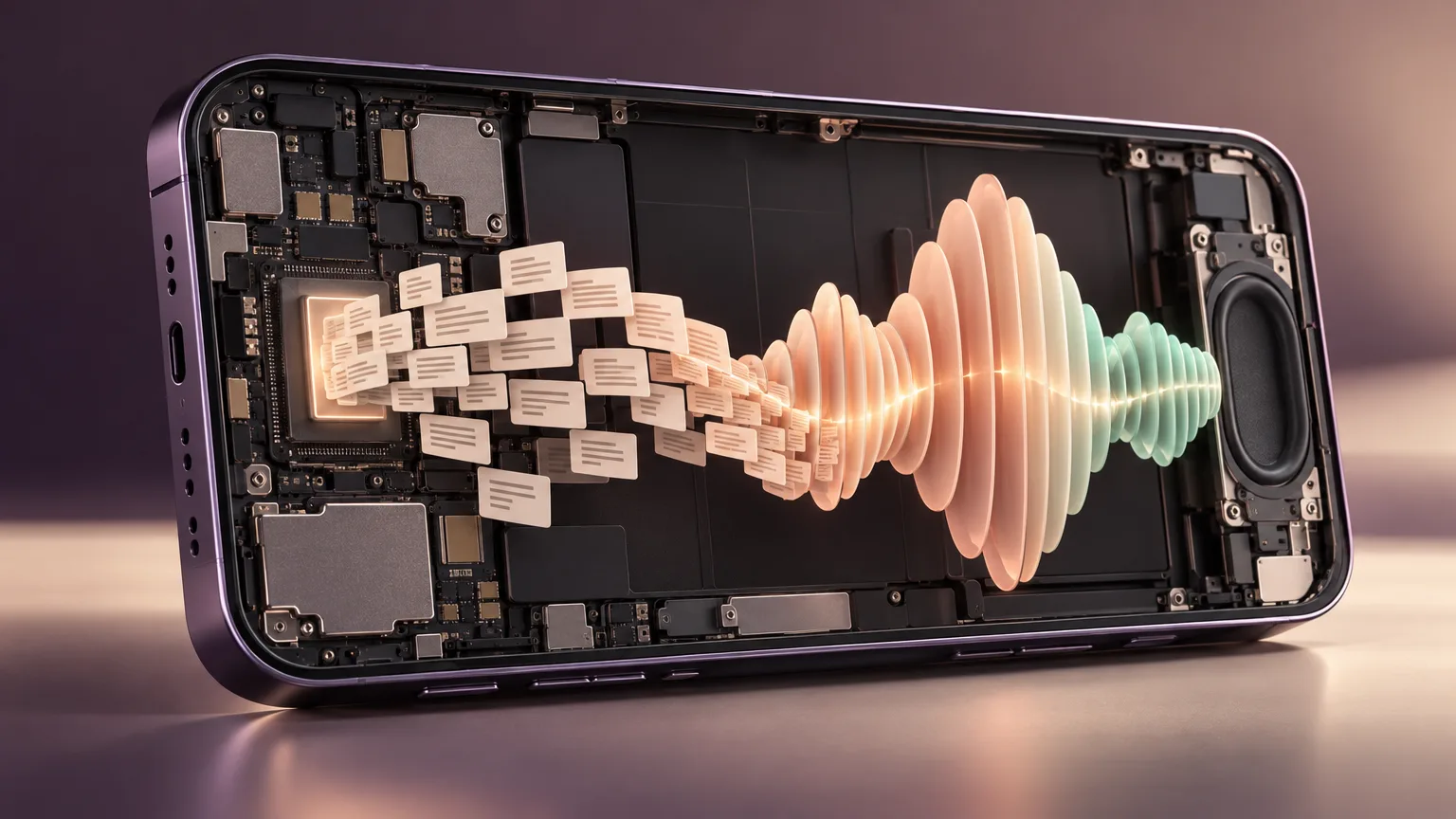
Phonon is a small text-to-speech model that runs directly on a device without a server or network connection, keeping typed text on the device. Available in two sizes, it supports five languages and offers more than 100 built-in voices.
Two versions and custom voices
Phonon comes in sizes of approximately 65 MB and 75 MB. Phonon 31m speaks English, while Phonon 40m supports all five languages: English, French, German, Spanish and Portuguese.
Alongside the built-in voices, users can create their own in Gradium Studio. With the speaker’s consent, they can clone a voice from a short recording or describe a new voice in text. The resulting file can then be downloaded and loaded into Phonon, which runs on the device.
The authors say they spent six months developing the model with partners and early users after its April announcement. During that work, they made the models smaller and added languages and support for custom voices.
Running on phones, computers and browsers
Phonon can run on phones, laptops, single-board computers and in a browser. Its authors say it also handles phone numbers, dates and codes.
The ptts inference framework was built for the model and supports more than ten backends for CPUs, GPUs and NPUs. These include WebAssembly, CUDA, Metal, WebGPU and Apple Core ML.
A reference PyTorch implementation has been part of the Transformers library since version 5.21. While ptts handles a single stream on-device, the Transformers integration targets GPU throughput, batch generation and the synthesis of large speech datasets.
In the Transformers integration, the model autoregressively generates audio latent representations, which the processor decodes into audio. Voices are supplied as precomputed speaker latents, and the included audio tokenizer is decoder-only.
Intelligibility results and demonstrations
Phonon is based on the Pocket TTS lineage and uses a method called flow matching to generate audio. Its authors say training was initially numerically unstable and required adjustments to achieve quality results across all five languages.
The authors say Phonon ranked first for German and Spanish intelligibility on the Hugging Face Open TTS Leaderboard and in the top three for every language they evaluated. The leaderboard measures intelligibility using word error rates in the outputs. The authors also say the Phonon models lead the CPU streaming test for time to first audio.
Demonstrations accompanying the release showed a voice guiding coffee preparation on an Apple Watch with Wi-Fi turned off and counting exercise repetitions on an iPhone without a signal. According to the authors, Phonon was downloaded more than 200,000 times in its first two weeks.
Licensing and commercial use
The English-language Phonon 31m is available under Apache 2.0, free for commercial use as well. Phonon 40m has a non-commercial license; commercial pricing for the other models depends on the number of users rather than the amount of speech generated.