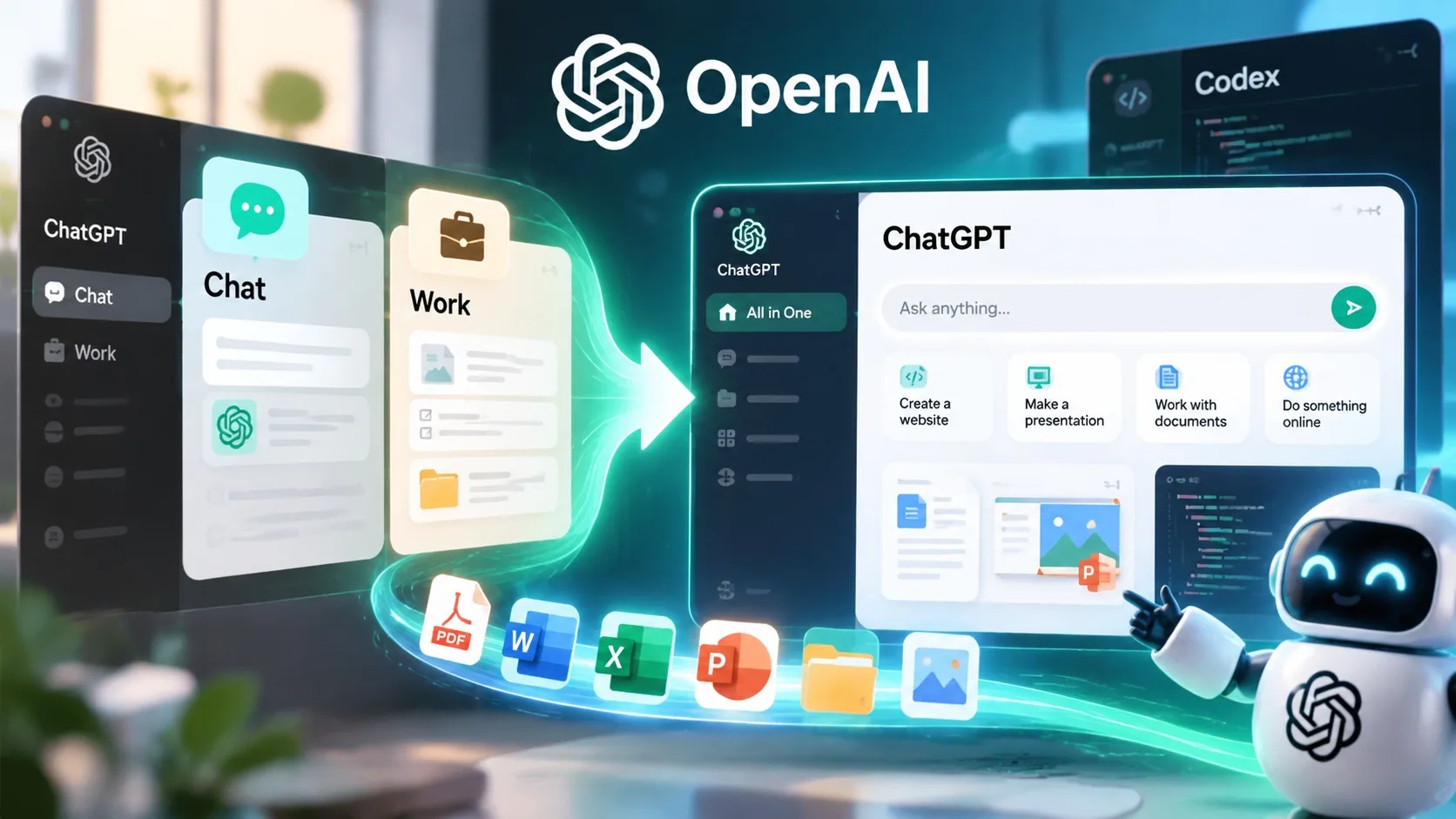
Anyone who opened the ChatGPT desktop app in recent months could easily get lost in it. OpenAI now wants to fix that. The company informed users by email that it will merge the Chat and Work tabs into a single environment. The change will also affect limits, as ChatGPT and the Codex developer tool will draw from one shared pool.
The app is currently divided into two sections, ChatGPT and Codex. The former is further split into the Chat and Work tabs. With so many options, it is easy to forget where you are actually working and where your unfinished project is located. OpenAI only added Work mode this July, when it redesigned the app around three modes available on all plans, including the free one.
The new unified environment will initially be made available to a small group of selected users, from whom OpenAI wants to gather feedback. Only then will the company roll it out to everyone. In the email, it promises that people will be able to complete the entire journey from an initial idea to finished work in one place. They will be able to upload files and add-ons to a conversation and ask ChatGPT to create a website, prepare a presentation, or handle something online. Users can monitor and guide its work as it progresses. Codex will remain a separate section of the app.
However, the change to limits has stirred up stronger emotions. Starting in December, subscribers to the Plus, Pro, and Business plans will draw tokens for both ChatGPT and Codex from a single pool. Those who do a lot of programming in Codex will have less capacity for regular chatting, and vice versa. OpenAI claims that most people will not notice the difference. However, depending on how users use the app and which model they use, they may have to wait for their limit to reset more often. This has sparked heated discussions on Reddit, with some people wondering whether the subscription still makes sense for them.
With this move, OpenAI is catching up with competitor Anthropic. It merged chat and Cowork in its Claude assistant into a single window back in mid-September. At the time, the company admitted that customers often did not know which tab to choose for a particular task. Claude now sorts requests automatically, so users do not have to switch between windows. The same interface includes chat, Cowork, and Artifacts, an interactive workspace. Claude Design, a tool for designing websites and prototypes that Anthropic introduced in April, also works throughout the app.
Alongside the unified interface, Anthropic added dedicated features for creating presentations and documents. Claude can create, edit, and present slides, and the result can be downloaded as a PDF or PowerPoint file. In documents, users can work with it to write individual sections, ask it questions, and comment on completed passages. They can share the results via a link and edit them on their phones, allowing them to review work started on a computer in the mobile app. The new features were initially made available to Pro and Max subscribers, while the free and team versions will receive them later.
Sources: techcrunch.com and pcmag.com