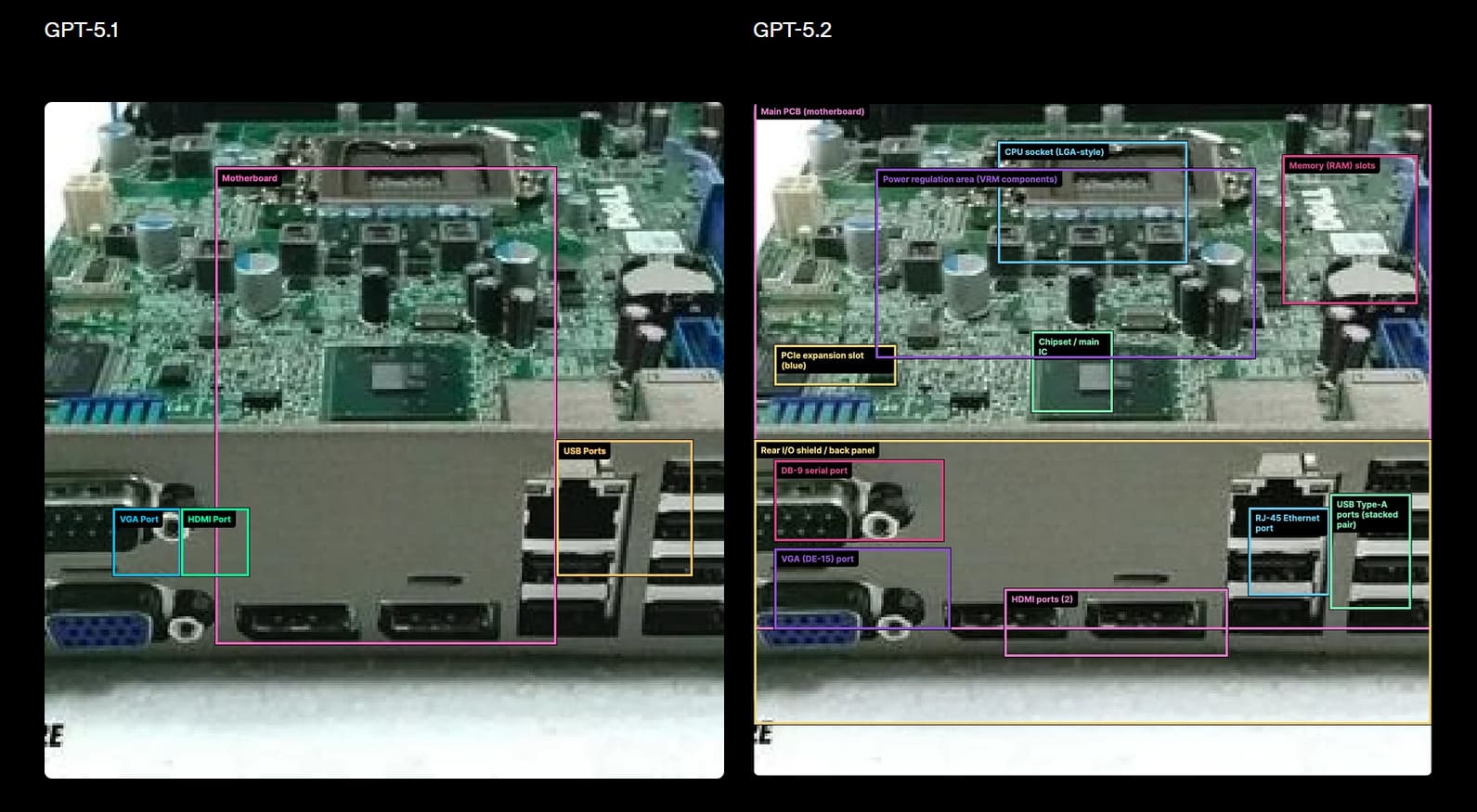
OpenAI has just launched a new family of models called GPT-5.2, which comes in three versions: Instant, Thinking, and Pro. This model is designed to help people at work, for example when creating spreadsheets, presentations, or writing code. According to Fidji Simo, OpenAI's head of product, GPT-5.2 is better at understanding images, long texts, and complex projects that require multiple steps. The company announced it on December 11, 2025, on its blog, where it emphasized that the model can process up to 400,000 tokens at once—which means it can analyze hundreds of documents simultaneously. The model's knowledge cutoff is August 31, 2025, so it is up to date on most events from this year.
The Instant version is fast for simple tasks such as writing text or translating. Thinking adds simulated reasoning for more complex tasks such as mathematics or programming, while Pro is the most accurate option for demanding problems.
Accelerated release
The release comes after an internal memo from CEO Sam Altman in which he described the situation as "code red" due to pressure from Google. Google recently introduced the Gemini 3 model, which outperformed some benchmarks and gained 200 million users in three months. OpenAI responded by postponing other plans, such as advertising in ChatGPT, and focusing on improving its chatbot. OpenAI has 800 million weekly active ChatGPT users, while Google Gemini has 650 million. OpenAI invested $1.4 trillion (approximately CZK 32.2 trillion) in infrastructure to maintain its lead.
This is the third major model release since August 2025. GPT-5 was released in August with switching between fast responses and reasoning, but users complained about cold responses. GPT-5.1 arrived in November with eight personalities for better conversations. However, according to many users, the quality of responses declined significantly, and they began switching to competitors. GPT-5.2 now brings further improvements, such as fewer errors—according to Max Schwarzer of OpenAI, the model hallucinates 38% less than GPT-5.1.
How does GPT-5.2 perform in tests?
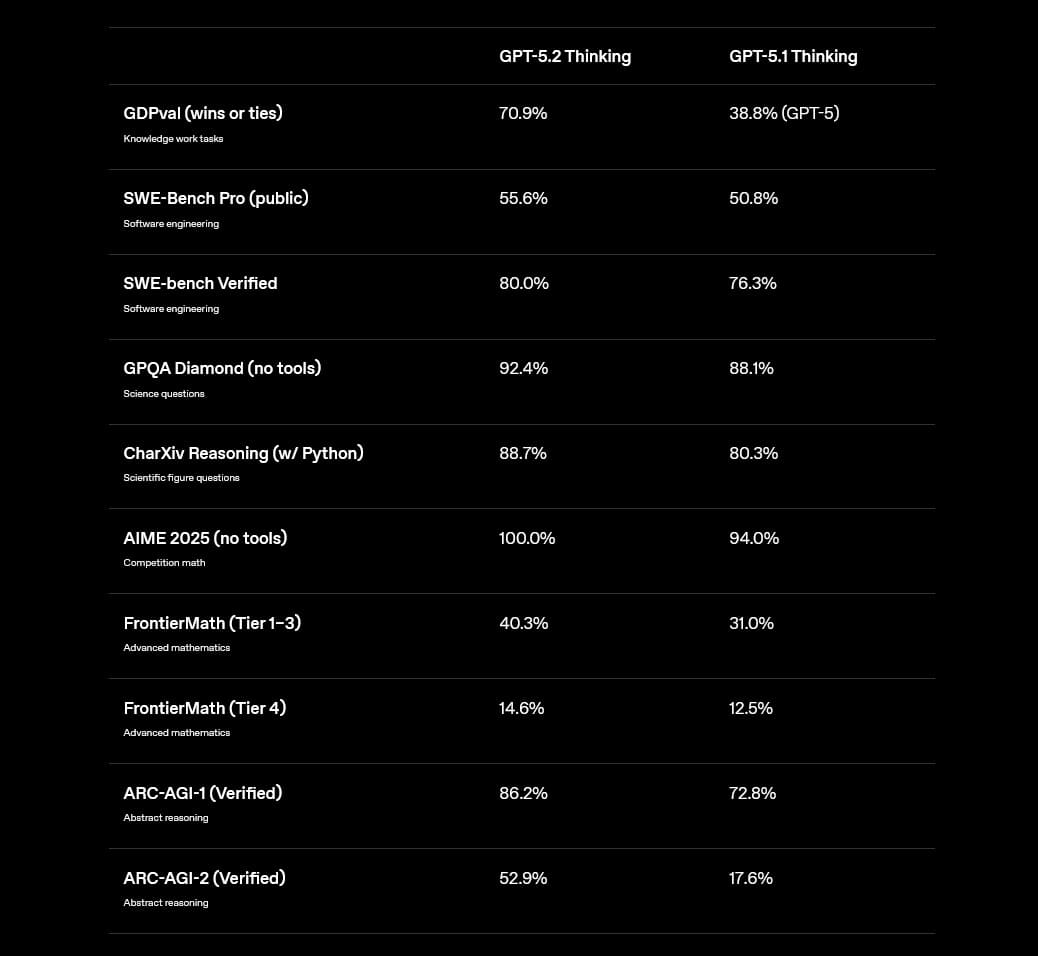
The model achieved excellent results in many tests. On GDPval, a benchmark that measures tasks across 44 professions, GPT-5.2 Thinking outperformed or matched professionals in 70.9% of cases. This includes creating presentations, spreadsheets, or diagrams, and it does so 11 times faster and for less than 1% of the cost of a human expert. On SWE-Bench Pro for software engineering, it scored 55.6%, which is better than Gemini 3 Pro's 43.3% and Claude Opus 4.5's 52.0%.
In the GPQA Diamond test of scientific questions, GPT-5.2 Thinking scored 92.4%, just ahead of Gemini 3 Pro's 91.9%. It scored 100% on the AIME 2025 mathematics test, 40.3% on FrontierMath (levels 1–3), and 14.6% on level 4. In abstract reasoning, it scored 86.2% on ARC-AGI-1 (Verified) and 52.9% on ARC-AGI-2. For visual tasks such as reading charts, it cut errors in half—scoring 88.7% on CharXiv Reasoning with the Python tool.
The model is also better with long contexts, handling information from 256,000 tokens with nearly 100% accuracy in some tests. In tool use, it scored 98.7% on Tau2-bench Telecom, indicating reliable resolution of customer requests across multiple turns.
Availability and pricing for users
GPT-5.2 has been available in ChatGPT for paid Plus, Pro, Business, and Enterprise plans since December 11, 2025. The older GPT-5.1 will remain available for three months in the legacy models menu. In the developer API, GPT-5.2 costs $1.75 (approximately CZK 40) per million input tokens, which is 40% more than GPT-5.1, but with a 90% discount on cached inputs. Output tokens cost $14 (approximately CZK 322) per million. GPT-5.2 Pro is more expensive: $21 (approximately CZK 483) per million input tokens and $168 (approximately CZK 3,864) per million output tokens.
The company works with Nvidia and Microsoft and uses their hardware, such as H100, H200, and GB200-NVL72 GPUs. Safety has been improved—the model responds better to sensitive topics such as suicide or mental health, with fewer than 1% undesirable responses in tests. OpenAI plans to introduce user age prediction to protect users under the age of 18.
GPT-5.2 in practice
GPT-5.2 makes it easier to work with documents, images, or code. For example, it can analyze interface screenshots with 86.3% accuracy on ScreenSpot-Pro or solve mathematical problems using tools. In customer support, it can handle complex scenarios, such as a delayed flight involving accommodation requests and a special seat, coordinating rebooking and compensation. The model represents the biggest leap in agentic coding since GPT-5 and performs reliably even with simple instructions.