

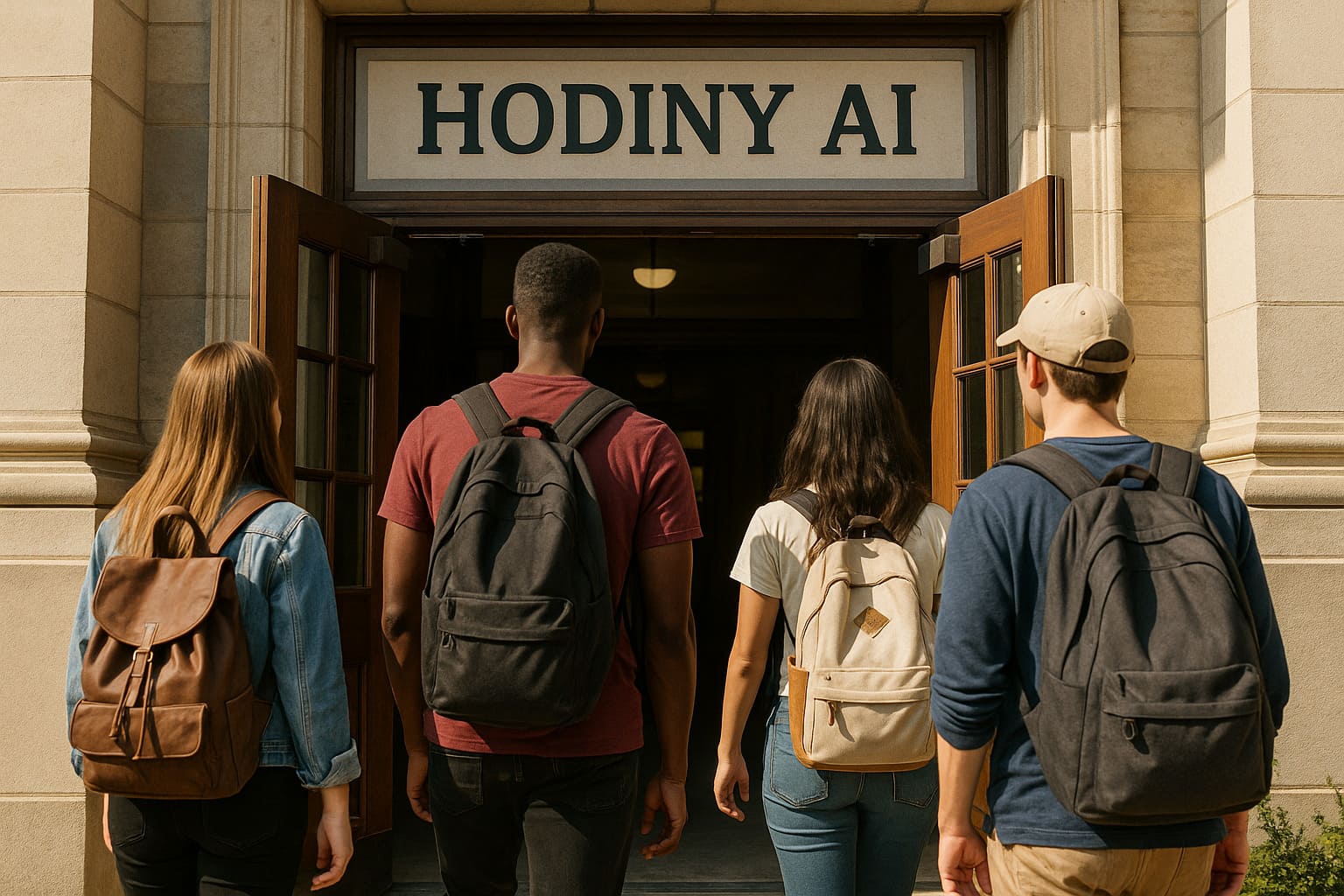
Artificial intelligence has become a nightmare for higher education. Students use it to write papers, professors to grade them, degrees are losing their meaning, and technology companies are getting rich. Ronald Purser, the author of the original article, describes how this is happening using the example of California State University, abbreviated CSU (California State University), the largest public university system in the US, with 23 campuses and nearly half a million students.
At first, professors feared that AI such as ChatGPT would enable cheating. Meetings included discussions about returning to paper exams. But then attitudes changed. Workshops with titles such as "Building Skills with AI in the Classroom" and "AI Literacy Fundamentals" began appearing on campuses. Panic turned into enthusiasm. CSU entered into a partnership with OpenAI worth CZK 391 million, providing all students and employees with free access to ChatGPT Edu. The press release spoke of personalized tools for the future.
This was happening while CSU was planning to cut its budget by CZK 8.625 billion. Faculty members were laid off, programs were eliminated, and student services were cut. CSU East Bay went through layoffs twice in one year, affecting departments such as general studies and modern languages. Sonoma State faced a deficit of CZK 552 million and planned to eliminate 23 programs, including philosophy, economics, and physics, as well as lay off more than 130 instructors—over a quarter of the total. At San Francisco State University, layoffs loomed while OpenAI held recruitment events in the library.
Selling Education
Public universities are turning into suppliers for the private market. Henry Giroux saw it first: disciplines have to justify themselves through revenue and outcomes. Sheila Slaughter and Gary Rhoades speak of academic capitalism, where knowledge is a commodity and students are customers. In Unmaking the Public University, Christopher Newfield describes how privatization impoverishes universities. Benjamin Ginsberg discusses the growth of administration while faculty disappear. Martha Nussbaum warns about the loss of humanities disciplines that foster imagination and civic reflection.
CSU Chancellor Mildred Garcia announced the partnership with OpenAI as a collaboration that would empower students and support the economy. Meanwhile, programs such as women’s and gender studies and anthropology were being eliminated in San Francisco County. Martha Kenney, chair of women’s and gender studies, and Martha Lincoln, a professor of anthropology, wrote an article for the San Francisco Chronicle. They warned that the initiative undermines critical thinking. Kenney said that her discipline is ideal for examining the social impacts of AI, yet receives little funding.
Technopoly at Universities
Neil Postman warned of technopoly, where efficiency replaces reflection. Peter Hershock says that technology changes the environment of thought. Langdon Winner asks whether technological artifacts have politics—AI does, because it promotes automation and standardization.
AI is becoming the norm in classrooms. Students learn to prompt instead of think. Curiosity and the search for one’s own voice are being lost. Administrators know this, but they continue as long as tuition money keeps flowing.
Cheating with AI
Students are cheating on a massive scale. Chungin "Roy" Lee at Columbia University admitted that AI wrote 80% of his papers. He was suspended for promoting Interview Coder, a tool for cheating in interviews. He then founded Cluely with Neel Shanmugam, promising to "cheat smarter." They secured CZK 121.9 million in funding. Their manifesto says: Why memorize when a model can do it in seconds?
Perplexity AI advertised cheating in an ad. Ohio State University, for example, stopped penalizing students for using AI. Ella Stapleton at Northeastern University discovered that Professor Rick Arrowood was using ChatGPT for his slides even though he prohibited students from using it. She demanded a refund of CZK 184,000 for the semester.
David Graeber spoke of "bullshit" jobs—now "bullshit" degrees are coming. Students pay for credentials without learning. Faculty grade work that students did not create. At workshops such as OpenAI days, they learn to use prompts to create courses.
Students at SFSU, often the first generation in their families to attend college, reject AI. Martha Kenney and Martha Lincoln heard questions such as: How can we resist? The California Faculty Association is suing CSU for introducing AI without consultation.
AI’s New Colonialism
OpenAI exploits workers in Kenya through the company Sama, paying them CZK 46 per hour to filter toxic content. Training AI consumes millions of kilowatt-hours of electricity and liters of water. In Empire of AI, Karen Hao reveals how Sam Altman conceals a monopoly behind a humane image.
CSU became part of this chain for CZK 391 million. Jennifer Trainor sees it as a scam: millions for OpenAI while cuts are being made. Faculty are essentially saying that students are guinea pigs.
An MIT study found that AI reduces neural connectivity in the brain by 47%. People forget what they "wrote" and write worse without AI. Cal Newport speaks of cognitive debt—the loss of the ability to think.


