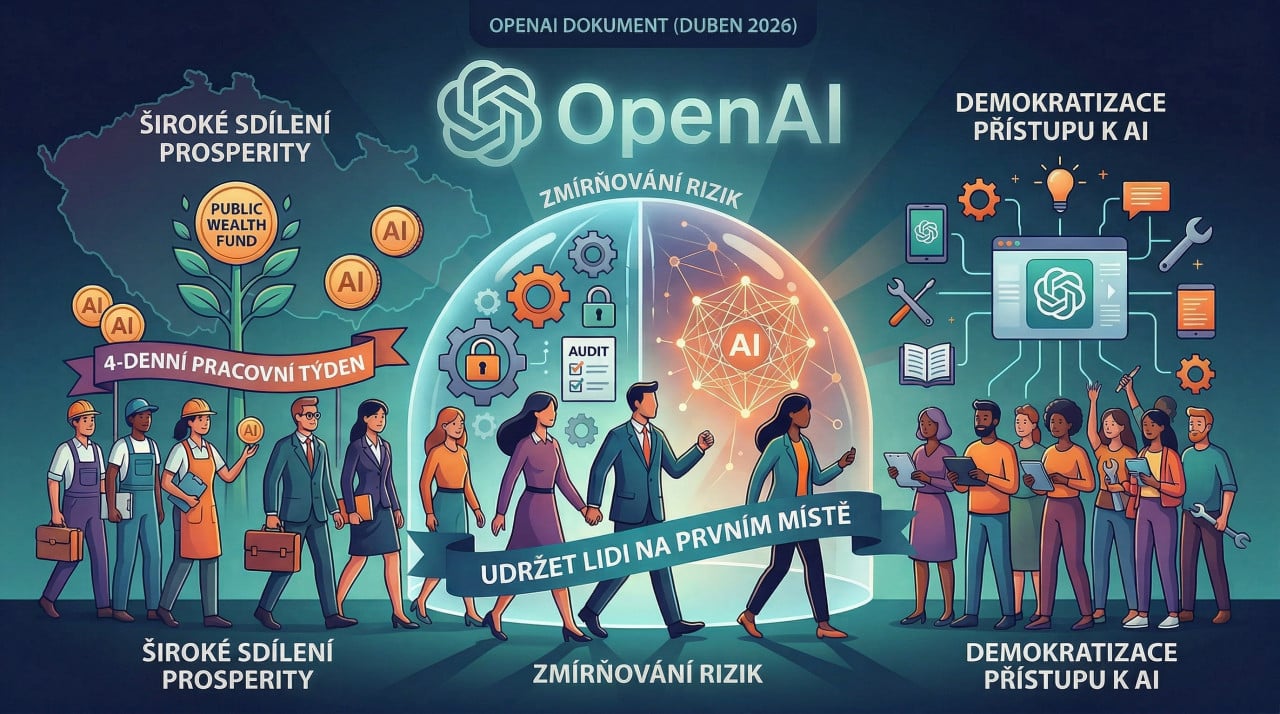
A few years ago, we imagined AI as a smart assistant that would help us write emails faster. Today, companies like OpenAI are talking about superintelligence that will surpass even the smartest people, even when they are assisted by AI. And instead of celebrating, we are asking: what will this do to our jobs, money, and society as a whole? That is precisely why OpenAI released the document Industrial Policy for the Intelligence Age. It is an open invitation to debate how to keep people first as we approach something far greater than anything we know today.
They admit it right at the outset. Superintelligence promises cheaper medicines, faster scientific discoveries, and lower prices for basic necessities. At the same time, however, it threatens to eliminate many jobs, concentrate wealth in a few hands, and allow some systems to escape human control. Rather than waiting to see what happens, they believe we should act now.
OpenAI looks to the past and sees similarities. When electricity, the internal combustion engine, and mass production arrived, society responded with the Progressive Era and the New Deal. New institutions, social protections, and expectations of what a fair economy should look like were created. Now something similar awaits us, but on a larger scale.
First topic: an inclusive economy
They begin with the people who actually do the work. Giving employees a stronger voice in the deployment of AI. They know best where machines can provide relief from dangerous, boring, or exhausting tasks and where they instead make work worse. They want workers to be able to say yes to AI deployments that improve the quality of work and no to those that destroy it.
They also propose helping employees become entrepreneurs. AI entrepreneurship, where artificial intelligence takes over accounting, marketing, or purchasing. This would be supported by microgrants, ready-made contracts, and shared facilities. Suddenly, even someone with excellent industry expertise but a fear of paperwork would have a chance.
Another interesting idea is the concept of a right to AI. Just as we once fought to bring electricity and the internet to remote places, everyone should now have access to useful models. Not necessarily the most powerful ones, but those that genuinely help small businesses, schools, libraries, and ordinary people. Without this, we would face an even greater divide between those who know how to use AI and those who are left behind.
Taxes must keep up with the times. As work shifts from people to systems, payroll tax revenues decline. OpenAI therefore calls for higher taxation of capital, corporate profits, and potentially even automated labor. At the same time, companies should receive tax breaks when they retain, train, and invest in their employees.
The boldest idea is a public wealth fund. Every citizen would receive a share of the growth generated by AI. The fund would invest in companies using artificial intelligence, and the returns would be distributed directly to people. Suddenly, even those who do not own shares would benefit from progress.
They also talk about energy. Data centers should pay for their own electricity, so that households do not have to foot their bills. And we need to rapidly expand high-voltage transmission lines that carry energy from power plants to major substations, through new partnerships between the government and private companies.
Efficiency gains should flow back to people. When AI lowers costs, companies should contribute more to pensions, health insurance, or childcare and eldercare. They are also piloting a four-day workweek at the same pay. If it works, it could lead to a permanent reduction in working hours or more time off.
Safety nets must be ready. They propose automatically triggering expanded support when AI is shown to be causing widespread layoffs in certain sectors. They also recommend portable benefits that people do not lose when changing jobs, as well as new opportunities in areas where human contact remains irreplaceable – childcare, eldercare, and education.
And finally, science. Networks of AI laboratories that rapidly test ideas generated by artificial intelligence, along with infrastructure that translates discoveries into practice. All of this would be distributed across universities, hospitals, and regional centers, not just a few elite locations.
Part two: a resilient society
OpenAI does not claim that everything will be rosy. It talks about misuse in cybersecurity and biology, systems that could spiral out of control, and pressure on young people. That is why it calls for safety systems that work in the real world.
They want tools for detecting risks, rapidly producing medicines to counter threats, and creating a market where companies compete on safety. They also call for a trust system, to verify that AI-generated content and decisions are authentic without surveilling everyone.
They propose stronger audits of the most capable models, plans for containing dangerous systems even after they have been released into the world, and better governance of companies developing AI. The government should have clear rules for how it uses AI itself, while also using it to make its own decisions more transparent.
People should have the opportunity to voice their views on which values systems should follow. And companies should report incidents and near misses so that lessons can be learned from them.
Finally, they call for better international cooperation. Sharing information about capabilities, risks, and safeguards through a network of national institutes.
The entire document ends on a humble note. These are starting points. As I read it, I felt that this time, someone from a major company was finally saying out loud: yes, change will come quickly and painfully. And instead of pretending that the market will solve everything on its own, let us talk about what kind of society we actually want.