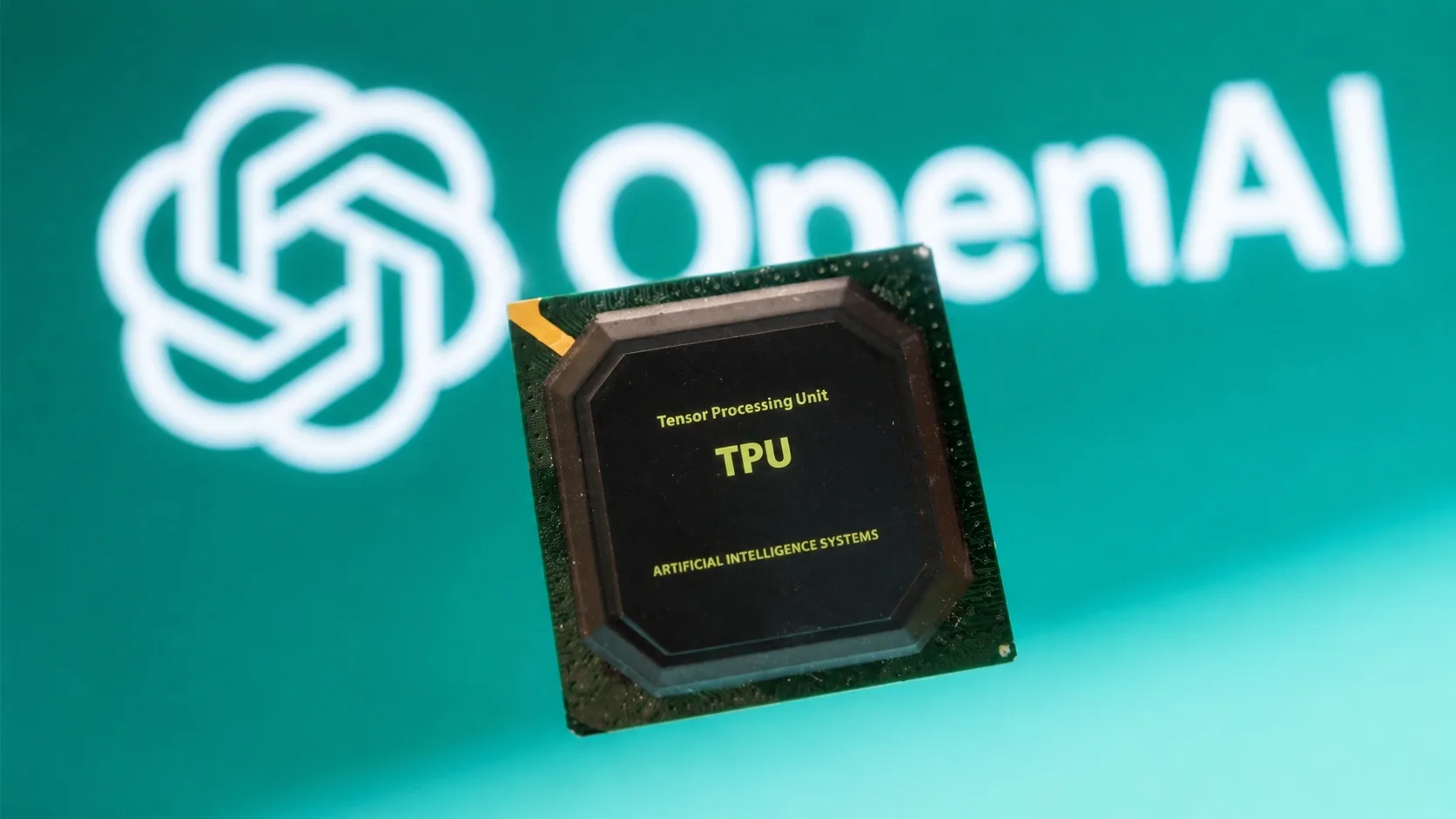
According to The Information, OpenAI is preparing to buy artificial intelligence chips from Google. OpenAI has long been one of Nvidia’s largest customers, sourcing most of the hardware used to run its models from the company. A deal with Google would significantly reduce this dependence.
No details have been disclosed yet. It is unclear how much OpenAI will pay, how many chips it will buy, or when it will receive them. Both companies declined to comment on the matter. According to Bloomberg, the final terms of the deal are still unknown because the negotiations are taking place in secret.
What TPU chips are
Google does not offer conventional graphics processors like Nvidia. It has developed its own tensor processing units, or TPUs, designed to perform the mathematical operations underpinning artificial intelligence models. It began developing them more than ten years ago and initially used them mainly to speed up its search engine. It unveiled them publicly in 2016, by which time it had already been operating them in its data centers for more than a year.
Over time, the chips proved particularly well suited to artificial intelligence workloads, and in recent years they have become a serious alternative to Nvidia’s expensive, highly sought-after processors. This April, Google unveiled the eighth generation in two versions. The 8t model is used to train models, while the 8i handles their routine operation—that is, situations in which a model responds to users.
This is not the first time OpenAI has worked with Google’s chips. Reports emerged as early as June 2025 that it had begun renting them through Google Cloud. At the time, the company described it only as initial testing and said it did not intend to deploy them at scale. The main hope was that TPUs would reduce the cost of running models. A direct purchase, however, would mark a change because OpenAI would own the hardware and would not have to pay Google for every hour of computing. Google has paved the way for this move. Alphabet’s chief financial officer said the company began delivering TPU systems directly to customers’ data centers in the second quarter, even though they had previously been available almost exclusively through its cloud.
An OpenAI job listing in San Francisco also suggests that the speculation has a factual basis. The company is looking for an engineer to lead the optimization of its most powerful models specifically for TPUs. The work revolves around compilers, which are software that translates an artificial intelligence model into instructions that a specific chip can understand. This is precisely why switching to a different type of processor is not as simple as replacing a component in a computer.
Richard Ho, who leads OpenAI’s hardware development team, also plays a role. He spent nearly nine years at Google and was one of the leaders of the Cloud TPU project. People from Google also helped OpenAI with its own Jalapeño chip, which the company developed with Broadcom. This hardware is designed to run finished models, and OpenAI plans its first deployment for the end of this year.
What OpenAI stands to gain
The clearest benefit is faster access to computing power, which OpenAI is constantly short of. Bloomberg describes the purchase as part of an effort to secure computing capacity from multiple sources at once. In addition to Nvidia, the company is betting on chips from AMD, its own Jalapeño, and now Google’s processors as well.
This also brings greater independence. A company that sources most of its hardware from a single supplier has less leverage in price negotiations and is vulnerable to supply disruptions. With three or four sources, OpenAI can choose between them and push prices down.
Lower costs are also a factor. Owned hardware is generally more economical than hourly rentals when used heavily over the long term. TPUs were also designed specifically for artificial intelligence workloads, so they could reduce the cost of running models in particular—an expense that consumes vast amounts of money as the number of ChatGPT users grows.
The purchase would put OpenAI on a more equal footing with its main rival. In April, Anthropic signed an agreement with Google and Broadcom for several gigawatts of computing capacity from the next generation of TPUs, which is expected to start coming online in 2027. Google is also trying to get its chips to as many customers as possible. This week, it announced that it would also offer TPUs through Oracle’s cloud. Its executive Amin Vahdat noted that the next generation of artificial intelligence will require a diverse range of computing capacity. The relationship between the two companies is also strengthening in the other direction, as Google Cloud began offering GPT-6 models to selected customers in a private test last week.
The move toward Google is all the more interesting because Nvidia is one of OpenAI’s investors. In September 2025, it signed a preliminary agreement under which it was to invest up to $100 billion in OpenAI, while OpenAI would deploy Nvidia systems with at least 10 gigawatts of capacity. In the end, however, Nvidia invested $30 billion in the funding round, significantly less than that. CEO Jensen Huang suggested in March that this could be the last similar investment before OpenAI goes public.
Just two weeks after the agreement with Nvidia, AMD also made an offer. It gave OpenAI the right to buy up to 160 million of its shares, equivalent to roughly one-tenth of the company. The condition is that OpenAI deploy AMD chips with 6 gigawatts of capacity.
Sources: bloomberg.com and reuters.com