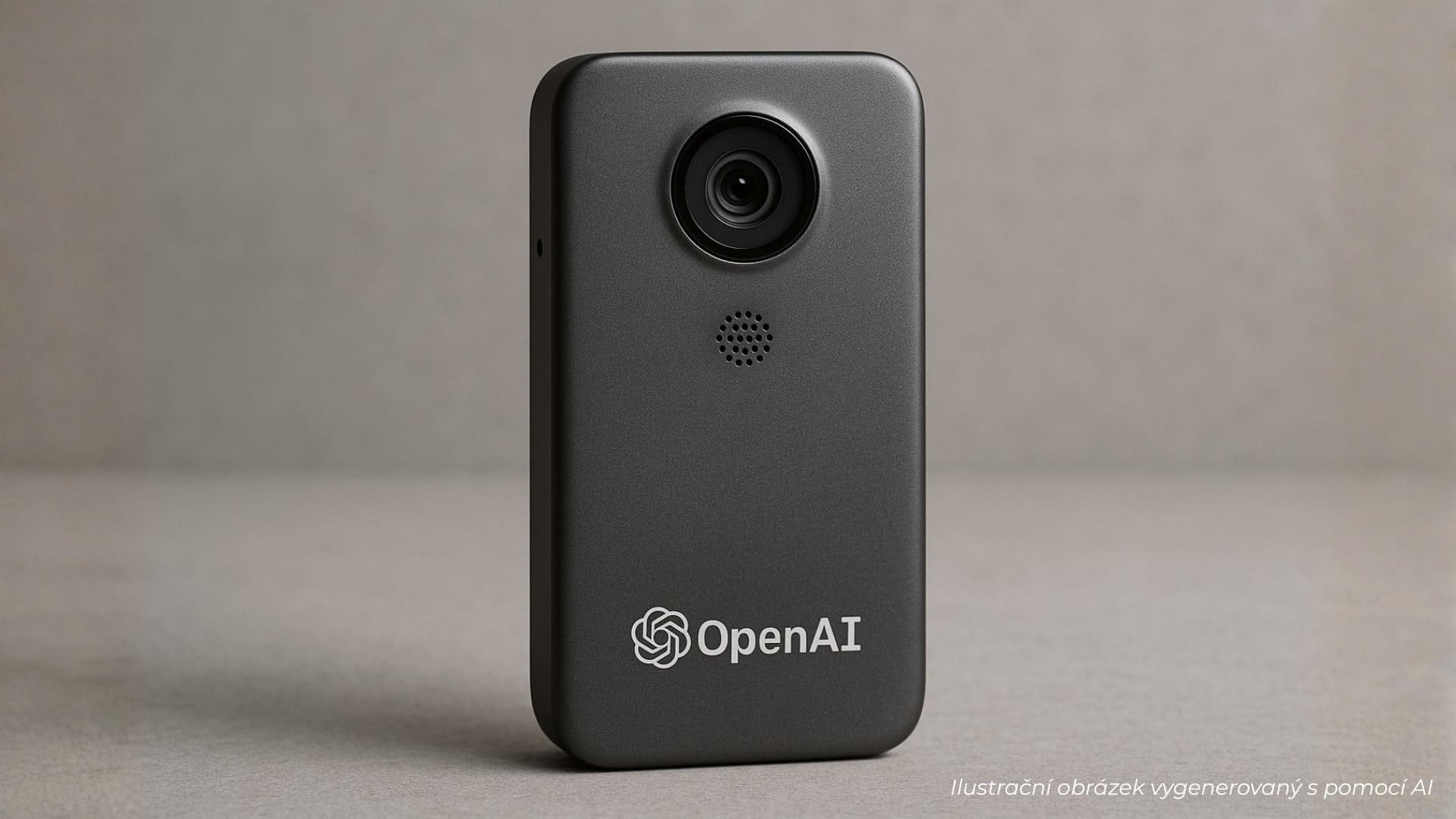
The pairing of names such as Sam Altman and Jony Ive has raised great expectations among technology enthusiasts. On OpenAI's blog, they unveiled their new project in May, which represents a complete breakthrough in modern technology. It is a next-generation AI personal assistant that is expected to become the hit of 2026. However, it has become clear that developing such a device is not easy. The highly anticipated AI innovation is therefore encountering obstacles, and its completion may take longer than expected.
From Apple to OpenAI and the first prototypes
Jony Ive is already an absolute legend in the world of design. He is behind such iconic products as the iPhone, MacBook, iPad, and Apple Watch. However, Jony Ive continued working as an industrial designer even after leaving Apple, at his new company LoveFrom.
Sam Altman acquired it in May 2024 for $6.5 billion, giving rise to a vision for a joint project that the public knew nothing about for a long time. Now, however, the first hardware prototypes are beginning to take shape. According to available information, it should be a palm-sized device with no display, equipped with a camera, microphone, and speaker. Unlike conventional AI assistants, it is intended to be a fully fledged conversational partner that behaves naturally and in a more “human” way.
Obstacles slowing down development
However, the development of the new AI assistant and conversational partner is not proceeding as smoothly as may have been expected at the outset. The first major problems are emerging during work on the project, relating to its privacy, operation, and the overall concept of its “personality.”
Using its camera and microphone, the new AI device is supposed to monitor its surroundings virtually nonstop. Rather than being activated like a conventional assistant, it remains online continuously and collects data about its user. However, this raises ethical questions about the loss of privacy and the potential misuse of data. And it would not be the first time. Various voice assistants and AI devices have faced similar problems in the past, such as the AI Friend necklace or the Humane AI Pin, which ultimately failed completely.
Operation itself poses another obstacle. While voice assistants from Amazon or Google have extensive cloud infrastructure, the new product from OpenAI and LoveFrom is facing a lack of computing power required for operation. The entire process is also costly and significantly slows down development.
Moreover, today's market is highly demanding and expects a great deal from AI devices (assistants). The failure of the Humane AI Pin or the AI necklace was not only due to the devices malfunctioning and making mistakes, but also to their strange and unlikable behavior. This is also why “personality design” is particularly challenging for OpenAI. The new AI assistant should be neither too ingratiating nor too direct, and it should be able to read specific situations appropriately. But this is more difficult than expected.
Today's most valuable private company
Pressure on OpenAI has also increased. According to the latest research, with a valuation of $500 billion, it has become the world's most valuable private company, surpassing even Elon Musk's SpaceX.
Therefore, even though the entire project presents obstacles and risks, OpenAI wants to expand its portfolio to include hardware and move into areas it has not covered until now.
Will the AI companion really become the hit of 2026?
The OpenAI and LoveFrom project aims to create more than just a smart speaker or conventional voice assistant. It seeks to create an AI device that will combine a virtual companion and assistant in one, while behaving naturally and ethically.
However, creating an entirely new relationship between people and technology is proving to be a major challenge. It brings problems involving privacy, computing power, and defining the personality of this AI device. The question now is whether these obstacles can be overcome and the new AI assistant will truly become the hit of 2026, or whether it will be reshaped into a compromise that loses its original ambition.