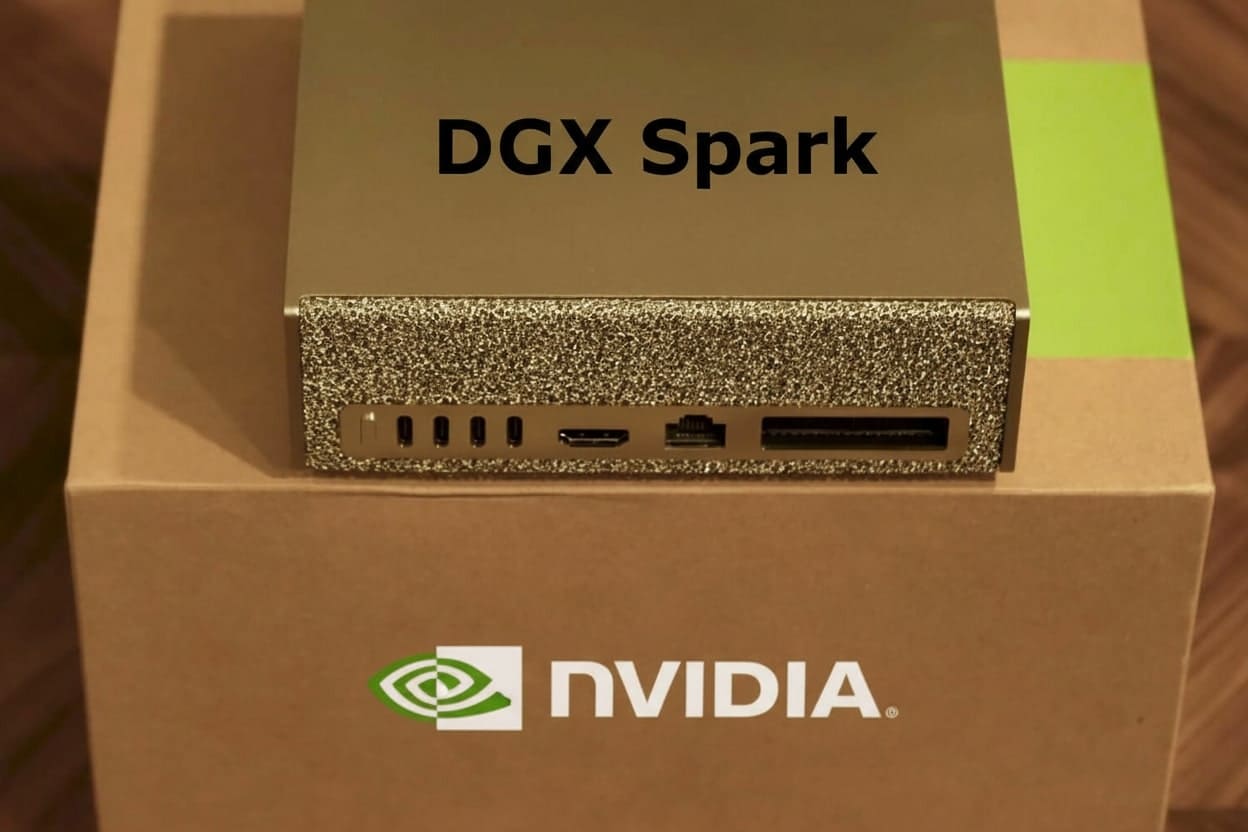
What Is DGX Spark and What Does It Look Like?
NVIDIA DGX Spark is a compact device measuring 150 mm long, 150 mm wide, and 50.5 mm high. It weighs just 1.2 kg, making it easy to carry. Inside is the NVIDIA GB10 Grace Blackwell Superchip, which combines a GPU based on the Blackwell architecture with a 20-core Arm processor featuring 10 Cortex-X925 cores for performance and 10 Cortex-A725 cores for efficiency. The device has 128 GB of shared LPDDR5x memory, accessible by both the CPU and GPU without the need to transfer data between them. It also includes storage in the form of a 4 TB self-encrypting NVMe M.2 SSD. Networking options include Wi-Fi 7, 10 GbE Ethernet, and a ConnectX-7 Smart NIC with speeds of up to 200 Gbps. Two DGX Spark devices can be connected via QSFP ports for distributed processing of larger models.
This device delivers up to 1 PFLOP of performance at FP4 precision using sparsity. The GPU contains 5th-generation Tensor Cores and 4th-generation RT Cores. The memory interface is 256-bit with a bandwidth of 273 GB/s. Power is supplied by a 240-watt adapter, and the device has connectors including 4x USB Type-C, RJ-45 for Ethernet, and HDMI 2.1a for output, as well as support for Bluetooth 5.4. The operating system is NVIDIA DGX OS, based on Ubuntu, which includes the entire NVIDIA AI software stack.
First Deliveries
The first DGX Spark was personally delivered by Jensen Huang, founder and CEO of NVIDIA, to Elon Musk at Starbase, Texas, during preparations for SpaceX's 11th Starship test. Huang walked among the engineers and met Musk in the dining hall, where they discussed the history of delivering the first DGX-1 to OpenAI. Musk accepted the device, commenting on its small size and high performance. This moment connected space exploration with AI, as it took place beside the world's largest rocket.

Another delivery took place at OpenAI in San Francisco, where Huang presented a DGX Spark to Sam Altman and Greg Brockman, OpenAI's co-founder and president. This moment followed up on the delivery of the DGX-1 nine years earlier. Greg Brockman remarked on social media that it was amazing to see 1 petaflop in such a small form factor and called it the best delivery service.
Performance and Use Cases
DGX Spark can handle AI models with up to 200 billion parameters on a single device and up to 405 billion parameters when two units are connected. It enables local prototyping, fine-tuning, and inference of models from DeepSeek, Meta, NVIDIA, Google, or Qwen. The software includes NVIDIA NIM microservices and frameworks such as Isaac for robotics, Metropolis for smart cities, and Holoscan for video processing.
In practice, it can be used to develop edge applications such as robotics or computer vision. In data science, for example, it handles large analytical workloads involving billions of rows of data. Reviewers such as those at HotHardware praise its accessibility for beginners thanks to playbooks on the NVIDIA Build portal that guide users through creating RAG agents or multimodal models. ServeTheHome called it "freaking cool" because of its shared memory, which eliminates the need for the cloud. Level1Techs describes it as a complete lab in a box for everyday data science workloads.
Partners such as Dell Technologies offer the Dell Pro Max with GB10, which supports models with up to 400 billion parameters when two systems are connected. The HP ZGX Nano G1n AI Station provides 128 GB of shared memory for developers. The Lenovo ThinkStation PGX is designed for agentic AI and transitioning from local prototyping to the cloud. LM Studio on DGX Spark enables models such as Qwen3 Coder to run without the cloud. Anaconda is testing Python on DGX Spark for processing large datasets. Roboflow uses it to train computer vision models locally.
Setup and Availability
A YouTube video from NVIDIA Developer shows how to power on and set up the device for the first time. The process involves connecting the power supply, network cable, and monitor via HDMI, then starting and configuring DGX OS. The device is ready for immediate use with preinstalled software.
DGX Spark has been available since October 15, 2025, at NVIDIA.com and through partners such as Acer, ASUS, Dell Technologies, GIGABYTE, HP, Lenovo, MSI, and select Micro Center stores in the US. Specifications include the NVIDIA Grace Blackwell architecture, Blackwell-generation CUDA cores, 1x NVENC and 1x NVDEC for video, and an operating noise level of 35 dB at 25°C.