At the OCP Global Summit in San Jose, NVIDIA focused on collaborating with more than 70 partners to design efficient gigawatt-scale AI factories intended to support the next generation of artificial intelligence models. These factories will use the Vera Rubin NVL144 architecture, an open, fully liquid-cooled rack-scale server architecture. This design is intended for Vera Rubin processors, which are expected to arrive in 2027. NVIDIA will contribute this architecture to the Open Compute Project as an open standard, allowing various companies to implement it in their data centers.
Vera Rubin NVL144 introduces innovations such as a central printed circuit board that replaces traditional cable connections. This enables faster assembly, easier maintenance, and expansion. Modular expansion slots allow the addition of NVIDIA ConnectX-9 networking at 800 GB/s and Vera Rubin processors for massive-context inference. The architecture supports data centers with 800-volt direct-current power, increasing scalability, improving energy efficiency, and reducing material consumption. Moving from a traditional 415- or 480-volt three-phase system to 800 VDC makes it possible to transmit 150% more power through the same copper conductors.
NVIDIA emphasized that Vera Rubin NVL144 is future-ready, with a flexible design for advanced inference engines and the requirements of autonomous AI agents. It is based on the existing modular MGX architecture, which is compatible with components from more than 50 partners. This allows data center operators to combine different components in a modular way and customize their AI factories. At the summit, more than 50 partners announced support for Vera Rubin NVL144, including Foxconn, which provided details about its 40-megawatt Kaohsiung-1 data center in Taiwan, designed for 800 VDC. Other pioneers include CoreWeave, Lambda, Nebius, Oracle Cloud Infrastructure, and Together AI.
Support for NVIDIA Kyber Grows, Delivering Higher GPU Density
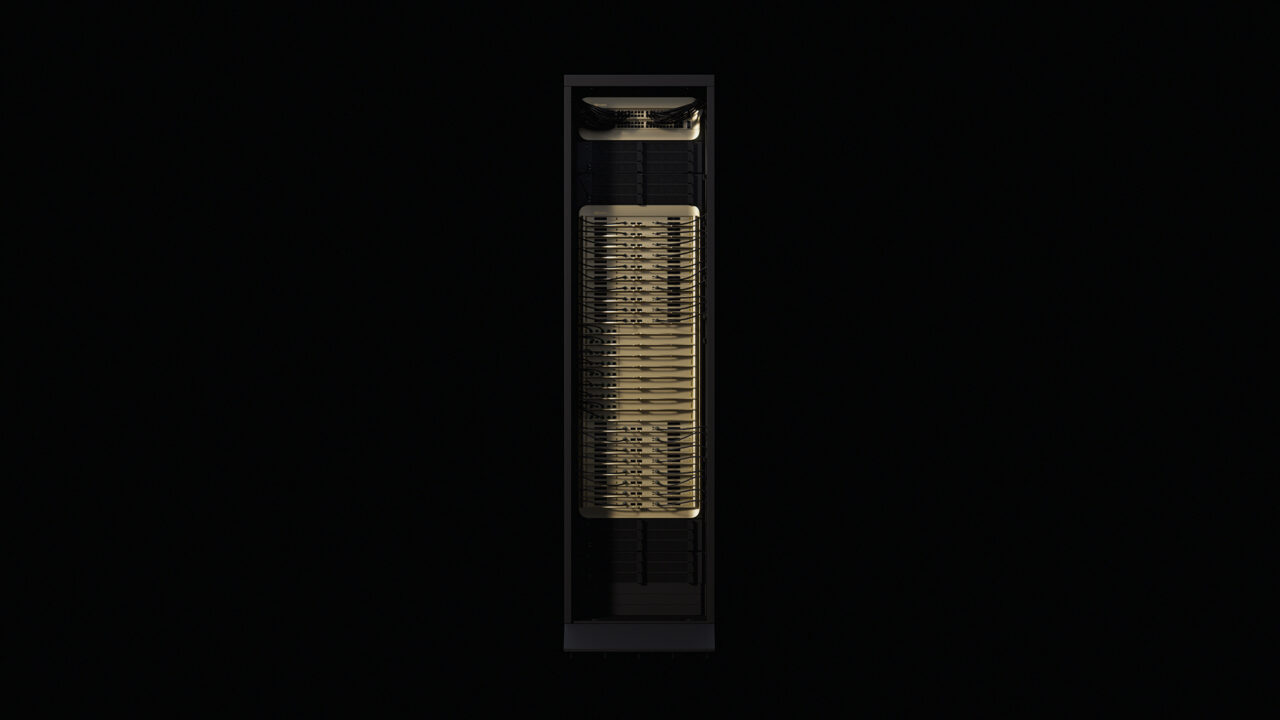
NVIDIA also revealed growing support for the NVIDIA Kyber rack-scale server architecture, which is intended to support infrastructure connecting 576 Rubin Ultra processors by 2027. Like Vera Rubin NVL144, Kyber introduces innovations in 800 VDC power, liquid cooling, and mechanical design. This system increases GPU density per rack, maximizing AI infrastructure performance. By rotating compute blades vertically, like books on a shelf, Kyber can accommodate up to 18 compute blades in a single chassis. Specially designed NVIDIA NVLink switch blades are integrated at the rear through a cable-free central board for seamless network scaling.
Kyber will become a foundational element of hyperscale data centers, offering higher performance, reliability, and energy efficiency. NVIDIA Kyber allows customers to reduce the amount of copper used by tons, resulting in millions of dollars in savings. Partners such as Vertiv introduced their space-, cost-, and energy-efficient 800 VDC MGX reference architecture, which includes complete power and cooling infrastructure. HPE announced support for both NVIDIA Kyber and NVIDIA Spectrum-XGS Ethernet, a technology for scaling across data centers as part of the Spectrum-X Ethernet platform.
Meta and Oracle Adopt Spectrum-X Ethernet
Meta Platforms Inc. and Oracle Corp. announced plans to standardize their data centers on NVIDIA Spectrum-X Ethernet network switches. These advanced switches provide faster connectivity and better data throughput for AI workloads. They use adaptive routing to optimize data flow across the network, making them ideal for the specific traffic patterns of AI applications. In an earlier demonstration, the world's largest AI supercomputer achieved 95% faster data throughput thanks to Spectrum-X.
Meta plans to integrate Spectrum-X Ethernet into the Facebook Open Switching System, which manages and controls network switches at massive scale. Gaya Nagarajan, vice president of network engineering at Meta, said they expect immediate gains in AI training efficiency. "The next generation of Meta's AI infrastructure requires open and efficient networking at a scale the industry has never seen before," she said. By integrating Spectrum-X into the Minipack3N switch and FBOSS, Meta will expand its open networking approach and achieve the efficiency needed to train larger models and deploy generative AI applications for billions of people.
Oracle is going even further. It is integrating Spectrum-X Ethernet not only into its existing data centers but also into future gigawatt-scale AI factories powered by Vera Rubin processors. Mahesh Thiagarajan, executive vice president of Oracle Cloud Infrastructure, said: "By adopting Spectrum-X Ethernet, we can connect millions of GPUs with breakthrough efficiency, enabling our customers to train, deploy, and benefit from the next wave of generative and inference AI faster."
The Expanding NVIDIA NVLink Fusion Ecosystem
Beyond hardware, NVIDIA NVLink Fusion is gaining momentum, allowing companies to integrate their semi-custom silicon into optimized data centers. Intel and Samsung Foundry are joining the ecosystem, which includes custom silicon designers, CPU providers, and IP partners. This accelerates the scaling of AI factories for demanding model training and agentic AI inference workloads. As part of the collaboration between NVIDIA and Intel, Intel will manufacture x86 CPUs that integrate into NVIDIA infrastructure using NVLink Fusion. Samsung Foundry is working with NVIDIA to meet the growing demand for custom CPUs, offering design-to-manufacturing expertise for custom silicon.
NVIDIA is a major contributor to OCP standards across several hardware generations, including key parts of the electromechanical design of the NVIDIA GB200 NVL72 system. The same MGX rack footprint supports GB300 NVL72 and will support Vera Rubin NVL144, Vera Rubin NVL144 CPX, and Vera Rubin CPX for higher performance and rapid deployment. Standards for compute trays and racks allow partners to combine components modularly and scale faster.
The ecosystem of direct-current infrastructure providers, power and cooling partners, and silicon manufacturers is aligning around open standards for the MGX rack-scale server reference architecture. The electric vehicle and solar industries have already adopted 800 VDC infrastructure for similar benefits. NVIDIA Vera Rubin NVL144 delivers a major leap in accelerated computing architecture and AI performance, with an energy-efficient, 100% liquid-cooled, modular design. Its central printed circuit board accelerates assembly and servicing, with modular expansion slots for networking and inference.