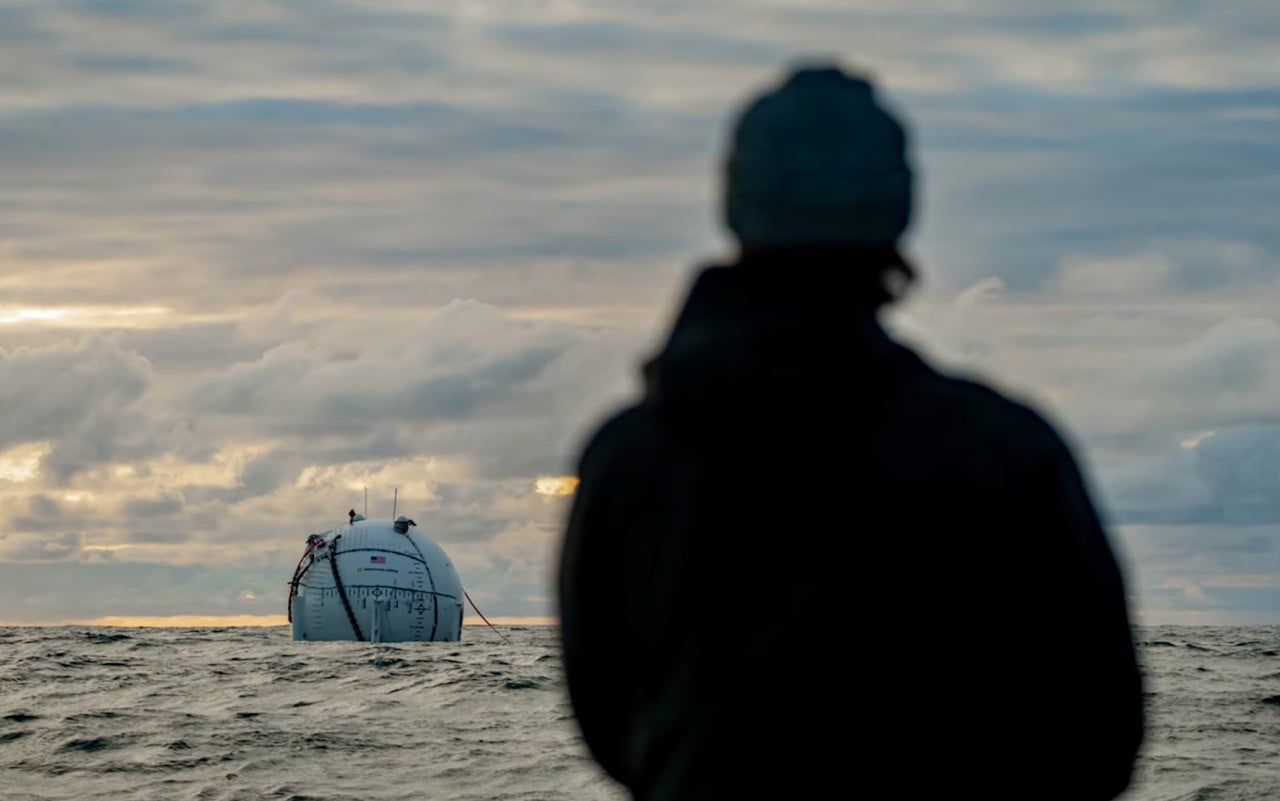
Enormous floating steel structures, hundreds of kilometers from the nearest shore. No cables, no cooling towers, no permits from local authorities. Just waves, satellites, and artificial intelligence chips. This is exactly what Oregon startup Panthalassa has spent ten years preparing for. And now it has the money to actually build it.
Panthalassa announced the closing of a $140 million funding round. It was led by Peter Thiel, co-founder of PayPal and Palantir. “The future requires more computing power than we can imagine. Out-of-this-world solutions are no longer science fiction. Panthalassa has opened the ocean frontier,” Thiel said.
Since its founding in 2016, Panthalassa has raised more than $210 million. The company’s valuation approached $1 billion after the round closed.
What Panthalassa is actually building
The node Panthalassa is developing resembles a giant lollipop. The entire structure stands 85 meters tall and consists of a massive steel tube, most of which is hidden below the surface. A hermetically sealed container housing artificial intelligence chips sits inside the lower section. The sea cools them for free, eliminating one of the biggest technical challenges faced by land-based data centers, where cooling consumes enormous amounts of energy and water.
The node moves on its own. The shape of its hull allows it to use wave motion for propulsion, without the need for an engine or fuel. A ship first tows it horizontally behind it. Once it is far enough from the coast, it tips into a vertical position and makes its own way to the target area. The energy comes directly from the waves. Moving water passes through a turbine and generates electricity that powers the chips for AI workloads, such as answering user queries. The data is then transmitted to land via SpaceX’s Starlink satellite network.
“One of the key insights we reached was that we have to use the electricity right where it is generated,” says Garth Sheldon-Coulson, co-founder and CEO of Panthalassa. “We will never transmit electricity back to shore. That fundamentally distinguishes us from every other ocean energy project.”
Why waves?
Artificial intelligence’s appetite for energy is growing faster than existing infrastructure can satisfy it. Land-based data centers are running into limits on every side. Overloaded power grids cannot keep up. Permitting takes years. Cooling water is becoming scarce. Communities near new centers bear an increased burden on local infrastructure. And hundreds of technology companies are lining up for the same construction firms and suppliers.
Panthalassa says the oceans simply do not have these problems. According to Sheldon-Coulson, wave energy in remote marine areas is “low-cost, sustainable, and abundant.” The open ocean offers undeveloped space, free cooling, and a resource that will never run out.
“There are three energy sources on the planet with the potential to provide tens of terawatts of new capacity: solar, nuclear, and the open ocean,” says Sheldon-Coulson. “We have built a technology platform that operates in areas with the highest wave-energy density, far offshore, and converts this resource into reliable clean energy.” Sheldon-Coulson compares waves to a battery: they are created by wind, wind is created by solar energy, and unlike the wind itself, waves continue even after the wind dies down. “Waves are doubly concentrated sunlight, and we can draw energy from them continuously, 24 hours a day.”
Ten years of development, three prototypes, and now real-world deployment
The company has been working on its technology since 2016 and has publicly tested it in two rounds of sea trials. The Ocean-1 and Ocean-2 prototypes demonstrated the core capabilities in 2021. They were followed in 2024 by Wavehopper, which advanced the development further.
The team consists of more than 120 people. Before Panthalassa, co-founder Brian Moffat developed wave-energy systems for Spindrift Energy and worked at Disney Imagineering. Chief Technology Officer Dan Place helped develop SpaceX’s landing platforms, on which Falcon 9 rockets land after returning to Earth. Other engineers came from Boeing, NASA, Tesla, and Apple.
The new funding will be used to complete the first pilot manufacturing plant near Portland, Oregon. The first Ocean-3 series nodes are expected to set sail for the North Pacific this year, where they will demonstrate offshore inference capabilities and validate the manufacturing process. Commercial deployment is planned for 2027.
Just steel, with no gears or failures
One of the key philosophies behind the entire design is simplicity. The nodes are largely rigid, with no hinges, flaps, or gearboxes. The water that drives the turbine circulates in a closed loop without leaking into the sea. The result is systems with no emissions and no engines. “Our supply chains are highly capable when it comes to this energy technology,” says Sheldon-Coulson. “Steel is an abundant terrestrial material. We consider that essential both for scaling and for environmental impact.”
The simplicity of the materials also makes mass production easier. Panthalassa wants to build the nodes as industrial products in coastal factories and send entire fleets out into the ocean. The company has not yet disclosed exactly where. The target areas must have suitable wave conditions and be sufficiently far from shipping lanes.
The co-founder of PayPal and Palantir has long supported the so-called seasteading project, a libertarian vision of communities floating in international waters beyond the reach of any state. His Founders Fund invested in Panthalassa back in 2018. He has now added his own money. John Doerr described it as “a triple win: workers win, communities win, and the United States gains a strategic asset that strengthens American technological leadership.”
Sources: ft.com and geekwire.com