Fort Worth has loved its Horned Frogs since 1911, and Bevo has plenty of supporters here as well. Yet for a long time, the Aggies had only a minimal visible presence in the city, until 2013, when Texas A&M opened its own law school in Fort Worth by acquiring the School of Law from Texas Wesleyan University. This allowed it to begin full-scale operations immediately. In just four years, the school ranked among the top one hundred law schools in the country, proving, at the very least, that the Aggies never do things by halves. Nearly five hundred students means that a large number of future graduates will have a personal connection to Fort Worth. The law school, however, was not the Aggies' first outpost in the city nicknamed Cowtown; that had appeared here a hundred years earlier.
The establishment of an alumni organization generally depends on having a sufficiently large number of former students. Such an organization then serves as a means of raising funds and attracting new prospective students while also providing alumni with an opportunity to gather. Fort Worth's Aggie alumni organization, however, essentially owed its existence to a single family, the Edringtons. It all began with the father, Captain H. C. Edrington, who came to Bryan, Texas, after the Civil War. From the founding of A&M College in 1876, he served as its financial officer until 1892, when he moved to Fort Worth and founded Traders' National Bank. His son William R. “Will" Edrington was also an A&M graduate (class of 1890), followed in his father's footsteps in banking, and remained a devoted member of the A&M family throughout his life. In 1911, Will enrolled his son, H. C. Edrington Jr., at the school, bringing together three generations of Aggies in the family. Every year, Will drove the entire family down to Bryan for the academic year's closing ceremonies. He was an Aggie heart and soul. In 1912, he himself became the school's financial officer.
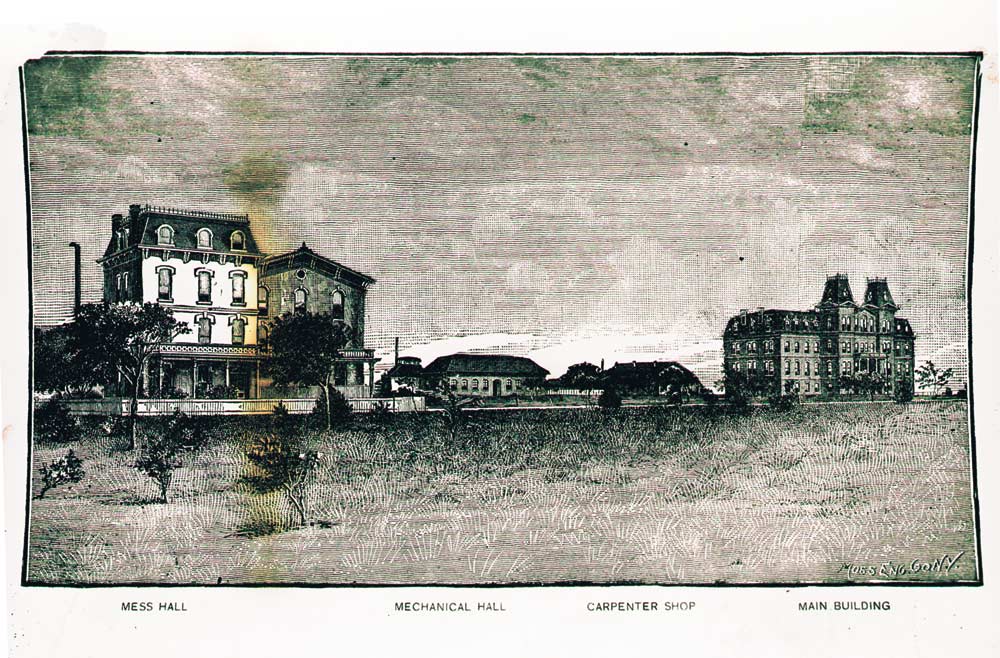
The Edrington family showed true courage when they literally saved the school from closing in 1912. Two fires, one in November 1911 and the other in May 1912, which destroyed the main building and dining hall, inflicted losses of $35,000 and $75,000, respectively, on the financially struggling school. The trustees estimated that rebuilding would require at least $200,000, and this was long before A&M and the University of Texas began sharing revenue from oil and natural gas production on state lands. There simply was no money for reconstruction. The school's future hung by a thread. At that point, H. C. Edrington Sr. and his son Will offered to provide a $300,000 loan that would allow the school to continue operating until the legislature would, they hoped, appropriate the necessary funds. This was nothing new for Captain Edrington; back in the 1880s, while serving as financial officer, he had helped keep the school afloat during difficult times. The Edrington family was as devoted to A&M as it was to making money.
A&M at that time differed significantly from the school today. Rather than a liberal arts college, it resembled a military academy and admitted men exclusively. They were called “Farmers," not “Aggies," and they wore their nickname with pride. No wonder, since A&M stood for agriculture and mechanical arts. Because Texas was still a predominantly rural state at the time, despite such large cities as Houston, Dallas, and Fort Worth, the name “Farmer" was not regarded as derogatory in any sense.
Unsurprisingly, Will Edrington took the lead in establishing a local alumni chapter in Fort Worth in 1914. Along with Traders' National Bank, it was part of the legacy he was preparing for his son. (His three daughters had no chance of attending A&M, even if they had wanted to, because the school admitted only men.) The local alumni's first major event was held one autumn evening that same year. The timing was no coincidence. Fort Worth was a city of passionate sports fans, and in the fall that meant American football above all. On Saturday, October 16, A&M played TCU in College Station and won decisively. The following Saturday, the Aggies were ready to face the Haskell Indians in Fort Worth itself. The Indians from Haskell Institute (Lawrence, Kansas) were a football powerhouse that attracted large crowds wherever they went. TCU had played them in Lawrence in 1912, and now the Indians were visiting Fort Worth, though not to face the then-weaker TCU team, which was so inferior to the Indians that a year later the “Christians" only narrowly defeated a high school team from North Fort Worth. TCU hoped that Cowtown's hospitality would entice the Indians to a rematch in Fort Worth in 1915, when the Horned Frogs intended to present themselves in a better light. In the meantime, however, Haskell came to town to play A&M. There was one catch: Fort Worth had to pay the Indians $1,000 in advance and guarantee a certain amount in gate receipts before they would sign the agreement. Even so, the city's leaders expected that, despite having no hometown team on the field, the game would establish Fort Worth's reputation as a major American football city comparable to Dallas, where the prestigious Texas vs. Oklahoma game was played annually as part of the State Fair. As many as ten thousand spectators were expected to attend, including the entire A&M student body, a thousand uniformed cadets, and a sixty-member marching band. Spectators were urged to show their colors! It seemed as though everyone from A&M had arrived except the football team, which lost to the “Haskell eleven." The Indians were not enticed back to Fort Worth to play the “Christians" (by then renamed the “Horned Frogs," perhaps because the nickname “Christians" sounded too mild and inoffensive) until 1921. Fort Worth newspapers described that contest as “the most attractive game of the football season." TCU lost again.
The local Aggies had more than football on their minds in the fall of 1914. The inaugural gathering of the Fort Worth alumni chapter opened with a formal dinner at the Westbrook Hotel on October 13, 1914. Thirty alumni who, like Edrington, bled the Aggies' colors of maroon and white organized the social event. At the time, the Westbrook Hotel was the most luxurious lodging establishment in the city and occupied the entire length of Fourth Street between Main and Houston (now the western side of Sundance Plaza). It was an evening for men, and the newspapers did not even mention the presence of wives. The Farmer spirit was especially vibrant on the eve of the upcoming game against the Haskell Indians. Because this was still Cowtown, one of the evening's toasts honored the team of A&M students who were judging livestock at that year's State Fair.
The evening's guest of honor was C. O. Moser, an A&M graduate from the class of 1904 who had risen to become one of the leading figures in the state's agricultural life and served as president of the Dallas Farmers alumni chapter. Another distinguished guest was Louis J. Wortham, chairman of the board and editor-in-chief of the Fort Worth Star Telegram, who, in a burst of soaring rhetorical exaggeration, perhaps forgetting where he was at the time, praised A&M as “the foremost educational institution in the state." At the very least, it was clear that the local newspaper fully supported the effort to establish an alumni association. The evening also attracted devoted Farmers from alumni associations in other cities, including Mount Taylor, Farmersville, Rockdale, and Waco.
Will Edrington served as master of ceremonies that evening. In his address, he acknowledged that “Fort Worth did not know much about A&M before 1911 and 1912," and regretfully noted that the corps of cadets had “never marched down Main Street" and that the nearest alumni association was based in Dallas. The two fires that threatened to close the school became an opportunity for Fort Worth alumni to rise up and show support for their alma mater.
After news of the second fire spread in May 1912, A&M alumni from across the state rallied to raise money for rebuilding. Ultimately, more than $1,000,000 was pledged in the form of loans, with the expectation that the legislature would repay them sooner or later. Fort Worth alumni raised more money than any other individual city, including the $300,000 pledged by the Edringtons. And the man who brought the matter to a successful conclusion was Louis Wortham, then a member of the legislature representing Fort Worth, who secured repayment of all those loans, thereby becoming virtually an honorary “Farmer."
Will Edrington, a tireless advocate for his alma mater, called on the future governor (the election was approaching in November 1914) to “ensure adequate funding for A&M's operations." He suggested that the state might begin with the sidewalks and streets on campus, which had never been paved. A&M students, he said, “are afforded no more comfort than hogs." If we could get him onto the board of trustees, he promised, many things would change in College Station. Before the evening ended, the members of the new Fort Worth A&M association agreed to hold their next meeting in the Continental National Bank building.
The underlying purpose of the October 1914 dinner became apparent only a few months later. Will Edrington stated that to ensure A&M would play TCU in Fort Worth the following season (“Farmers against Christians!"), it was essential for local alumni to work together to persuade A&M's “athletic council," which was then preparing the 1915 football schedule. It was not just about the game itself; equally important was the hope that the “entire corps of cadets" would accompany the team, along with friends and relatives. The financial benefit to Fort Worth, not to mention the publicity, would be enormous. This prospect prompted TCU's athletic director to ask the local Farmers alumni association for help in extending an invitation not only to A&M's football team but to “the entire corps of cadets to come as TCU's guests." The alumni association accepted the invitation, and together they devised a plan to organize the biggest football game in TCU's history up to that point. Their prospects were not helped by the fact that the highly anticipated A&M game against the Haskell Indians had failed to live up to its promised splendor. Some among the Farmers suggested that Fort Worth might first need to “cultivate a football audience" before a local contest could become a financial success. TCU's leadership and the A&M alumni association hoped to change that perception while also making Fort Worth more receptive to American football.
Another result of the October 1914 gathering was the establishment of the Fort Worth student association at A&M itself. H. C. Edrington Jr., truly his father's son, was one of its founders. By 1920, the association had fifty-five members from Fort Worth “and its vicinity" and had become one of the largest and most active student organizations on campus. Many of Fort Worth's finest families sent their sons to A&M. The association's members then enthusiastically promoted the good name of their hometown, with its “enterprising spirit," and of A&M, with its “outstanding athletic achievements." The bond formed that Tuesday evening in October at the Westbrook Hotel remains alive today, more than a hundred years later.