

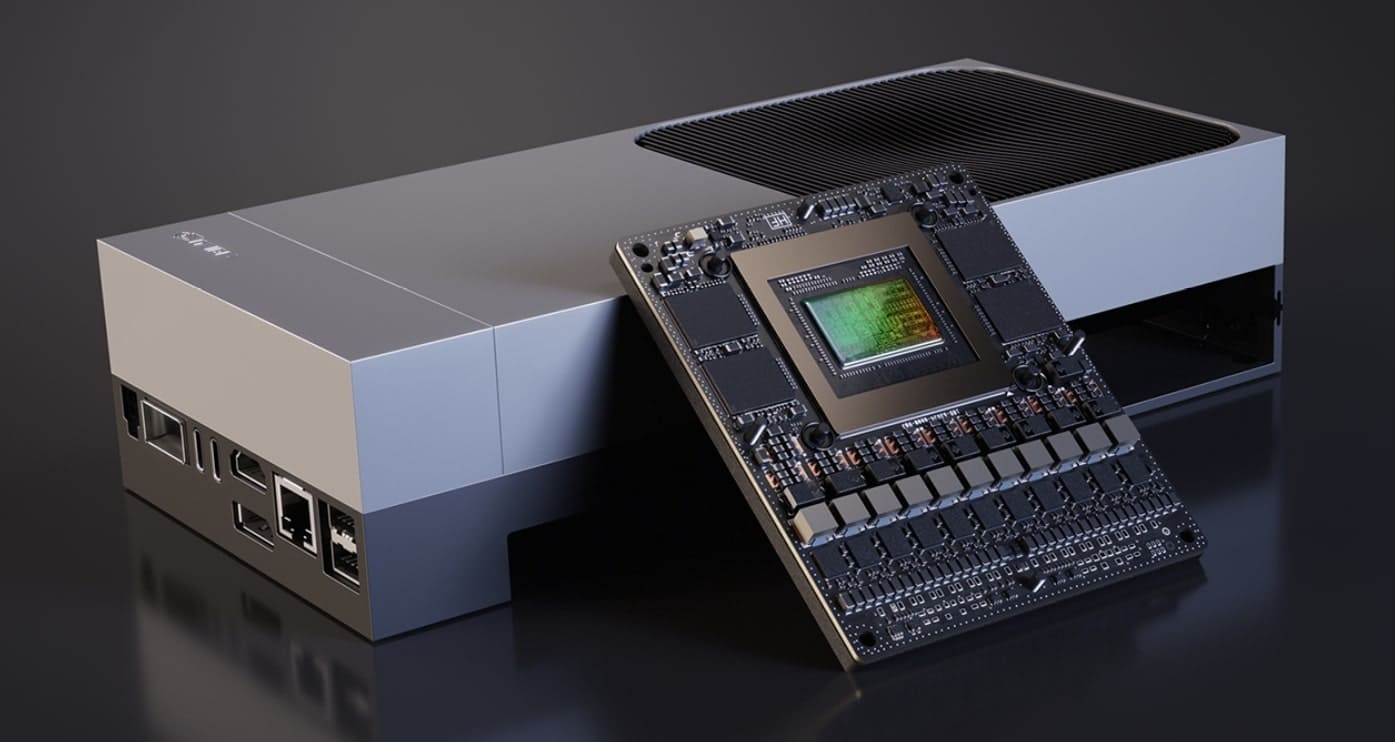
The Future of Robots with Nvidia: Thor T5000 Is the New Brain for Robotics
Nvidia has just announced that its latest robotics chip module, called Jetson AGX Thor, is now available for purchase as a developer kit priced at $3,499 (approximately CZK 78,500). This chip, which the company calls the "robot brain," will enable customers to create advanced robots. The first kits will begin shipping next month, as Nvidia confirmed last week. After prototyping with the developer kit, Nvidia will sell Thor T5000 modules for mass production of robots. If a company orders more than 1,000 units, the price per module will drop to $2,999 (approximately CZK 67,200).
This move comes at a time when Nvidia CEO Jensen Huang has described robotics as the company's biggest growth opportunity outside artificial intelligence (AI), which has tripled the company's total sales over the past two years. "We don't make robots or cars, but we provide the entire industry with our infrastructure computers and related software," Deepu Talla, Nvidia's vice president of robotics and edge AI, said during a call with reporters on Friday.
Thor T5000 Chip Specifications
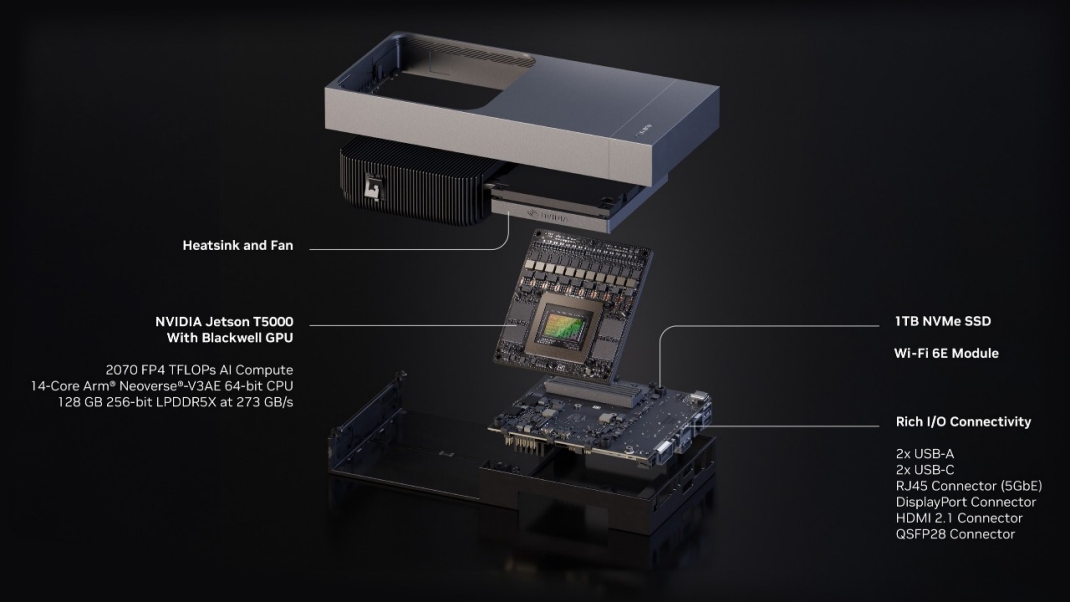
Jetson Thor chips are based on the Blackwell graphics processor, the current generation of Nvidia technology used in both its AI chips and computer gaming chips. This chip offers 2,560 CUDA cores and 96 fifth-generation Tensor cores, along with a 64-bit, 14-core Arm Neoverse V3AE processor. According to Nvidia, Thor is 7.5 times faster than the previous generation, enabling it to run generative AI models, including large language models and visual models that interpret the surrounding world—essential for humanoid robots.
The chip is equipped with 128 GB of LPDDR5X memory with a 256-bit interface and bandwidth of 273 GB/s, which is essential for large AI models. Its performance reaches up to 2,070 teraflops (TFLOPs) in FP4 mode with sparse computations, 1,035 TFLOPs in sparse FP8, and, in dense mode, 1,035 TFLOPs in FP4 or 517 TFLOPs in FP8. The chip's power consumption is up to 120 watts, with support for both maximum-performance and standard modes. It also includes a programmable NVIDIA PVA 3.0 vision accelerator delivering up to 165 GFLOPs in FP32 and 320 GFLOPs in FP16, support for lossless compression, caching, and advanced graphics interfaces such as OpenGL 4.6+ or Vulkan 1.1+, plus CUDA 11.4+.
These specifications enable real-time sensor data processing, multimodal AI, and rapid perception, making the chip ideal for robots in logistics, manufacturing, or services. The chip also supports lossless compression and advanced graphics features, increasing its versatility.
Industrial Applications
Nvidia says its Jetson chips are used by companies such as Agility Robotics, Amazon, Meta, and Boston Dynamics. The company has also invested in robotics companies such as Field AI. Agility Robotics, for example, is integrating Jetson Thor into its next-generation robots to improve perception and decision-making. The Thor T5000 chip is designed for real-world deployment in complex environments where rapid sensor data processing and on-site decision-making are required.
Although robotics accounts for only about 1% of Nvidia's total revenue, despite the company having introduced several new chips for robots since 2014, this segment is growing rapidly. Nvidia recently merged its automotive and robotics divisions into a single unit, which reported quarterly sales of $567 million (approximately CZK 12.7 billion) in May, a 72% increase year over year.
Jetson Thor chips can also be used for autonomous vehicles, particularly those made by Chinese brands. Nvidia refers to them as Drive AGX, and they run on the Drive OS operating system, which is optimized for automotive applications. This means that the chip is not only intended for robots, but also for advanced systems in cars, where it processes data in real time.
Growth Potential and Availability
The Jetson AGX Thor developer kit is already shipping, while production T5000 modules will soon be available for large orders. This chip represents a significant leap in on-device AI processing for robots, enabling more autonomous and intelligent machines across various industries. Nvidia emphasizes that it provides infrastructure for the entire industry, opening the door to innovation without manufacturing end products itself. With growing interest in physical AI and humanoid robots, the Thor T5000 could become the foundation for future generations of technology.


