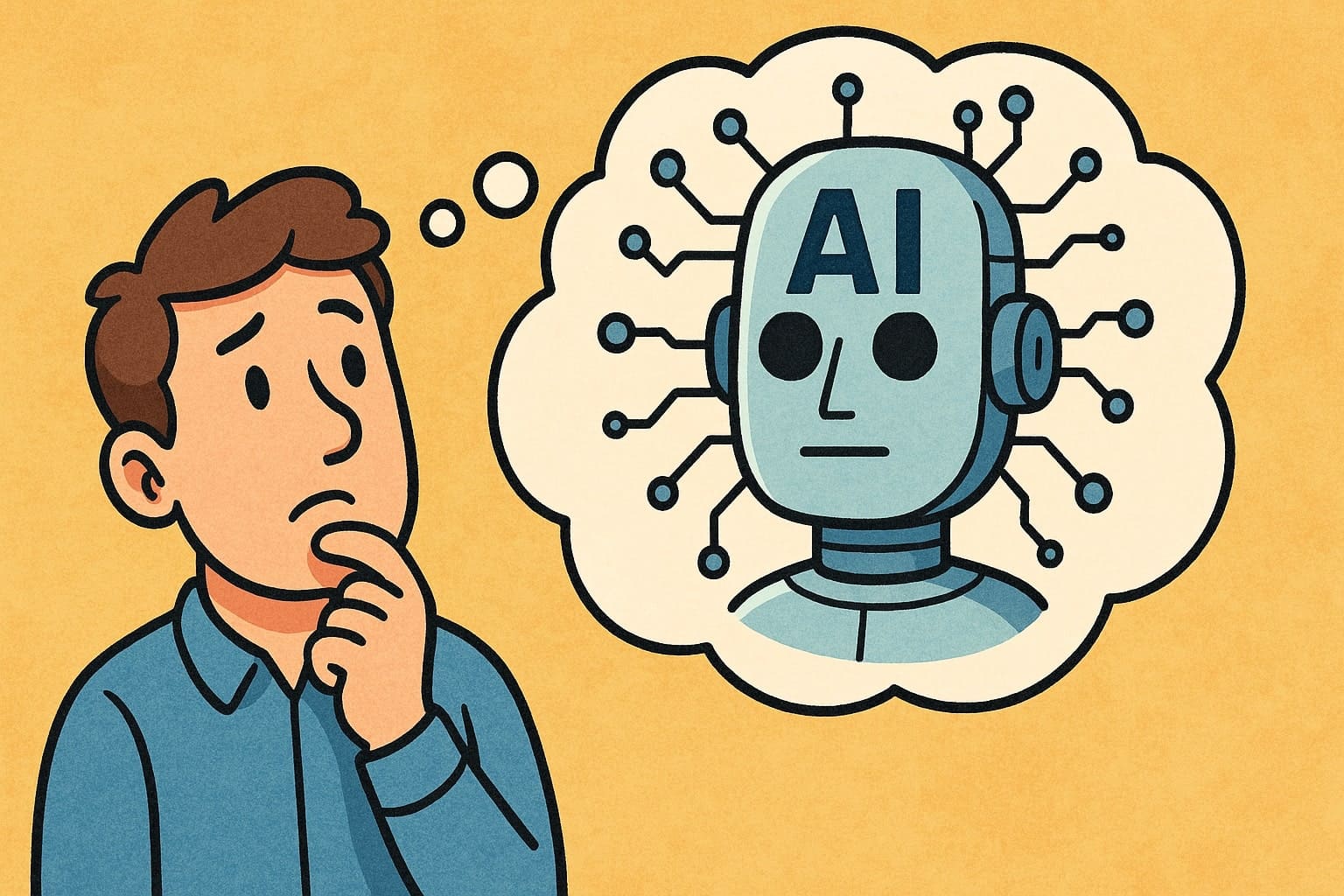
The AI Trap: More Features, Less Value
Today, when artificial intelligence makes it possible to build software faster than ever before, many teams find themselves caught in a trap. Instead of focusing on real progress, they concentrate on how many features they can produce. But what if this speed only creates the illusion of success? Let’s take a closer look, because this issue affects everyone involved in creating digital products.
Critical Thinking Is Still Up to You, Not AI
If you look at what Jeff Patton says in his book on user story mapping, your job is not simply to build more software faster. It is about maximizing the impact of what you create. AI can help you generate prototypes within hours, but it cannot ensure that those prototypes solve real user problems. For example, if a team quickly creates a new feature using tools such as ChatGPT or Gemini, but without a deeper understanding of customer needs, it will often end up as unnecessary clutter.
This is where critical thinking comes in. You need to consider multiple options, evaluate what works and what does not, and distinguish signals from noise. AI is a great copilot, but you are the one in control. Without this, you risk becoming merely a prompt master who shifts responsibility to the machine. This leads to solutions being built without a clearly defined problem—for example, features that look impressive but that no one uses.
Output Is Not the Same as Outcome
One of the biggest mistakes is confusing the quantity of output with actual impact. AI accelerates development cycles, allowing teams to create more prototypes and features in less time. But as product development experience shows, this ease often leads to "software waste"—things that no one needs. For example, if a team focuses on rapidly adding AI elements, such as automatic content generation, without validating them with users, it can result in costly mistakes.
In Running Lean, Ash Maurya emphasizes that your speed of learning is your greatest advantage. Do not ask, "How quickly can we build it?" but rather, "How quickly can we identify bad ideas?" Ideas come easily, and AI can now turn them into solutions almost instantly. Without validation, however, this creates an illusion of progress, where it seems that a lot is happening, while in reality, unnecessary things are merely being refined.
How Can You Avoid This Trap?
To avoid it, start with experiments. First, filter your ideas: Ask how closely your idea aligns with your vision and strategy. If it does not, let it go. Then move on to testing. Start with simple experiments that can provide signals within hours—such as surveys or landing pages (pages for testing interest). For example, create a simple page describing the feature and track how many people sign up.
Once you have more knowledge, invest in more sophisticated tests, such as user interviews or interactive prototypes that take only a few days. For promising ideas, move on to more robust methods, such as the "Wizard of Oz" approach (manually simulating a feature before actually building it). Measure success using specific criteria: For example, if you are testing a new feature, define success as receiving at least 50 positive responses from 100 respondents.
AI can help you design these experiments—try a prompt asking for 15 test variations divided by time frame (4 hours, 2 days, 4 days), including the method, sample size, and success criteria. This allows you to learn quickly and avoid building unnecessary things.
User Research—the Foundation AI Cannot Replace
The speed of AI does not change the fact that successful products are based on a deep understanding of users. Interviews, surveys, and usability tests remain essential. Without them, you risk creating "progress theater," where old systems are enhanced with AI features but real pain points remain unaddressed. For example, AI can predict trends, but only user research can confirm whether they are meaningful.
When you use AI intelligently—for example, to automate prototyping or data analysis—it reduces errors and increases efficiency. But only when combined with validation. Teams that do this achieve sustainable growth because they balance speed with priorities and real impact.
Ultimately, building faster with AI is not automatically better. It can amplify both good and bad decisions. If you focus on learning and value, you will become a team that truly changes the game. And that is what will ultimately determine success.