There are two types of measurement systems in the world: metric and imperial. The metric system is used by every country except three (although some remnants of the other system persist in the United Kingdom). The remaining three countries officially use the imperial system, also known as British Imperial, which uses inches, feet, and miles; pints, quarts, and gallons; and ounces and pounds as units.
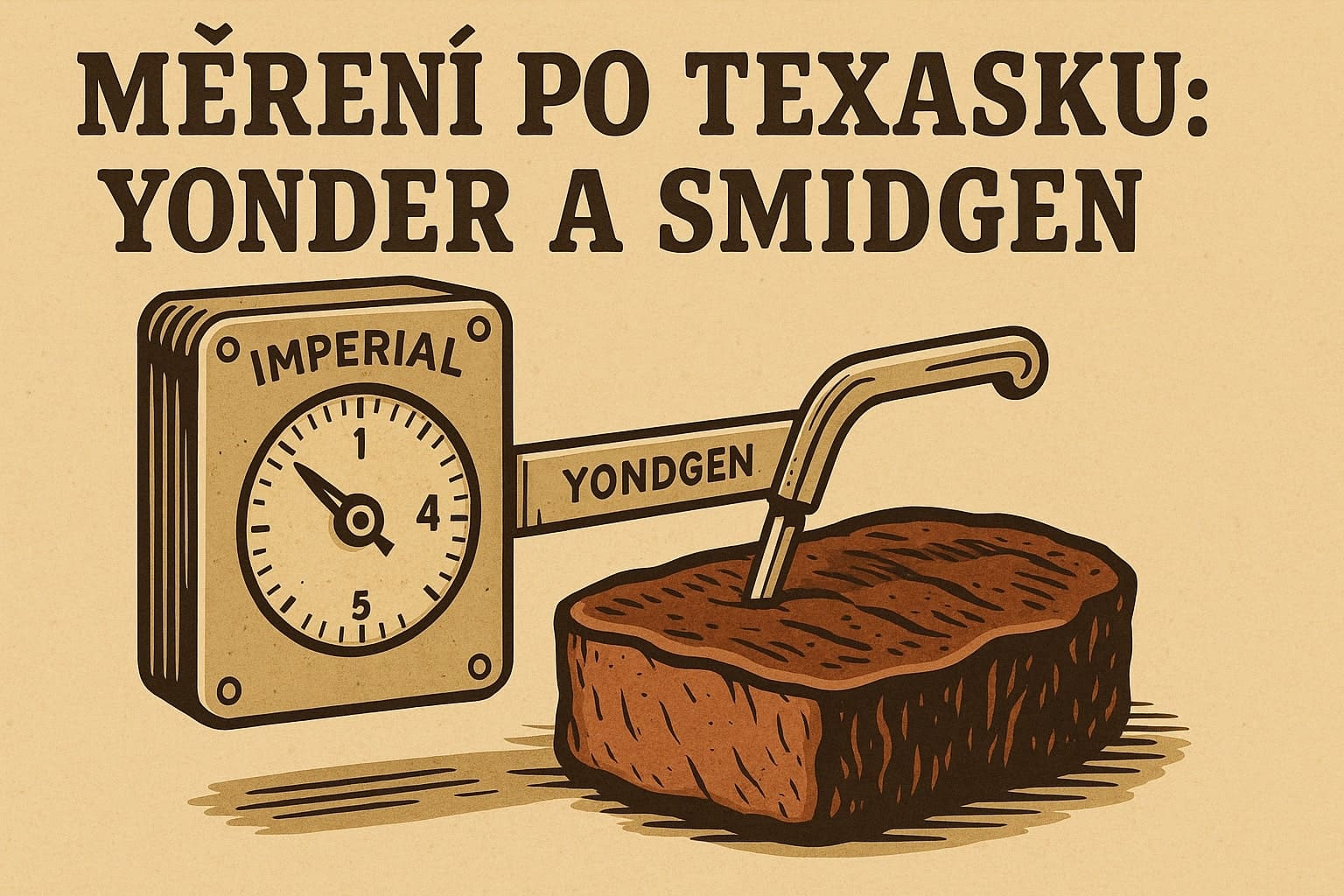
These backward countries are Liberia, Myanmar, and the United States of America. In Texas, we often use an even more informal Southern system for distance and weight, which I like to call "Yonder and Smidgen." Yonder is for distance, smidgen for weight or quantity.
I've found that there are two kinds of people in Texas: those who say "yonder," and those over there who don't.
"Yonder" is highly versatile in its meanings. It can be used for proximity: "Put this down yonder at the other end of the table." (Put this over there at the other end of the table.)
It can be in, out, or even over.
For down the hall: "I'm goin' in yonder to the TV room." (I'm going in there to the TV room.)
For the yard: "Could you go out yonder and get the paper?" (Could you go out there and get the newspaper?)
Or for a trip across town: "Gotta drive over yonder to H.E.B." (I have to drive over there to H.E.B.)
Or it can be used for long distances, as in: "Can't believe they drove all the way out yonder to Arizona just for a birthday party." (I can't believe they drove all the way out to Arizona just for a birthday party.)
Just change the preposition and you've adjusted the distance—down yonder, in yonder, out yonder, over yonder, way out yonder. And let's not forget the "wild blue yonder" and the ultimate "up yonder," where we all want to be when the roll is called.
I think the greatest distance Texans regularly contend with is Texas itself. So when yonder isn't enough, we have this: "The sun did rise and the sun did set and I ain't out of Texas yet." (The sun rose and the sun set, and I'm still not out of Texas.)
Another informal distance you often hear in Texas is "damnear": "The way he swung that axe he damnear took my head off." (The way he swung that axe, he almost took my head off.) "If you wanna buy beer, you're gonna have to drive damnear to Dallas, or damnear into next week." (If you want to buy beer, you'll have to drive almost all the way to Dallas, or nearly into next week.)
Long ago, I had a great-grandfather who measured distances in beer. "It's about a two-beer drive." (It's about a drive that takes two beers.) I don't condone it; I'm just reporting it.
And for very short distances, we have "If it had been a snake it would've bit you." (If it had been a snake, it would have bitten you.)
Then for density, we have "Couldn't throw a rock without hittin' ..." (You couldn't throw a rock without hitting...): "You can't throw a rock in Austin without hittin' a lawyer." (In Austin, you can't throw a rock without hitting a lawyer.)
Or for something small and cramped, we have: "That room was so small you couldn't swing a cat in there." (That room was so small you couldn't swing a cat in it.) Why anyone would want to swing a cat, I've never understood. I doubt cats are fond of this custom.
For quantity, we have a smidgen. It's used mainly in cooking: "Just put a smidgen more of garlic in there and the beans will be perfect." (Just put a tiny bit more garlic in there and the beans will be perfect.)
For a larger quantity, a bucketful: "How many nails you need?" "Bring a bucketful." (How many nails do you need? Bring a whole bucketful.) Or: "He ain't worth a bucketful of warm spit." (He isn't even worth a bucketful of warm spit.)
I wish we could discuss oil measurements, but things would quickly get indecent.