

87% of marketers use artificial intelligence for content creation
Between December 2024 and February 2025, Ahrefs conducted an extensive survey of 879 marketing professionals from around the world to understand how generative artificial intelligence is changing content marketing and SEO. The results show a dramatic shift in how companies approach content creation, with 87% of respondents saying they use AI tools to create content or assist with content creation. The survey focused on five key areas: the growth of AI use in content creation, how generative AI is used in SEO and content marketing, the performance of AI content compared with human content, how teams think about the risks of AI content, and changes in spending on AI solutions and content.
Massive AI adoption across companies of all sizes
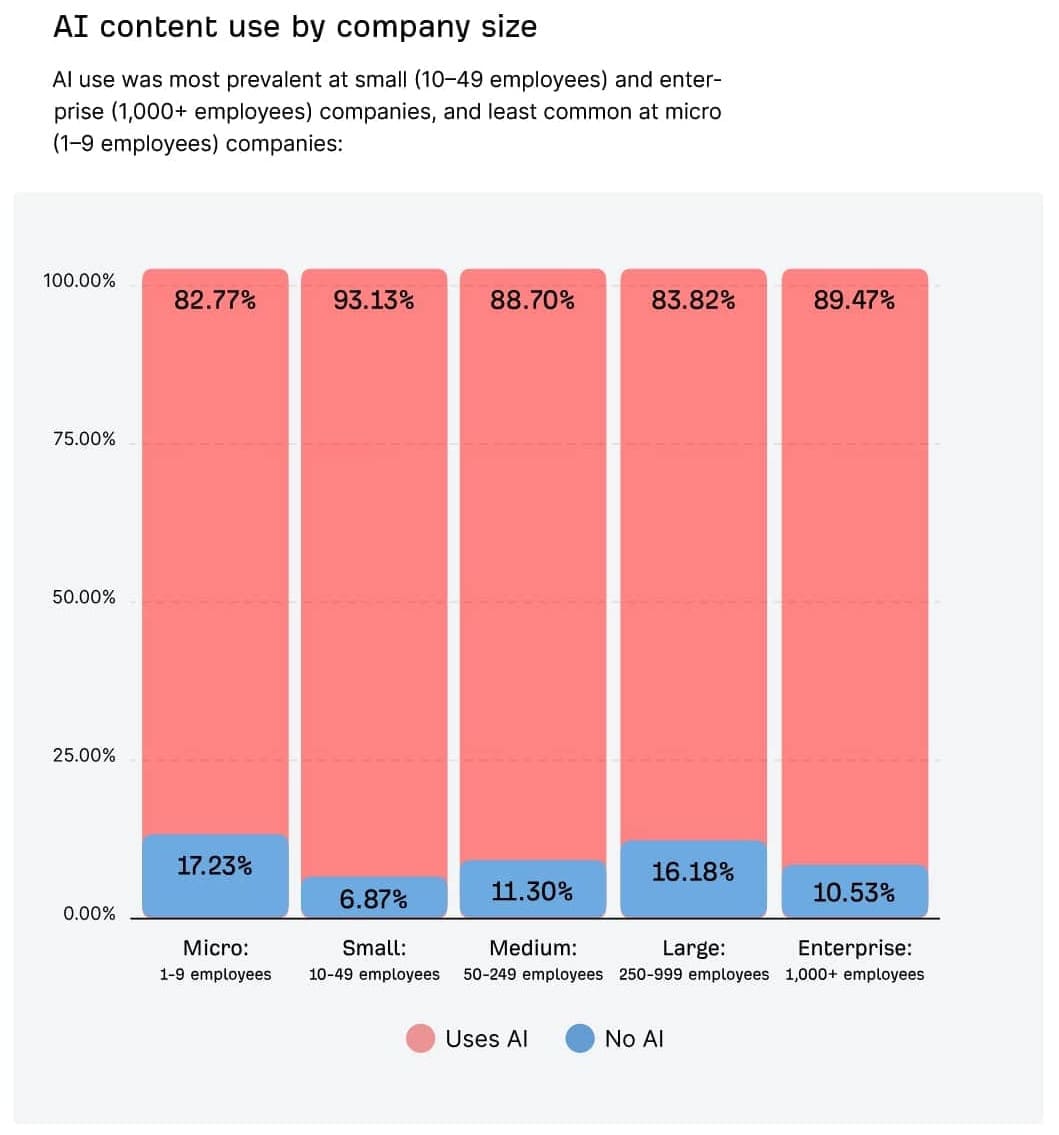
The survey data reveals that the use of AI for content creation is extremely widespread regardless of company size. Small companies with 10-49 employees (91%) and large companies with more than 1,000 employees (89%) report the highest rates, while micro-companies with 1-9 employees report the lowest rate (88%). Interestingly, AI use also remains consistently high across marketing teams of different sizes—from individuals working alone (81%) to teams with more than 100 people (90%). Chris Long, VP of Marketing at Go Fish Digital, notes: "We are finding that organizations of all sizes are extremely interested in using AI in their marketing initiatives. Smaller organizations have the advantage of being more agile and faster with their integrations."
Dramatic increase in content production thanks to AI
Companies using AI publish significantly more content than those that do not use AI. The median monthly publishing frequency for companies using AI is 17 articles per month, while for companies not using AI it is only 12 articles per month—an increase of 42%. This increase is most pronounced among micro-companies (1-9 employees) and small companies (10-49 employees), while large corporations actually publish more content without AI workflows. Andrew Bolis, AI & Marketing Consultant, explains: "Content writers can easily double or triple the amount of marketing content they create using AI tools. AI-assisted writing is especially useful for multichannel campaigns that require creating different content formats for different channels."
ChatGPT dominates among AI content creation tools
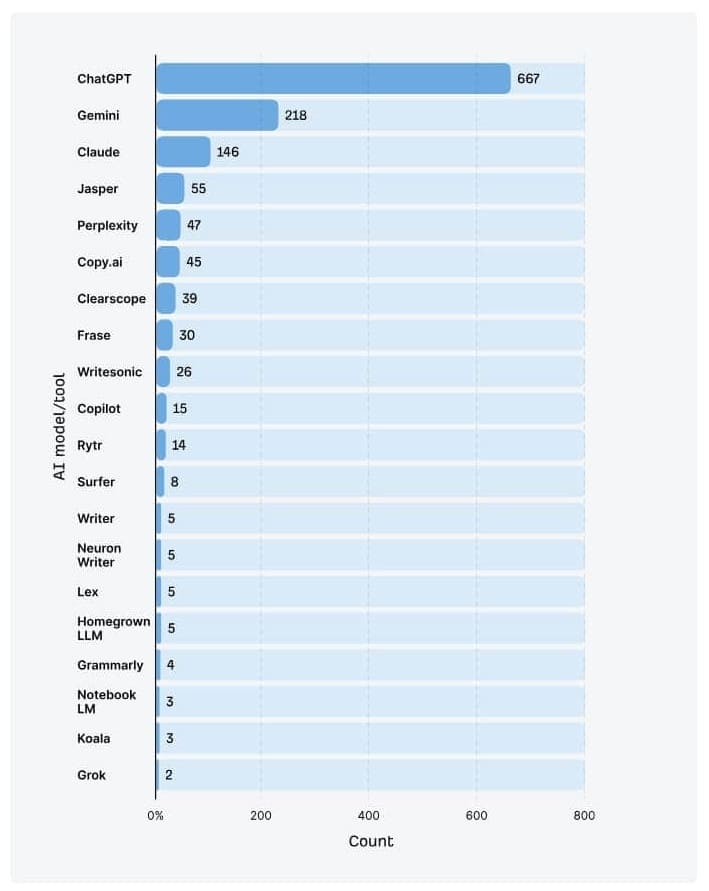
ChatGPT is by far the most widely used AI tool for content creation—used by 44% of respondents, followed by Gemini at 15% and Claude at 10%. A total of 94 different tools were mentioned in the survey, with 77% of the listed AI tools falling into the "LLM" category (specific LLM models or model providers such as Anthropic's Claude or OpenAI's gpt-4o), while only 23% are considered "wrappers"—software tools that use one or more LLM models with additional features, such as Surfer SEO or Jasper. Ryan Law, Director of Content Marketing at Ahrefs, notes: "I have tried dozens of different AI content creation tools and keep coming back to Claude and ChatGPT. Given that LLM providers such as OpenAI and Anthropic are competing to deploy new models and features, most companies seem to be well served by using the LLM models themselves, with little need for specialized wrappers."
Blog content as the primary area of AI use
Blog posts are the most common type of content created with AI—reported by 87% of respondents—followed by website and landing page copy (64%) and social media posts (63%). The least common content formats created with AI are white papers (15%) and e-books (17%). Erika Varangouli, Head of Branded Content at Riverside.fm, explains this trend: "Generating blog content is—for the vast majority of companies—the least demanding type of content on their domain. Almost no branding work goes into blog content. Usually, no one concerns themselves with maintaining the brand's tone on the blog. Instead, they most often focus on publishing content 'for ranking.' It is content that requires minimal expert input (or at least used to)."
Brainstorming and planning as the most common AI tasks
When asked about how they use AI in different parts of their content marketing and SEO workflows, 76% of respondents said they use AI to generate topic ideas. 73% said they use AI to create content outlines, and 67% said they use it to improve their content. At the opposite end of the spectrum, image creation (19%), content localization or translation (22%), and keyword clustering (23%) were the least popular use cases. Connor Gillivan, founder and owner of TrioSEO, comments: "AI is great for ideas, research, and planning. It can drastically reduce the time needed to complete SEO tasks that previously had to be done manually."
Lack of transparency in AI use
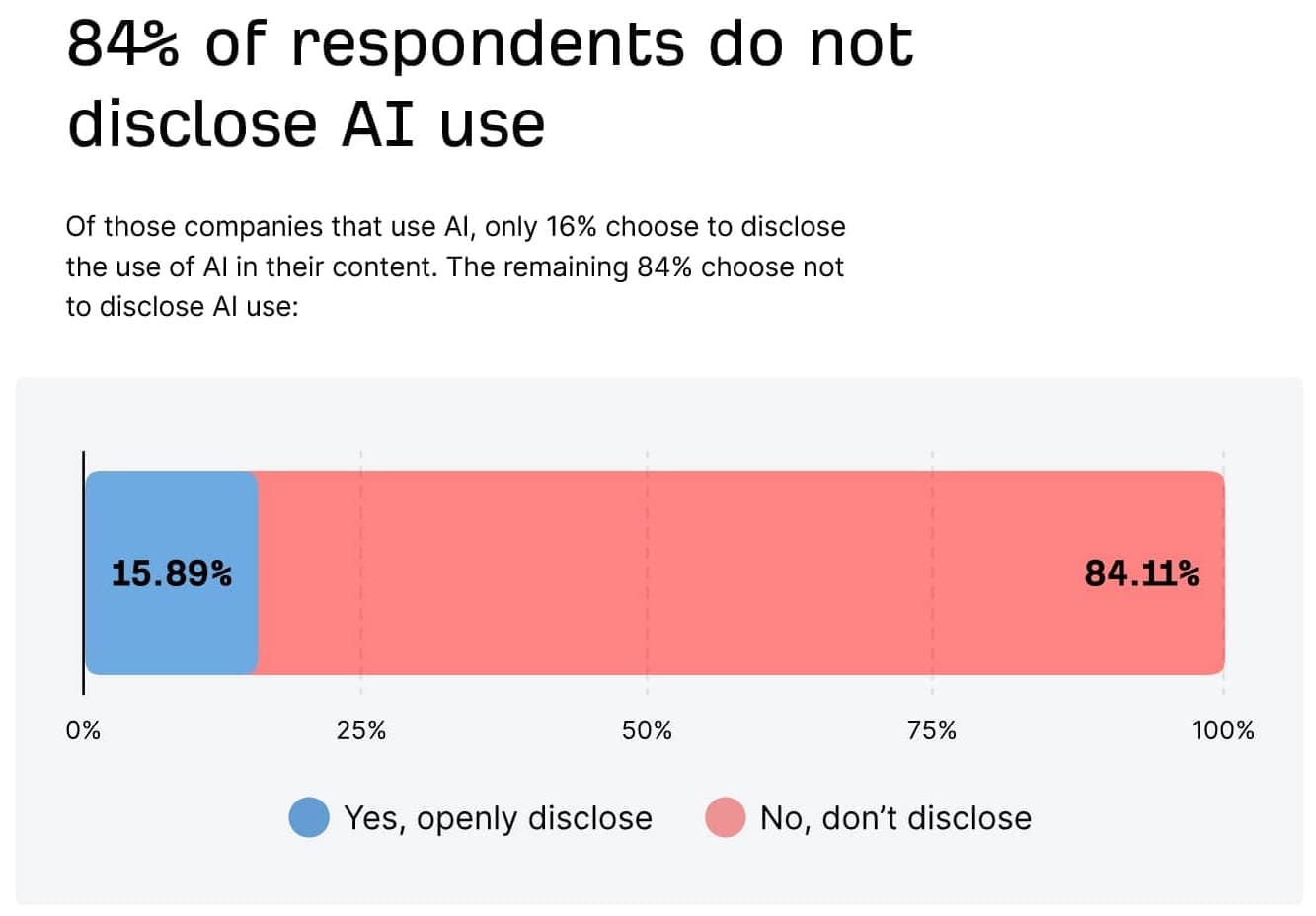
Only 16% of companies that use AI choose to disclose its use in their content. The remaining 84% choose not to disclose their use of AI. Disclosure was most common among micro-companies (1-9 employees) and large corporations (1,000+ employees). Interestingly, companies that are the heaviest users of AI content are also the most likely to disclose its use—26% of companies that publish 76-100% pure AI content disclose its use, compared with only 15% of those that publish no pure AI content.
Minimal publication of "pure" AI content
Only 4% of respondents said that more than 75% of the content they publish is pure AI content without any editing or additional input. Conversely, 50% of respondents said that none of the content they publish is pure AI content. Chris Long, VP of Marketing at Go Fish Digital, warns: "Although it is tempting to use AI outputs directly as content on your website, marketers must resist doing so. We saw from the March 2024 core update how harmful AI-only content can be. Instead, marketers can use AI for initial drafts—but they must have their teams review the content to ensure it is genuinely useful to users."
Similar effectiveness of AI and human content
There is almost no difference in the self-reported effectiveness of respondents' content strategies. AI users reported an average score of 6.4/10, while non-AI users reported an average of 6.3. Similar results emerged when respondents were asked to rate the effectiveness of their content marketing strategy in attracting organic search traffic. For AI users, the average score was 6.1/10, compared with a slightly higher average of 6.5 for AI users. Despite these similar results, 65% of respondents believe that human-written content is of higher quality than AI content, with 29% reporting that it is "slightly better" and 36% reporting that it is "much better."
Organic traffic growth among companies using AI
To add further context to these figures, Ahrefs used its API to examine the estimated organic traffic growth for each respondent's domain between January 2024 and January 2025. In this simple analysis, websites that reported using AI content recorded a median year-over-year growth rate of 29.08%, compared with a median of 24.21% for sites that did not use AI. The trend was positive for both segments, but AI content users—with their increased publishing frequency—appeared to experience stronger growth.
Dramatic differences in content creation costs
When asked about the average cost per blog post, 87% of AI users reported costs of $0-100, compared with 39% of non-AI users. 11% of non-AI users reported spending more than $1,000 per blog post, compared with just 2% of AI users. 4% of non-AI users reported spending more than $5,000 per blog post. Using the midpoint of each range to calculate approximate weighted average costs, the average cost was $131 for AI content and $611 for human-created content, or 4.7 times higher.
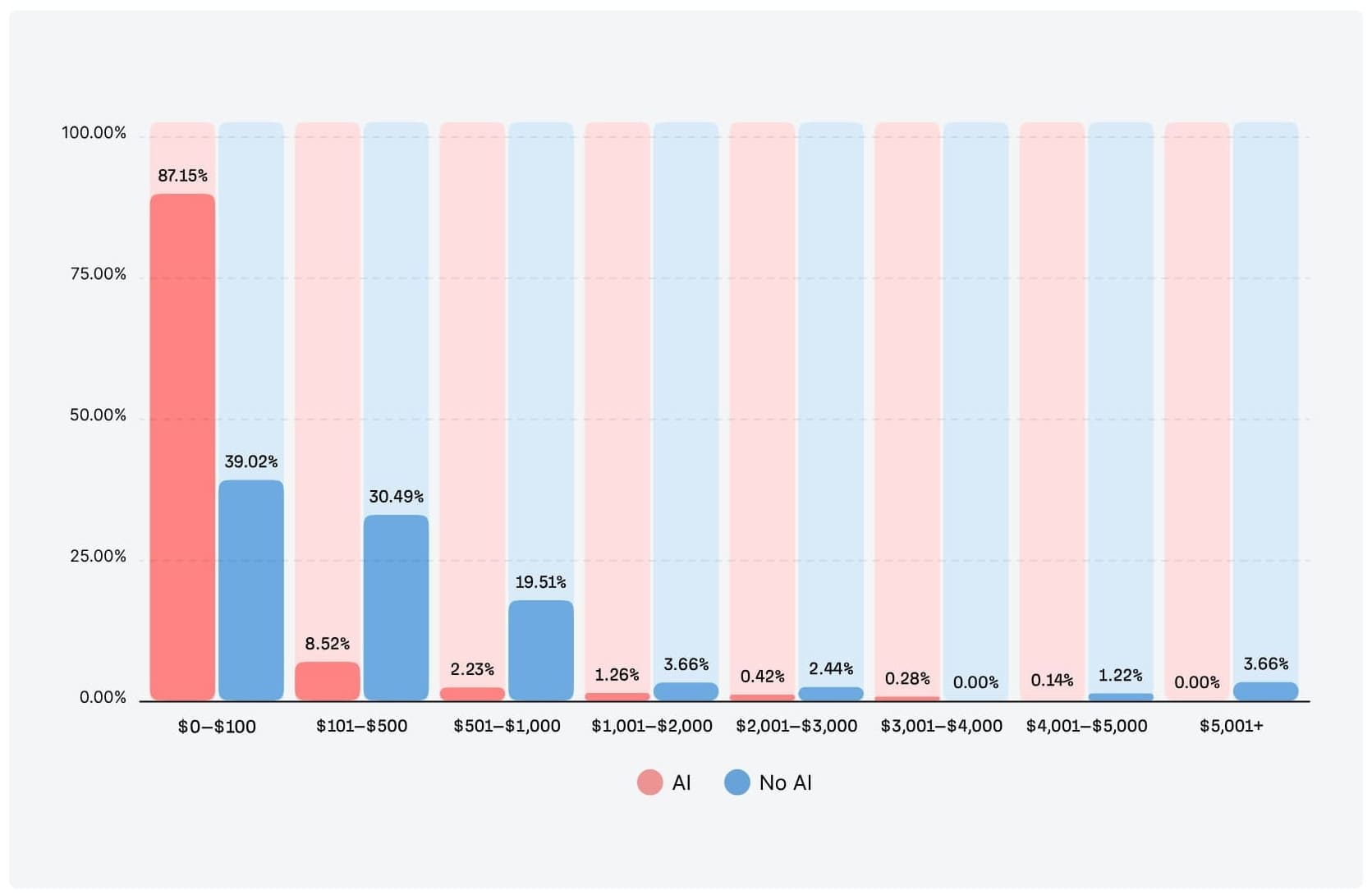
Similar overall budgets despite different costs
Average monthly content marketing spending was almost identical in the AI and non-AI segments: $2,475 and $2,442. Cassandra Naji, CEO of Campfire Labs, comments: "It is interesting that companies using AI do not necessarily spend less—they produce more with the same budget. Although we are still in a challenging budget environment, companies continue to invest in moving away from the constant struggle of content creation and toward focusing on strategy, audience insights, and measuring real business impact."
Plans to increase investment in AI content
More than half of respondents plan to increase spending on AI content over the next year (17% "significantly increase" and 34% "increase"). 43% plan to keep their spending the same, while only 6% plan to reduce spending (5% "decrease" and 1% "significantly decrease"). When the data is grouped by company size, micro-companies (1-9 employees) are the most likely to increase their spending, while enterprises (1,000+ employees) are the least likely to reduce their spending.
Accuracy as the main barrier to AI adoption
The most common reason for declining to use AI was concern about the accuracy of AI-generated content (60%), followed by concerns about plagiarism (57%) and bias contained in AI content (36%). The biggest perceived risks of using AI content were sharing misinformation (62%), creating a worse user experience (56%), and damaging the company's reputation (37%). 37% of respondents were also concerned about the risk of receiving a Google penalty.
Conclusion and future outlook
Ahrefs' research suggests that AI use is widespread in content marketing across companies and marketing teams of all sizes. Generative AI enables companies to reduce the marginal cost of content creation and increase publishing frequency, allowing the same budget to go further. With most respondents believing that AI content can rank as effectively as human-written content, this increased publishing frequency may enable companies using AI to grow their organic traffic faster than those avoiding any use of AI. While many companies are concerned about the lack of accuracy and the spread of bias and misinformation from AI content, most companies have established processes for reviewing AI-generated content. The data also suggests that the risks of being adversely affected by a Google algorithm update or receiving a manual penalty are relatively low for AI content. As a result, most companies plan either to maintain or increase their spending on AI content over the next year.


