

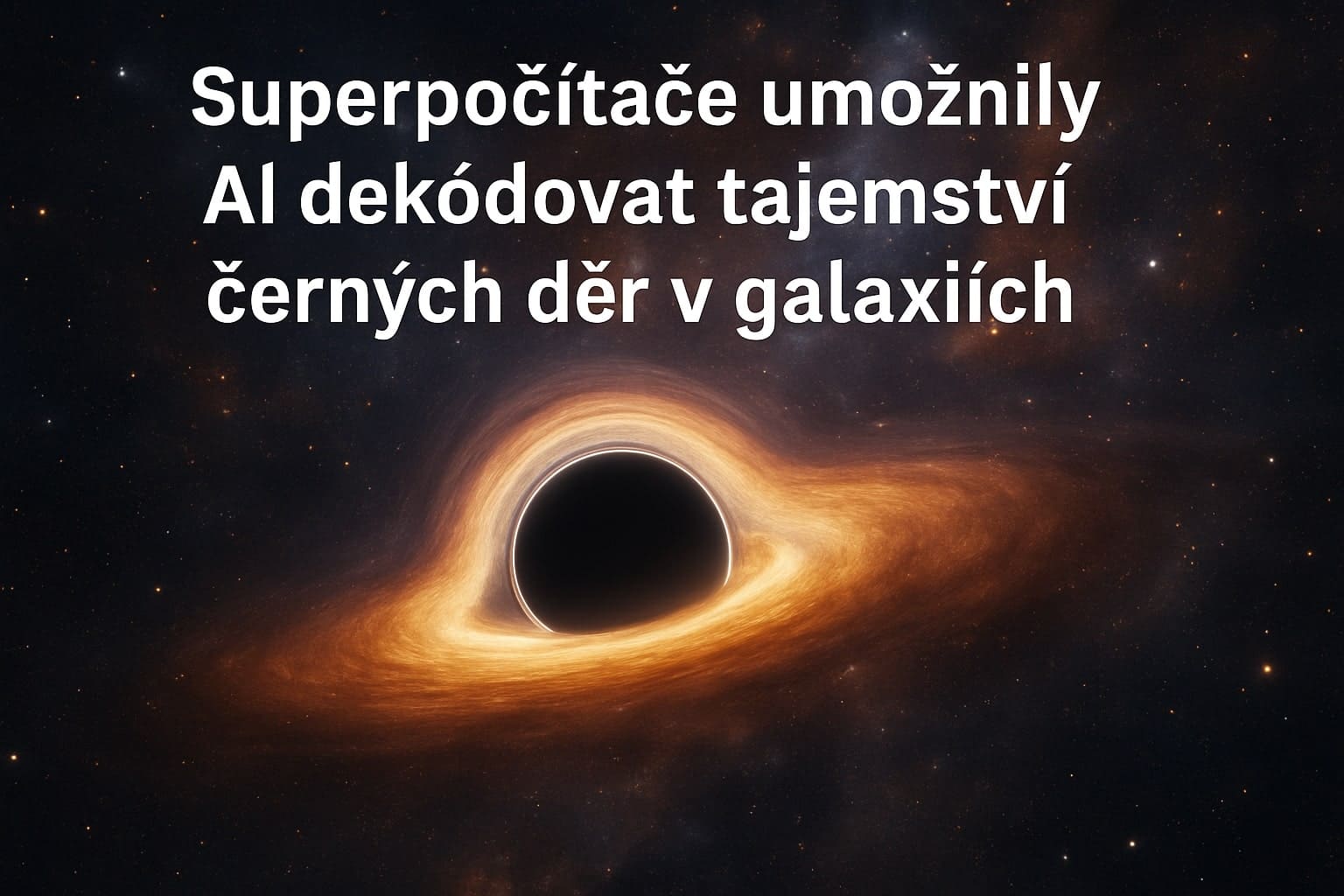
Supercomputers Enabled AI to Decode the Secrets of Black Holes in Galaxies
Using neural networks, millions of synthetic simulations, and artificial intelligence, an international team of astronomers has uncovered new cosmic insights into black holes. Their research showed that the black hole at the center of our Milky Way is spinning at nearly its maximum speed. These extensive sets of simulations were created thanks to the computing capabilities of the Center for High Throughput Computing (CHTC), a joint institution of the Morgridge Institute for Research and the University of Wisconsin-Madison. The astronomers published their findings and methodology in three papers in the journal Astronomy & Astrophysics.
Pioneering High-Throughput Computing Technology
High-throughput computing, which celebrates its 40th anniversary this year, was pioneered by Wisconsin computer scientist Miron Livny. It is a new form of distributed computing that automates computational tasks across a network of thousands of computers, essentially transforming one massive computational challenge into a supercharged fleet of smaller tasks. This computing innovation helps drive big-data discoveries across hundreds of scientific projects worldwide, including the search for cosmic neutrinos, subatomic particles, and gravitational waves, as well as efforts to unravel antibiotic resistance.
In 2019, the Event Horizon Telescope (EHT) collaboration released the first image of the supermassive black hole at the center of the M87 galaxy. In 2022, it unveiled an image of Sagittarius A*, the black hole at the center of our Milky Way. However, the data behind these images still contained a wealth of information that was difficult to decipher. The international team of researchers trained a neural network to extract as much information as possible from the data.

From a Handful to Millions of Simulations
Previous studies by the EHT collaboration used only a few realistic synthetic datasets. Funded by the National Science Foundation (NSF) as part of the Partnership to Advance Throughput Computing (PATh) project, the Madison-based CHTC enabled astronomers to feed millions of such datasets into a so-called Bayesian neural network capable of quantifying uncertainties. This allowed researchers to make much better comparisons between the EHT data and the models.
Thanks to the neural network, researchers now believe that the black hole at the center of the Milky Way is spinning at nearly its maximum speed. Its rotational axis points toward Earth. In addition, the emission near the black hole is caused mainly by extremely hot electrons in the surrounding accretion disk rather than by a so-called jet. The magnetic fields in the accretion disk also appear to behave differently from what conventional theories of such disks predict.
Michael Janssen, lead researcher from Radboud University Nijmegen in the Netherlands, comments: "The fact that we are challenging the prevailing theory is, of course, exciting. However, I primarily see our AI and machine-learning approach as a first step. We will continue to improve and expand the related models and simulations."
Impressive Scaling of Computing Power
Chi-kwan Chan, Associate Astronomer at Steward Observatory at the University of Arizona and a long-time PATh collaborator, adds: "The ability to scale up to the millions of synthetic datasets needed to train the model is an impressive achievement. It requires reliable workflow automation and efficient distribution of the workload across storage resources and computing capacity."
Professor Anthony Gitter, Morgridge Investigator and PATh Co-PI, says: "We are pleased to see EHT using our computing capabilities to bring the power of AI to its science. As in other scientific fields, CHTC's capabilities enabled EHT researchers to assemble the quantity and quality of AI-ready data needed to train effective models that facilitate scientific discoveries."
The NSF-funded Open Science Pool, operated by PATh, offers computing capacity provided by more than 80 institutions across the United States. The Event Horizon black hole project has performed more than 12 million computational tasks over the past three years.
A New Approach to Scientific Research
Livny, director of CHTC and principal investigator of PATh, explains: "A workload consisting of millions of simulations is a perfect match for our throughput-oriented capabilities, which have been developed and refined over four decades. We enjoy collaborating with researchers whose workloads challenge the scalability of our services."
The research published in three scientific papers represents significant progress in our understanding of black holes. The first paper addresses calibration improvements and a comprehensive synthetic data library. The second paper describes the Zingularity framework for Bayesian artificial neural networks. The third paper presents Zingularity results from the 2017 observations and predictions for future expansion of the array.
This breakthrough in the use of artificial intelligence and high-throughput computing for astronomical research opens up new possibilities for understanding the most extreme objects in the universe. The ability to process millions of simulations simultaneously and extract meaningful information from them using neural networks represents a significant step forward in the scientific study of black holes and their properties.


